
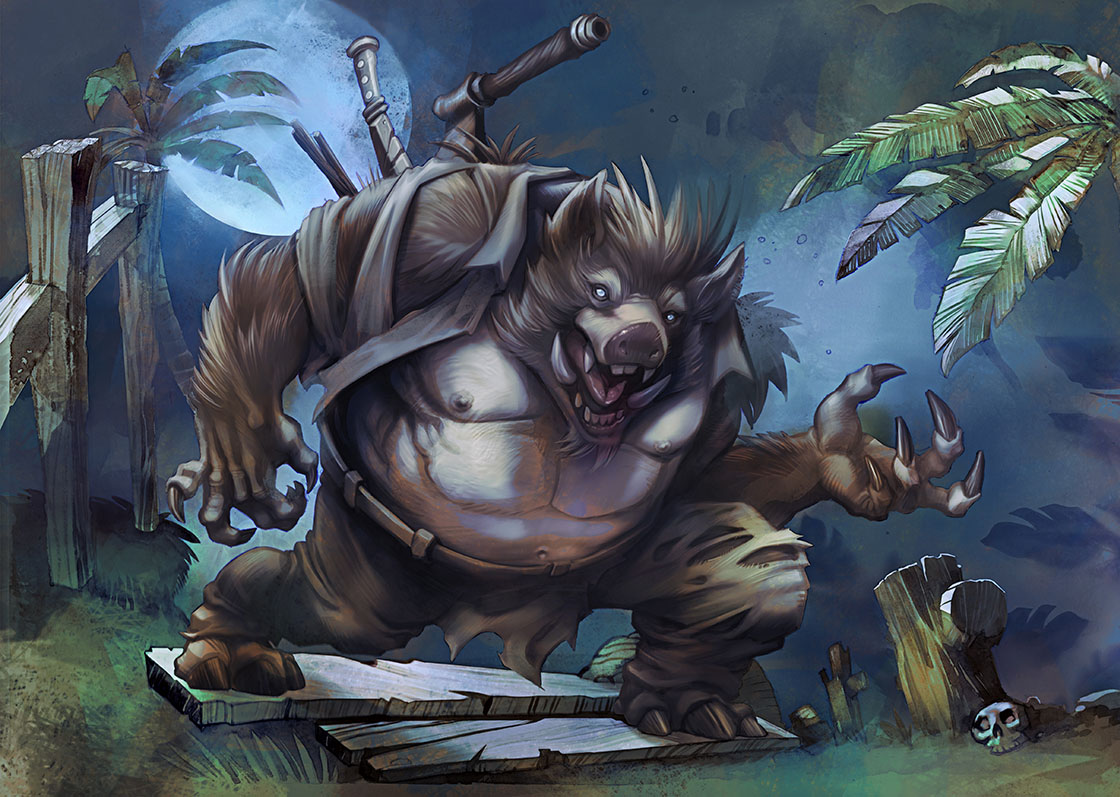
Illustration by André Vazzios
Werepig
Folklore and history
Despite its name, the Brazilian werewolf has very little in common with a "wolf." Our tradition has Iberian roots, where it is common to find stories of werewolves that transform into farm animals. They are hybrids of man and dog, pig, calf, bull, donkey, and so on.
Correr o fado: living out the curse
In Portugal, the werewolf is one of several human-animal hybrids bound by a curse, or fado. After changing shape, they must run through seven parishes, seven squares, seven churches and seven cemeteries. Some tellings leave out the number, but the curse still sends them roaming the roads, attacking and devouring. The Portuguese expression correr o fado describes this ordeal. Another is cumprir um fadário: to live out the fate laid upon you.
In Tradições populares de Portugal (1882), Leite de Vasconcellos records several accounts of how someone becomes a werewolf. In one from Maia, the curse could fall on any one of seven children born in succession, boys or girls, if the siblings had not stood as godparents to one another.
In other accounts, also popular at the time, it is said that the curse arises when the child is the result of a relationship between godfather and godmother. In rare cases, a witch can spontaneously generate a werewolf using magic words.
Maria do Rosário Tavares de Lima collects these versions in Joanópolis – a municipality just over 100 km from São Paulo. In her book “Lobisomem – Assombração e Realidade” (1983), which helped transform the city into the Werewolf Capital, she points out that a man who goes 10 years without confessing and receiving communion, or without touching holy water, also runs the curse. The same happens to those who disrespect their parents or godparents.
The pig form
The Pig-Werewolf is one of the best-known versions of this cursed being. It appears when the person carrying the curse rolls (or wallows) in a place where a dog and a pig have passed, assuming the characteristics of both animals. It is often described as being large and gaunt, like a bear, with a short tail and ears. Its large snout is always sniffing and growling wherever it goes. The werewolf is hungry, and it is possible to distinguish a common pig from a monster, in its initial form, due to the enormous hunger it demonstrates.
The accounts from Belém
In the accounts collected by Walcyr Monteiro (2000), in Belém, the transformation into a werewolf can be an involuntary fate or the result of a pact sought by the man himself. In the latter case, he offers drops of blood to the Devil at a crossroads, at midnight on Friday. In exchange, he gains luck in gambling and in amorous conquests. The price comes on Friday nights: until dawn, he must wander the streets and vacant lots in the form of a pig.
In an account from the Pedreira neighborhood, suspicion fell on José, who lived by playing cards and disappeared on Fridays. In the story, a friend is attacked by a pig shortly after José enters the woods. When he threatens to shoot, the animal retreats. Shortly after, José reappears, pale and mysterious.

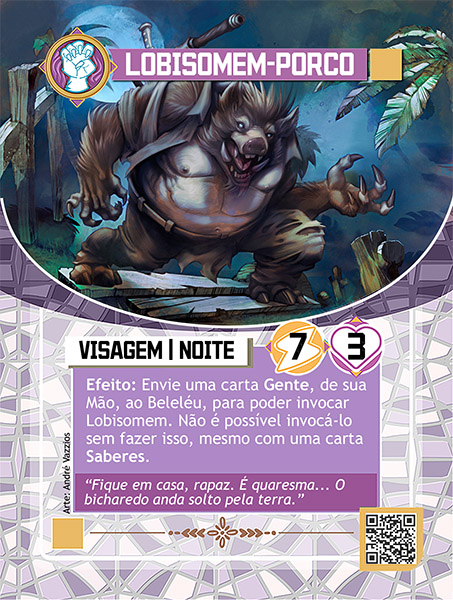
Werepig
Strength: 7
Health: 3
Wonders / Night
“Stay home, lad. It’s Lent… The beasts are roaming free.”
Transformation Ritual · Fated Burden
To summon the Werepig, send a Folk card from your hand to the Beleléu (your discard pile). You must pay this cost even when using a Lore card to summon it.
Download the high-resolution artwork

References
- CASCUDO, Luís da Câmara. Licantropia sertaneja. Imburana: revista do Núcleo Câmara Cascudo de Estudos Norte-Rio-Grandenses, v. 5, n. 9, jan./jun. 2014. Republicação do texto de 1923. (periodicos.ufrn.br)
- LIMA, Maria do Rosário de Souza Tavares. Lobisomem: assombração e realidade. São Paulo: Escola de Folclore, 1983.
- MONTEIRO, Walcyr. Visagens e assombrações de Belém. 3. ed. rev. e atual. Belém: Banco da Amazônia, 2000.
- VASCONCELLOS, J. Leite de. Tradições populares de Portugal. Porto: Livraria Portuense de Clavel & Cia, 1882.