

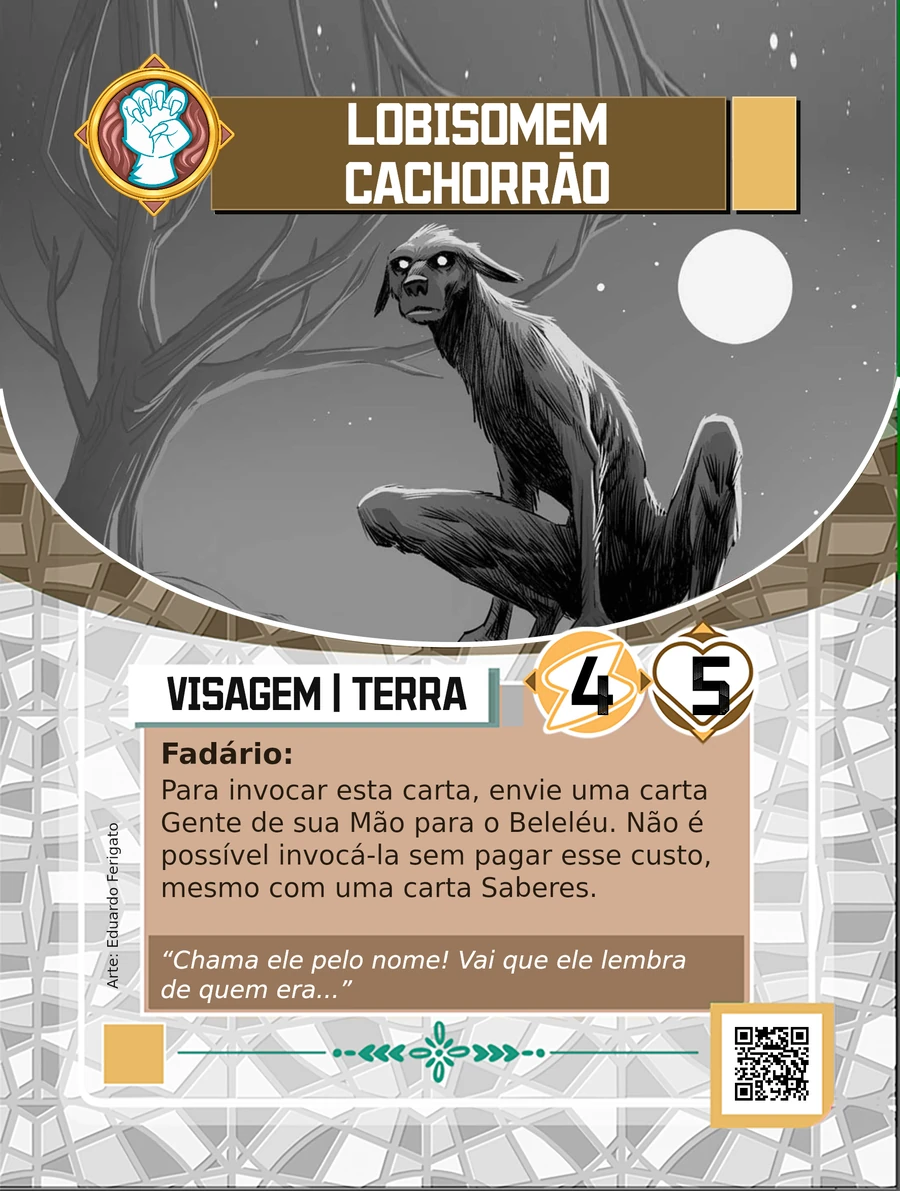
Illustration by Eduardo Ferigato
Hound Werewolf
Folklore and history
How can werewolves exist in a country where there are no wolves like those in Europe? Here, the animal that has "wolf" in its name is the maned wolf, quite different from Canis lupus. Contemporary representations of a maned werewolf reimagine this approximation, but, in the traditional versions discussed here, the monster takes on other appearances.
In truth, the Brazilian werewolf has very little in common with the wolf. And this tradition is closely related to the versions of the myth that came from Portugal. In 1882, in the book Popular Traditions of Portugal, José Leite de Vasconcelos compiled numerous stories of people transforming into animals – several of them even conflicting. Among the recorded stories, we find werewolves that are dogs, horses, cats, and even chickens or ducks.
Here, notorious representations of werewolves describe them as large, wiry-haired dogs that walk with their hips very arched. Sometimes, you can even recognize the creature by its sound. Antônio Paixão, from the Praia Grande quilombo in Iporanga, says that the werewolf is a man who turns into a giant dog. One night, sleeping alone, he heard something hitting his ear. And how did he know what it was? "They say he cracks his ear," he explained. The pack of dogs went after him. In other versions, the cursed one who assumes this form may be the seventh son after six sons or even someone bitten by a werewolf.
In Portugal, the werewolf shares the curse, or fate, with other creatures. Depending on the region and the version, the paths change: Vasconcelos records seven parishes in Vila Real, seven bridges and seven rivers in Mafamude, and seven churchyards in Oliveira do Hospital. Sometimes the number is not present, but the fate of these cursed beings is to run through the roads. In some narratives, the werewolf attacks and devours whoever it encounters. That is why the term "running the fate" is quite common in Portugal to refer to the curse of the creatures.
In addition to werewolves, tardos and corrilários also run the fate through the Lusitanian lands, as Nuno Matos Valente presents in the Traditional Portuguese Bestiary. The records, however, show different relationships between these figures.
In a version from Valongo, collected by Vasconcelos, the child is subject to the fate when the godfather, during the baptism, does not say the right words. When it is grown up, but before the age of communion, it transforms into an animal and comes to be called Tardo. If, for seven years, no one breaks the curse by making it bleed, the tardo transforms into a werewolf – and only then does it eat people. In Maia, the Tardo appears as a small dog that tries to stun people by urinating on their legs, leaving them unsure of which way to go. In other records by the author, it also takes the form of a cat or goat.
The corrilários, on the other hand, are tormented souls that appear in the form of a dog. Among the explanations for their origin are violent and premature deaths: the person returns as a corrilário and runs the fate for the years they would still have to live. In Valente's Bestiary, the corrilário also appears as the continuation of a werewolf's fate after death.

Hound Werewolf
Wonders / Earth
“Call him by name! Maybe he’ll remember who he used to be…”
Fated Burden
To summon this card, send a Folk card from your hand to the Beleléu (your discard pile). You must pay this cost even when using a Lore card to summon it.
Download the high-resolution artwork

References
- ANDRADE, Anna Maria; TATTO, Nilto (ed.). Inventário cultural de quilombos do Vale do Ribeira. São Paulo: Instituto Socioambiental, 2013.
- CASCUDO, Luís da Câmara. Geografia dos mitos brasileiros. 1. ed. digital. São Paulo: Global, 2012.
- VALENTE, Nuno Matos. Bestiário tradicional português: as criaturas fantásticas do imaginário popular. Alcobaça: Edições Escafandro, 2016.
- VASCONCELOS, José Leite de. Tradições populares de Portugal. Porto: Livraria Portuense de Clavel & C.ª, 1882.