
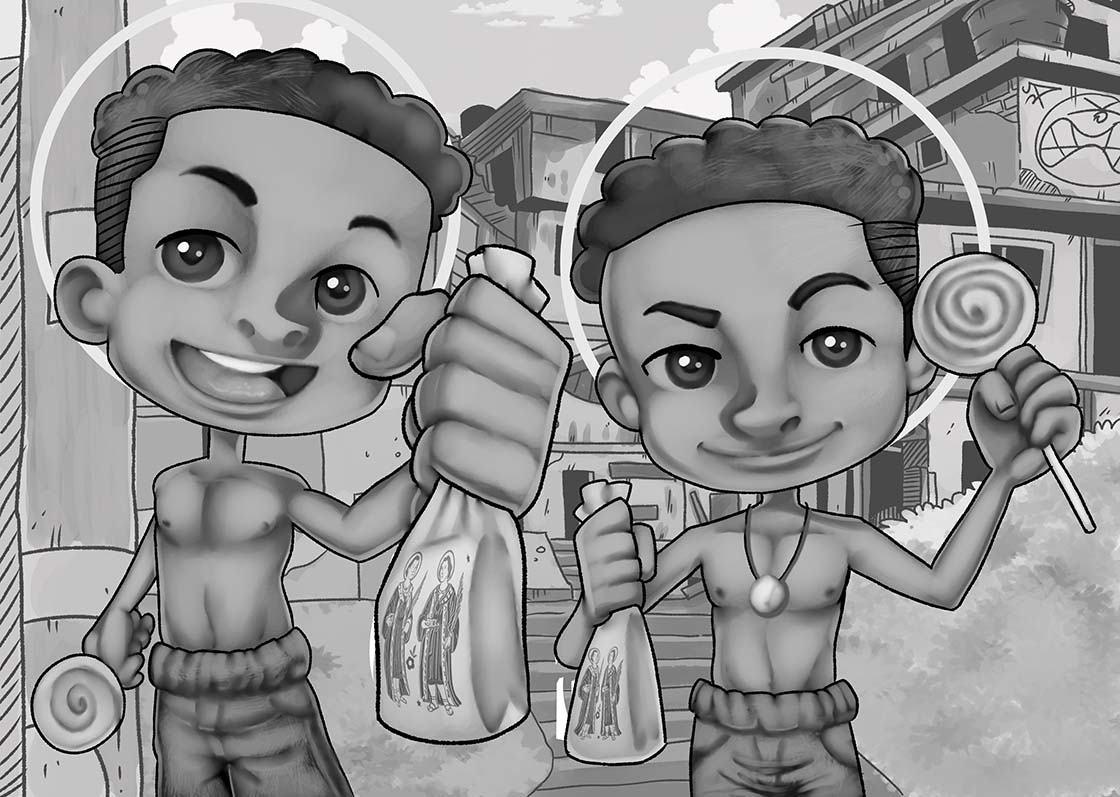
Illustration by Roe Mesquita
Cosmas and Damian
Folklore and history
Saint Cosmas asked for two little shirts in blue.
On his feast day, Saint Cosmas wants caruru.
Come dance, Cosmas, dance!
I’m dancing on the sand.
— Ritual song for Cosmas and Damian
Christian tradition has it that the twins Cosmas and Damian were doctors and took care of the sick without charging for the treatment. Hence the name they received: anárgyros, a Greek word that means “without silver”. Tradition holds that they were beheaded during the persecution of Christians. In Brazil, many children know them both from the bag of sweets they receive on the saints’ feast day.
In the Roman Catholic calendar the feast of Saints Cosmas and Damian falls on 26 September. It moved from the 27th in the calendar reform of 1969. The 27th became the feast of Saint Vincent de Paul.
In popular devotion, the festivities continued on the 27th. In practice we have two days, which seems appropriate for the twins.
That is the Catholic side of the story. The twins also have a place in Afro-Brazilian religious life. The association goes back to colonial times, when drawing connections between religious traditions was one way Black communities kept their cultures and faiths alive.
In Candomblé traditions of Yoruba origin, Cosmas and Damian are associated with the Ibejis, the twin orixás. In Candomblé, erê can refer to a ritual state in which a person takes on the manner of a child. In Umbanda, erês are understood as child spirits.
In some regions, such as Bahia, it is common for another cultural practice linked to the Ibejis/Cosmas and Damian to occur on the 27th: the tradition of the caruru of the seven boys. Caruru is a dish made with okra, dried shrimp and palm oil, which on this day is served with side dishes such as boiled chicken, black-eyed peas and plantain.
In the caruru of the seven boys, the children are the first to eat. They eat with their hands and, in some houses, even wipe their fingers on the hostess’s skirt.
The culinary history of caruru brings together varied preparations. In “Culinary art in Bahia”, Manuel Querino describes versions made with okra, mustard, taioba and other leaves, to which grouper, roasted fish or jerky meat were added. The dish was served with acaçá or cassava flour. Its record allows us to discover the diversity of recipes that circulated under this same name in Bahian cuisine.
Câmara Cascudo, in “Anthology of food in Brazil”, records that, in the Salvador boys’ caruru, children were served first and adults later, with singing and round dancing. The author also associates the saints with the protection of everyday food. Devotion thus involves the abundance of the house and the sharing of food, bringing together young and old at the table.

References
- CASCUDO, Luís da Câmara. Antologia da alimentação no Brasil. 1. ed. digital. São Paulo: Global, 2014.
- QUERINO, Manuel. A arte culinária na Bahia. Salvador: Livraria Progresso Editora, 1957.
- VATICAN NEWS. SS. Cosme e Damião, mártires. Santo do dia, 26 de setembro. [s. d.]. Disponível em: https://www.vaticannews.va/pt/santo-do-dia/09/26/ss–cosme-e-damiao–martires.html. Acesso em: 10 nov. 2026.