
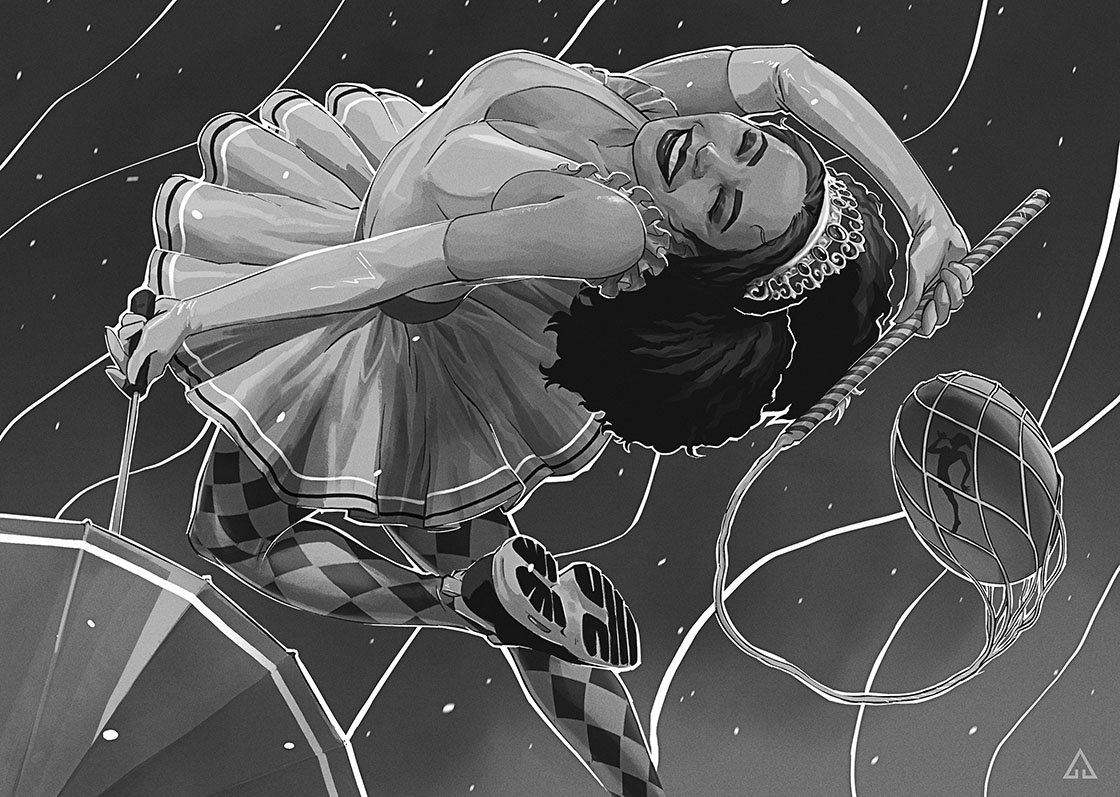
Illustration by Artur Rocha
Bate-Bolete
Folklore and history
For a long time, women were not welcome in Rio de Janeiro’s Bate-Bola troupes. That taboo began to break down in the 1990s. Many troupes now have women’s sections of their own in the Carnival celebrations of Rio’s suburbs.
Women known as Bate-Boletes often dress to match their troupe’s Carnival theme, but their costumes differ from those of the traditional Clóvis. The Clóvis wears a jumpsuit, a heavy overcoat and the characteristic wire-mesh mask. The women generally leave their faces uncovered to show their elaborate makeup. Swimsuits, shorts or leggings are paired with ornaments, bows and crowns that draw attention to the body and express femininity and sensuality.
In her thesis on how Bate-Bolas and Bate-Boletes present themselves, Priscila Andrade traces connections between their costumes and Rio’s funk scene. Bate-Bola belongs to Carnival, a celebration closely associated with samba. At parties in Rio’s suburbs, though, it’s funk you’re likely to hear.
Andrade notes a contrast in Rio funk fashion. Men often choose loose clothing that makes them look bigger, while women favour shorter, closer-fitting outfits. She suggests that a similar distinction shows up in the Bate-Boletes’ costumes.
Andrade also asks who holds authority in the troupes. Some women’s troupes operate independently. Others are affiliated with a larger group, and you can hear the connection in their names: Fascinação has the Fascinet’s, Relíkia the Relikett’s, Arrastão the Arratet’s and Superação the Superet’s.
During her fieldwork, Andrade saw men making decisions while women were left on the sidelines. The pattern points to how much still has to change for women to participate fully, though it does not describe every troupe.
Female participation, however, is not limited to the Bate-Bolete costume described above. There are also women who go out wearing the Bate-Bola costume, including the mesh mask, and who take on leadership of the groups.
Women also lead troupes. In 2026 Júlia Oliveira Souza headed Meninas do Complexo da Praça Seca, a group of just over sixty, including 32 women. As she told UERJ’s ImaginaRIO newsletter, being the “head” means organizing meetings, keeping track of payments and looking after everyone’s costumes. She helps sew them herself, drawing on what she learned from her grandmother and sister.
The troupe has a life outside Carnival too. Sabrina Dias Veloso describes how the Brilhetes de Anchieta begin preparing for their next outing by painting a neighbourhood wall together each year. Members, relatives and other troupes come along. Sometimes the gathering coincides with the feijoada for Saint George. The painted wall marks the troupe’s place in the neighbourhood, and the celebration brings together the people who keep it going.
Taking a troupe onto the streets costs money. The Brilhetes pay monthly instalments recorded in a payment booklet, so the troupe can buy materials and pay its suppliers. Even falling behind has a nickname: in Bate-Bola circles, someone who misses payments and eventually leaves the troupe may be called “Aurora”, after the well-known Carnival march.

References
- ANDRADE-SILVA, Priscila; GAMBA JUNIOR, Nilton Gonçalves. Entre Carnaval e cotidiano: uma estética de apresentação pessoal das personas Bate-bolas e Bate-boletes. dObra[s], v. 18, n. 43, p. 114–136, 2025. DOI: 10.26563/dobras.v18i43.1883. Disponível em: https://doi.org/10.26563/dobras.v18i43.1883. Acesso em: 10 nov. 2026.
- ANDRADE-SILVA, Priscila. A persona no cotidiano e a persona no Carnaval: Bate-bolas, Bate-boletes e uma pesquisa sobre a cultura do vestir. 2022. Tese (Doutorado em Design) – Departamento de Artes e Design, Pontifícia Universidade Católica do Rio de Janeiro, Rio de Janeiro, 2022.
- UNIVERSIDADE DO ESTADO DO RIO DE JANEIRO. Laboratório de Comunicação, Cidade e Consumo. Bate-Bola: o personagem central do carnaval de rua carioca. ImaginaRIO, v. 17, n. 68, 25 fev. 2026. Disponível em: https://www.lacon.uerj.br/imaginario-68. Acesso em: 10 nov. 2026.
- VELOSO, Sabrina Dias. Quando vai ser a saída?: avançando na pista com as Brilhetes de Anchieta. 2023. Dissertação (Mestrado em Cultura e Territorialidades) – Universidade Federal Fluminense, Niterói, 2023.