

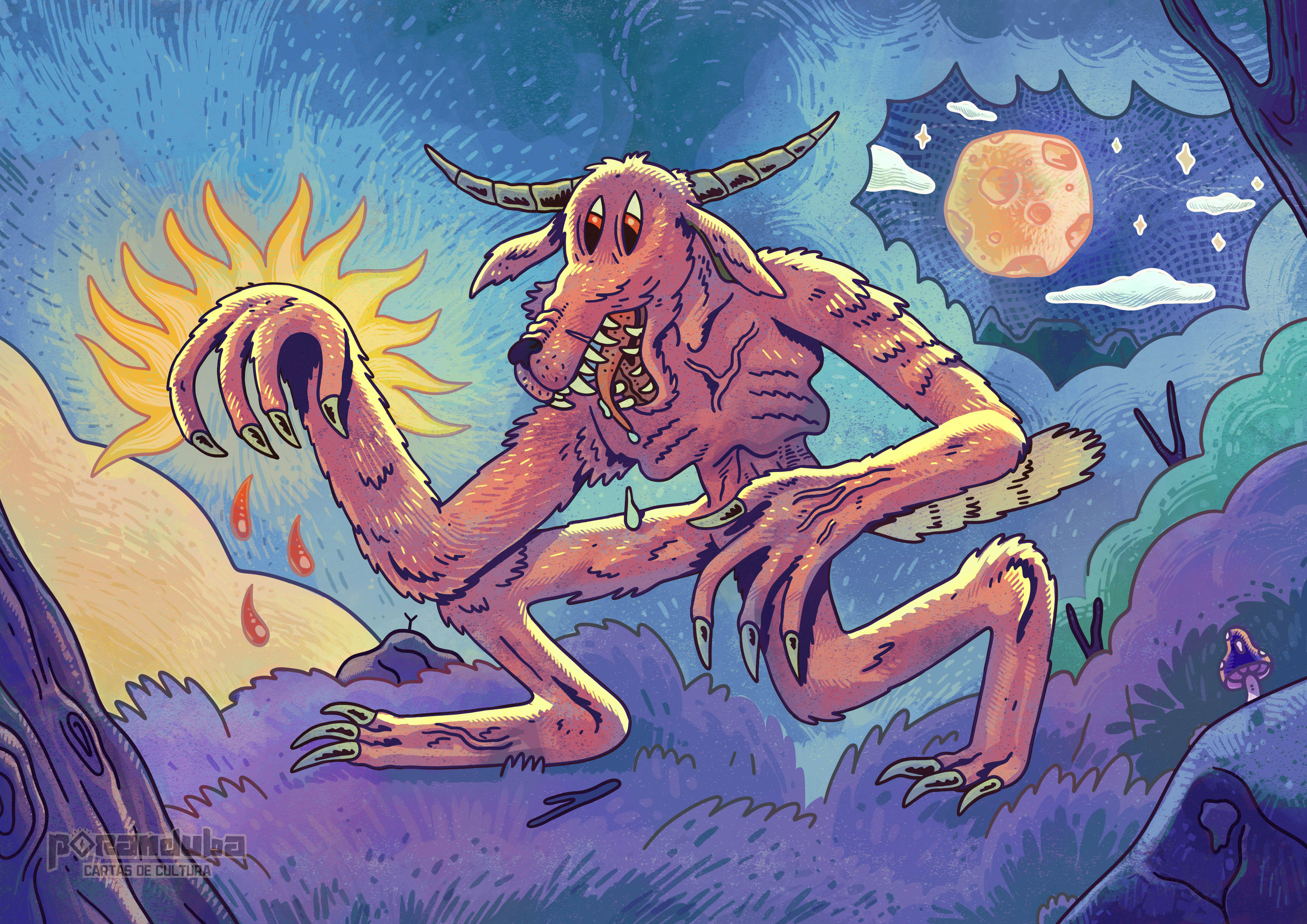
Illustration by Berjê
Werebull
Folklore and history
For a werewolf to transform, writes Câmara Cascudo, it is necessary to follow a ritual. On specific dates – which are not linked to the full moon, but to the days of the week, the werewolf goes to a place where animals wallow. In this wallowing area, a space with trampled and turbulent grass where animals roll to cool off and scratch themselves, he takes off his clothes, buries them in a hole in the ground or hangs them at the top of a tree.
Cascudo also suggests that the man should tie seven knots in his shirt before hiding it. Then, “he rolls from left to right, bringing his feet and hands together”. Thus begins the transformation of the flesh: the more animals that have passed through the wallowing area, the more hybrid the werewolf will be.
The forms of the werewolf
In Brazil, the Werewolf is often described as a mixture of man, dog, and pig. In Mato Grosso do Sul, the memoirist Hélio Serejo points out: "Some werewolves (half pig, half dog) pass along the paths dragging a thick chain. […] Each link of the chain represents a transformation. With each transformation, the chain gains another link. The noise of the chains contaminates the trees and wire fences, which begin to repeat the noise in echo."
There is yet another version collected by Serejo, in which the Werewolf is not only a hybrid, but also breathes fire: "on calm, windless, and noiseless full moon nights, a werewolf (half pig, half pony horse) with bristling fur usually appears, with a deep hole in its head that constantly expels smoke and fire, and two hairy and enormous ears that drag along the ground, producing a violent racket, like a storm breaking branches."
Serejo recounts that the werewolf once attacked a platoon of revolutionary soldiers on the border with Paraguay. Although everyone attacked him, he still easily defeated them. "because before, a horned ox, a horse, and a pig had been towed into the wallowing place where they had been 'cooling their bodies,' and, as in these circumstances the werewolf had become a terrible beast of immense strength, he drove away the audacious soldiers and destroyed the fort."
The bovine form also appears in a story that Câmara Cascudo published in 1923. Francisco Teixeira, known as Seo Nô, recounted that he had been attacked by a large, black, and hairy calf. He fought with the animal until he managed to wound it in the neck, causing it to flee. The following morning, João Severino, his workmate at the sugar mill, did not show up to cut sugarcane. Nô went to look for him and found him with his neck bandaged, treating a cut. The wound on the man revealed who the animal of the previous night was.
Hunger and the signs of transformation
When fate strikes, the Werewolf attacks and devours everything. Corpses, dogs, carrion, and even animal excrement. Maria do Rosário also mentions molasses, soap grease, and human blood. It attacks and devours people, but especially unbaptized children. That is why it is always lurking around pregnant women, since the child in the womb is still pagan.
On the days when it is not transformed, the werewolf suffers greatly from its stomach. It vomits constantly, expelling the filth it fed on while a beast. That is why they say it is always yellow, weak, and with deep dark circles under its eyes.
The werewolf runs like the wind. Some say that the wind itself indicates the imminent arrival of the werewolf. As Serejo writes: “Being entirely black, it blends into the darkness, and was rarely seen. Its presence was known by the evil deeds it committed and by an angry, hot wind that preceded its arrival. A wind that calls the werewolf, clearing a path, is a wind that scorches everything, killing crops and drying up springs.”
How to break the curse
There are some ways to disenchant the creature. Vasconcellos (1882) records in Portugal: “The curse is only broken by drawing blood from its tail.” Drawing blood from the werewolf in a fair fight ends the curse. In some versions, this is more difficult: only a drop of blood should be drawn. Therefore, the use of a pin is recommended. Cascudo tells the story of a man attacked by a werewolf who fought with it all night. Tired, with no energy left to lift the knife, he used a branch of aroeira wood to pierce the monster and end its transformation.
Still, caution is needed. Fearful men who allow themselves to be bitten by the werewolf acquire its fate. If the werewolf's blood touches its opponent, he too will become a werewolf. The only person who can do this without undergoing the transformation is the werewolf's own wife. Another option is to burn the clothes the monster leaves behind. Maria do Rosário found yet another alternative: to beat the werewolf with two tobacco ropes, tying a third around its neck.

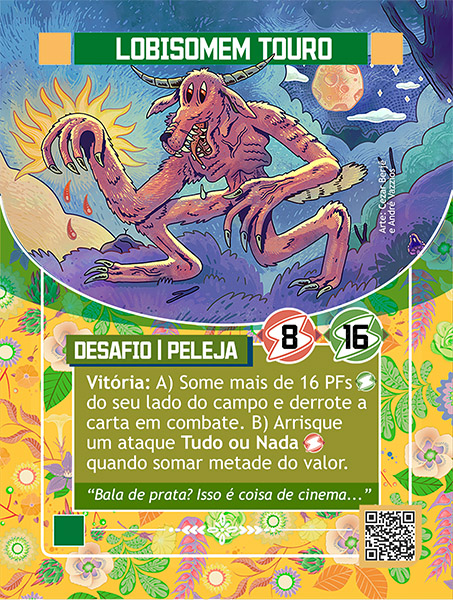
Werebull
Challenge / Combat
The beast rolled where a bull, a pig and a pony had lain. Draw blood from the cursed creature to break its fate!
Win · A) Have at least 16 STR on your side of the field and defeat this card in combat. B) At half the target, you may risk an All-or-Nothing attack.
Download the high-resolution artwork
References
- CASCUDO, Luís da Câmara. Licantropia sertaneja. Imburana: revista do Núcleo Câmara Cascudo de Estudos Norte-Rio-Grandenses, v. 5, n. 9, jan./jun. 2014. Republicação do texto de 1923. (periodicos.ufrn.br)
- LIMA, Maria do Rosário de Souza Tavares. Lobisomem: assombração e realidade. São Paulo: Escola de Folclore, 1983.
- MACHADO, José Homem. O folclore da Ilha do Pico. Horta: Núcleo Cultural da Horta, 1991.
- SEREJO, Hélio. Lendas de Mato Grosso do Sul. In: SEREJO, Hélio. Obras Completas vol. VIII, Campo Grande: Instituto Histórico Geográfico, 2008a.
- SEREJO, Hélio. O Lobisomem. In: SEREJO, Hélio. Obras Completas vol. I. Campo Grande: Instituto Histórico Geográfico, 2008b.
- VASCONCELLOS, J. Leite de. Tradições populares de Portugal. Porto: Livraria Portuense de Clavel & Cia, 1882.