

Illustration by Andre Vazzios
Upside-Down Saint
Folklore and history
Saint Anthony has a reputation for finding lost things. Why not a sweetheart? The trouble is that the saint has his own timetable, and someone in love may be in a hurry. To speed things along, people turn to sympathetic magic, using folk charms known as simpatias.
How folk charms work
A simpatia sets up a connection between the material world and the world of magic so that a change in one can bring about a change in the other. Take the ways people make things uncomfortable for Saint Anthony’s statue until he grants a request. They might take the infant Jesus from his lap, put the statue in the freezer or turn it upside down in a glass of water.
Saint Anthony also received complaints because of the drought. In Superstition in Brazil, Cascudo (2015) records the custom of leaving his image on the roof, exposed to the sun. The intention was to make the saint feel thirsty and send rain. In another practice, the image was placed upside down in the little water that remained in a pond.
According to historian Laura de Mello e Souza, these practices, which she calls "affectivized forms of popular religiosity," began to disappear in Europe at the end of the 18th century, but persisted in colonized countries, especially due to devotion to saints and the Virgin Mary.
As the author rightly points out, the saint who is venerated is also the one who, in the tit-for-tat, can be thrown into a corner, cursed, hated in fits of anger or dissatisfaction. It's affection to excess!
Loves, devotion, and festivals
In the square dance of the June festivals, we sing unaware: "I asked in a prayer, to dear Saint John, to give me a marriage. Saint John said no, Saint John said no, that's up to Saint Anthony." The more experienced, however, know that Anthony's fame is for finding love, not for keeping it. That's why the little rhyme became famous: "My dear Saint Anthony, I beg you, by who you are. Give me the first husband, and I'll arrange the other one later." Whoever really wants a good matchmaker saint turns to Saint Joseph.
According to his hagiography, which is what the biographies of saints are called, Fernando Antônio de Bulhões – the one who would become known as Saint Anthony of Padua – was born in the 12th century in Lisbon. Throughout his life he became known as the protector of the poor, as he had the custom of taking bread from the convent and distributing it among the hungry. The act is still practiced today, when parishes distribute Saint Anthony's bread rolls every 13th of the month.
The date refers to Saint Anthony's Day itself, celebrated on June 13th, as part of the June festival cycle. In cities that have the saint as their patron, it is common to celebrate the period with the sale of cake in his honor. The recipe varies, but it will often be a sponge cake with dulce de leche filling and whipped cream topping. The detail, and what makes it so sought after, is the gifts: inside the cakes, the parish hides hundreds of rings, medals, or figurines of Saint Anthony. Whoever finds one will get married within a year.
It is interesting to see how, in times of adversity, popular culture seeks to adapt in order to remain alive. During the pandemic, the municipality of Campo Grande/MS was one of those that maintained the tradition in an adapted way. For three years, the Saint Anthony cake was sold in the form of a cake in a jar, with 500 rings randomly distributed among the orders.

Upside-Down Saint
Lore
“Dear Saint Anthony, I pray, as only you know how: find my first husband, please. I’ll find the next somehow.”
Matchmaking Charm · Search
Cast a matchmaking charm. Search your deck for a Folk card and summon it directly to the field. Then shuffle.
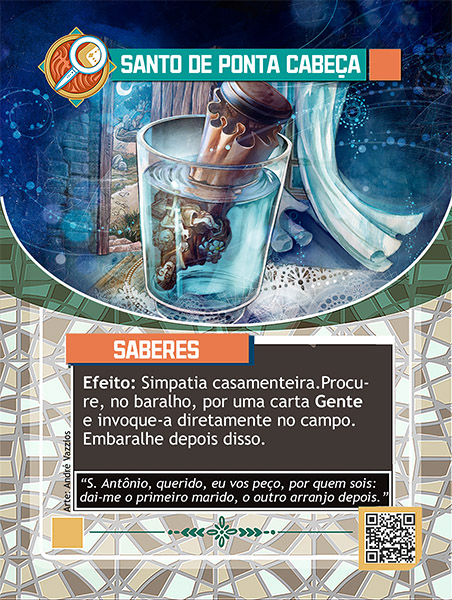
Download the high-resolution artwork

References
- CASCUDO, Luís da Câmara. Superstição no Brasil. 1. ed. digital. São Paulo: Global, 2015.
- SIMAS, Luiz Antônio. Santo de casa: fé, crenças e festas de cada dia. Rio de Janeiro: Bazar do Tempo, 2022.
- SOUZA, Laura de Mello. O Diabo e a Terra de Santa Cruz − Feitiçaria e Religiosidade Popular no Brasil Colonial. São Paulo: Companhia das Letras, 1999.
- VARAZZE, Jacopo de. Legenda Áurea. Vidas de Santos. São Paulo: Companhia das Letras, 2003.