
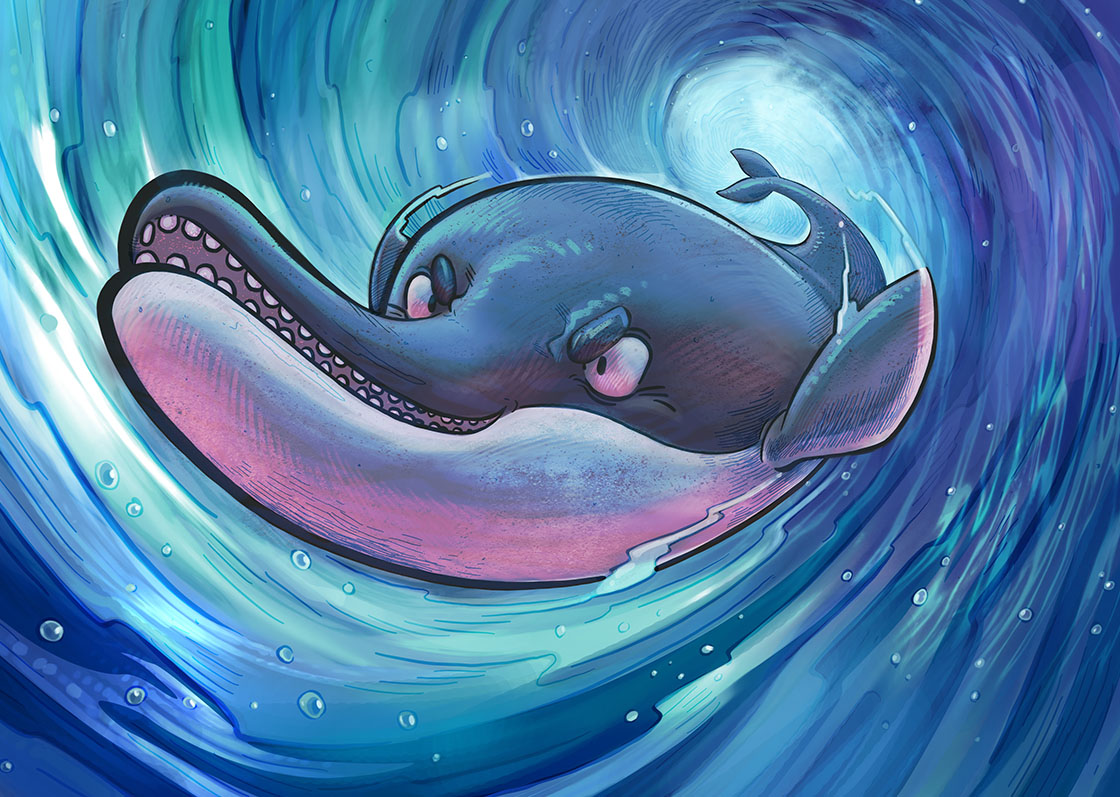
Illustration by Nilberto Jorge
Tucuxi
Folklore and history
"Answer me, black boto, who gave you this pitch? Was it sea spray slime or a woman's stench?" – This River is My Street, by Ruy Barata
The Dolphin That Protects
Besides the Amazon River Dolphin, in the waters of the Amazon River we find another enchanted animal: the Black Dolphin – also called the Tucuxi Dolphin (Sotalia Fluviatilis). Traditionally, there are no known stories of this animal assuming human form, much less of it attacking women. However, this does not mean that there is a lack of stories about it in our popular culture.
The Tucuxi is considered a benefactor, and it is said that it is common to hear stories of this dolphin pushing shipwrecked people to the shore, saving them from a tragic fate. It is a beloved animal among fishermen in the Amazon, who always value its presence around the boat as a sign of good luck. A vigilant friend watching over their safety.
Sairé
This apparent opposition between the two sighted animals inspires a notorious dispute in the Amazon region of Pará. In Alter do Chão, a municipality near Santarém (PA), the Boto Festival has been held in September since 1999. The event takes place during the Sairé, a festivity that revives a centuries-old tradition introduced by the Jesuits in the Amazon region in the 17th century.
In order to facilitate catechetical work, the religious figures created a manifestation that incorporates elements of Portuguese folk festivals with religious rites and Catholic prayers in Nheengatu. The highlight was the carrying of the object that gave the festival its name: the Sairé. A semicircle made of vines and decorated with cotton and flowers. Practically a litter.
Over time, other elements were incorporated into the festival by the people, such as games and drinks, which led to the Sairé being banned in 1943 by Franciscan priests. Only 30 years later, the festival was reactivated in Alter do Chão, but with different characteristics. It began to receive much more intervention from the public authorities and the idea of promoting tourism.
This is how the Boto Festival was incorporated into the Sairé in the late 1990s, mimicking much of the structure of the already consolidated Parintins Folklore Festival, where we find the historic dispute between the Garantido and Caprichoso oxen. It is worth noting: the presence of the Botos in the Sairé festival still generates controversy today.
In any case, the festival continues, and the Boto-Preto and Boto-Vermelho groups fiercely compete for victory, year after year. With the victory of Boto Preto in 2022, the groups reached 11 titles each. This tie was recorded by the Municipality of Santarém at the opening of the 2023 festival. The Boto Festival is composed of a series of stages that the groups must contemplate in their allegories, staging the conquest of an indigenous woman by the amorous boto. Unlike tradition, in the festive version portrayed in the festival, the Tucuxi takes on human form and also seduces women.
Cobra Sofia
A mythical derivation of the stories of the Boto-Tucuxi in the Amazon takes place in Amapá, on Santana Island, where the enchanted animal assumes another figure: that of the father of a gigantic sleeping serpent, which would be under the city, the Cobra Sofia.
Sofia is part of the Cycle of Great Snakes that permeates the entire Amazon region, where, in addition to the main myth of a great snake that represents the Amazon River itself, we have regional legends that incorporate specific descriptions and names into this narrative form. This is the case of Rosalina, the Great Snake of the Jatuíra River.
In the story that circulates in Santana, they say that the Tucuxi fell in love with an indigenous woman named Icorã. To seduce her, he did not assume human form like his water relative. He took the form of a beautiful swan and, as a bird, he impregnated her. When the baby was born, the woman threw the child into the river so that no one would know what had happened. The boto used his powers and transformed the baby into a snake, which grew and grew until it reached its gigantic proportions today. They say that when there are tremors in the city, it is the Cobra Sofia that is moving underground.

Tucuxi
Strength: 3
Health: 3
Wonders / Water
“Are you daft? That’s the black boto. That one doesn’t turn into a person!”
Friend to Humans · Rescue
When you summon this card, choose a Folk card in the Beleléu (your discard pile) and summon it directly to the field.

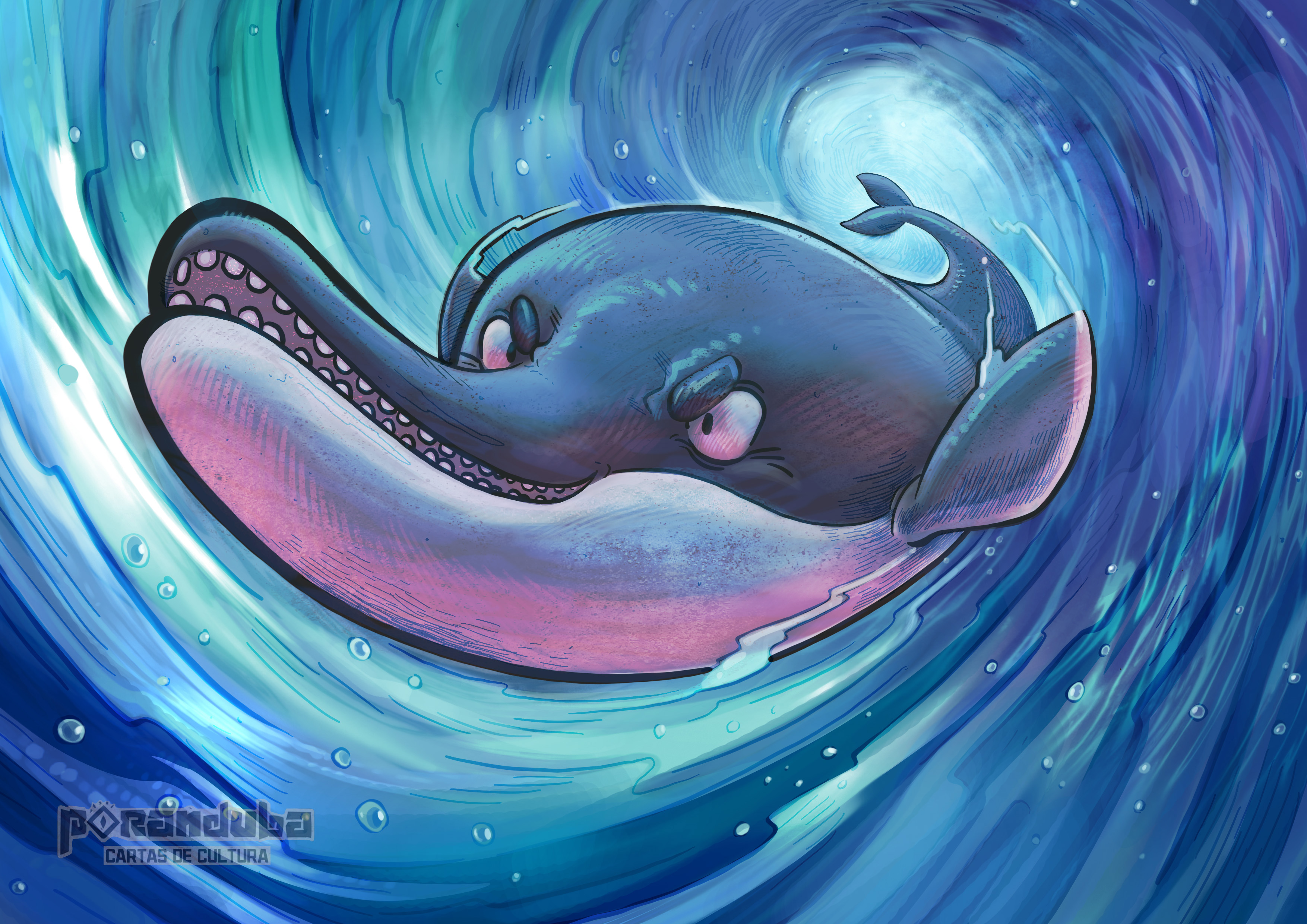
Download the high-resolution artwork
References
- CASCUDO, Luís da Câmara. Dicionário do Folclore Brasileiro. São Paulo: Global, 2012.
- MORAES, Thaissa Naiara Nonato. O (des)encanto da Sofia: a cobra-grande como mito e crítica social na cidade de Santana. Orientador: José Maria da Silva. 2016. 81 f. Trabalho de Conclusão de Curso (Graduação em Ciências Sociais) – Departamento de Filosofia e Ciências Humanas, Universidade Federal do Amapá, Macapá, 2016.
- SANTARÉM. Prefeitura Municipal. Festival dos Botos: Tucuxi e Cor de Rosa preparam-se para a disputa. Agência Santarém, 15 set. 2023. (santarem.pa.gov.br)
- SIMÕES, Maria do Socorro; GOLDER, Christophe. Belém conta. Belém: UFPA, 1995a.
- SIMÕES, Maria do Socorro; GOLDER, Christophe. Santarém conta. Belém: UFPA, 1995b.
- SLATER, Candace. A festa do boto: transformação e desencanto na imaginação amazônica. Rio de Janeiro: Funarte, 2001.