
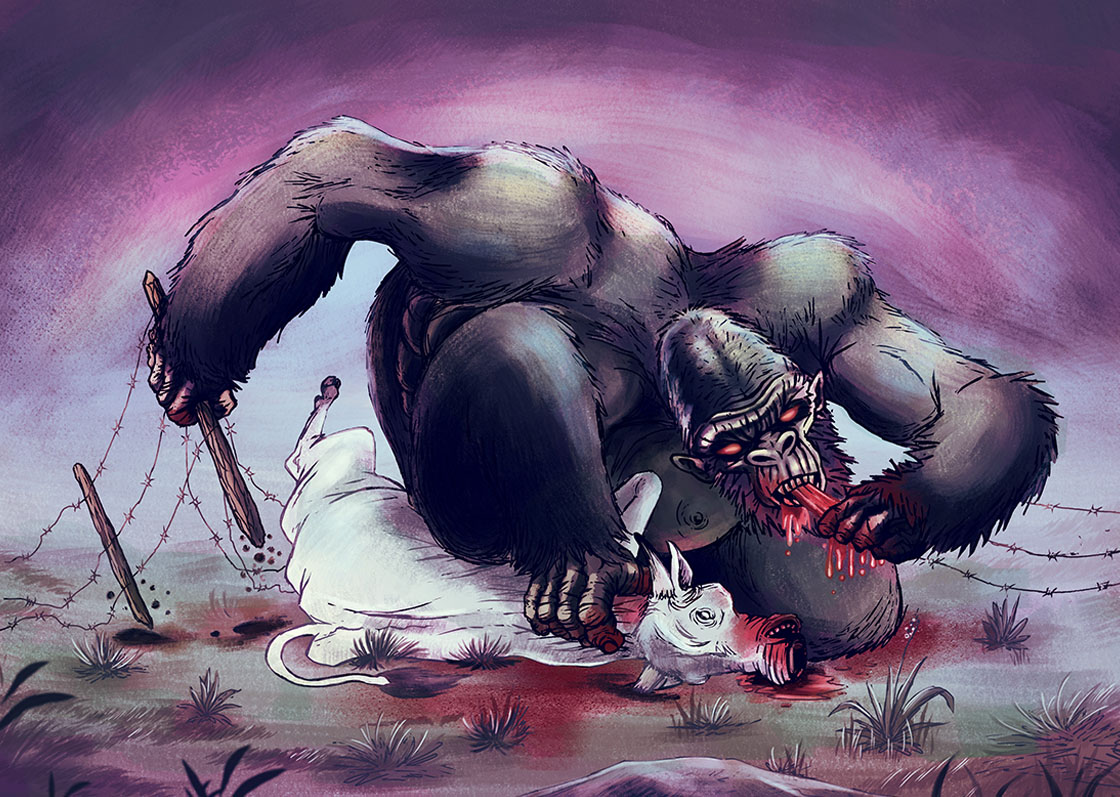
Illustration by Rafael Limaverde
Tongue-Snatcher
Folklore and history
In 1933, a paradigmatic film for the history of cinema premiered: "King Kong". The story was about an ape of gigantic proportions, which fascinated and enchanted audiences. A few years later, the Brazilian press began to mention the appearance of our own king of the apes. A "King Kong" was said to be roaming throughout the area between the Rio Vermelho and the Rio Tocantins, in the backlands of Goiás.
Reports from 1937
On March 18, 1937, the newspaper "A Noite", from Rio de Janeiro, wrote: "Strange news has been circulating for a long time about the discovery of dead cattle, missing their tongues." The reason was never discovered, but the newspaper pointed to a suspicion among the population. A monkey-monster.
Friends of one of the interviewees (a painter) reported finding a gigantic footprint – three times larger than that of men – in the semi-dry mud next to a fallen tree. On the way back, roars and grunts similar to those of monkeys.
Another interviewee is introduced as "Jorge de Tal," a man considered trustworthy, who found a dead cow without its tongue on the farm of "Mr. Enéas Peludo." From the sum of the two events, the culprit's version was formed.
A report in the Diário Carioca of March 21, 1937, mentions a news item published in the first days of that month by the Correio Official de Goiás: a "colossal human skeleton" had been found on the banks of the Araguaia River. The report asks if the bones were from an animal of the same species. It is through this record from the Diário Carioca that we return here to the news from the Goiás newspaper.
The dead cattle supposedly showed only abrasions on the jaws and lacerations inside the mouth, revealing signs that the tongue was violently torn out. However, there are no signs of struggle on the ground. "Only another animal of gigantic strength could subdue a bull in the middle of the forest or field," he concludes.
The calculations in the article, replicated in several media outlets and signed only by "a correspondent," estimate that, based on the footprint and the force required, it would take a monkey almost four meters tall. Since it has not yet been seen, it would have to attack at night and in deserted areas.
On April 9 of the same year, new news emerged. Several local farmers were interviewed, including a colonel, who stated: "A few days ago, one of my cowboys arrived, reporting the death of a dairy cow. It had been milked that morning. It was released into the field. In the late afternoon, when the cowboy went to herd the cow, he saw it lying dead by the edge of the trail. Its head was dislocated, its tongue torn out, and there was a pool of still-fresh blood at the spot." Other testimonies follow, showing a modus operandi of strangling the animals.
News and propaganda from Goiás
A speech by the writer and jurist Paulo Figueiredo sheds light on this episode. It was the 1930s, and throughout Brazil, the press frequently spoke of Goiás and its new capital. The headlines were among the most incredible: the appearance of a King Kong on the banks of the Araguaia River; a man in a black cloak who frightened passersby in Goiânia; discovery of a mummy woman…
As Figueiredo points out, all these supposed events were creations or distortions of the journalist Joaquim Câmara Filho, a native of Rio Grande do Norte who settled in Goiás, where he headed the State Propaganda Department. There, "he dedicated himself, body and soul, to the propaganda of Goiás and Goiânia, making this State and that city two objects of permanent attraction for Brazilians."
Câmara Cascudo's records
Câmara Filho was also one of Luís da Câmara Cascudo's sources. In "Geography of Brazilian Myths," the folklorist recounts that he received news of Arranca-Língua in May 1938, sent by Professor Manuel Ambrósio, from Januária, Minas Gerais. To learn more, he sought out the very person responsible for Goiás's propaganda. The information disseminated by the journalist thus reached folklore studies.
Cascudo also transcribes a letter from Zoroastro Artiaga, sent from Goiânia on September 16, 1938. According to Artiaga, the monster was initially known as Bicho-Homem: a human figure covered in hair, which fed on cow tongues. In one account, it appeared to a hunter on the Rio das Mortes carrying a human skull under its arm.
Artiaga attributes the name "King Kong" to the regional press, inspired by the film. Câmara Filho is said to have spread its exploits throughout Brazil. The letter helps to understand this association: the film character offered a familiar image to describe the being that haunted the backlands.
An explanation for the cattle without tongues
On October 3, 1939, the Rio de Janeiro newspaper Diário de Notícias published the note “End of a legend,” about cows found without tongues in Uberaba, Minas Gerais. State veterinarian Sylvio Vianna was investigating the deaths. In the region, a story circulated that a monster was killing cattle and devouring their tongues. According to the note, Vianna concluded that, due to the drought, the animals ate tough grass and injured their tongues. The lesions progressed until they caused them to fall off. The news shows that similar stories also circulated in the Triângulo Mineiro region.

Tongue-Snatcher
Challenge / Combat
The government blames foot-and-mouth disease, but this monster is killing the local cattle. Stop it before yours is the next tongue it tears out!
Win · A) Have at least 14 Strength on your side of the field and defeat this card in combat. B) At half the target, you may risk an All-or-Nothing attack.

Download the high-resolution artwork

References
- ACADEMIA deu posse a Paulo de Figueiredo. A Voz de Luziânia, Goiás, 12 out. 1983. (memoria.bn.br)
- CASCUDO, Luís da Câmara. O Arranca-Língua (Sertões do Araguaia — Goiás). In: CASCUDO, Luís da Câmara. Geografia dos mitos brasileiros. 1. ed. digital. São Paulo: Global, 2012.
- FIM de uma lenda. Diário de Notícias, Rio de Janeiro, ano X, n. 5.195, 3 out. 1939. Primeira secção, p. 5. (hemeroteca-pdf.bn.gov.br)
- KING-KONG! Curiosas revelações. A Noite, Rio de Janeiro, 18 mar. 1937. (memoria.bn.br)
- KING-KONG às margens do Araguaya, em Goyaz. Diário Carioca, Rio de Janeiro, ano X, n. 2.692, 21 mar. 1937, p. 19. (hemeroteca-pdf.bn.gov.br)
- O MONSTRO estrangulador que devóra linguas! A Noite, Rio de Janeiro, 9 abr. 1937. (memoria.bn.br)