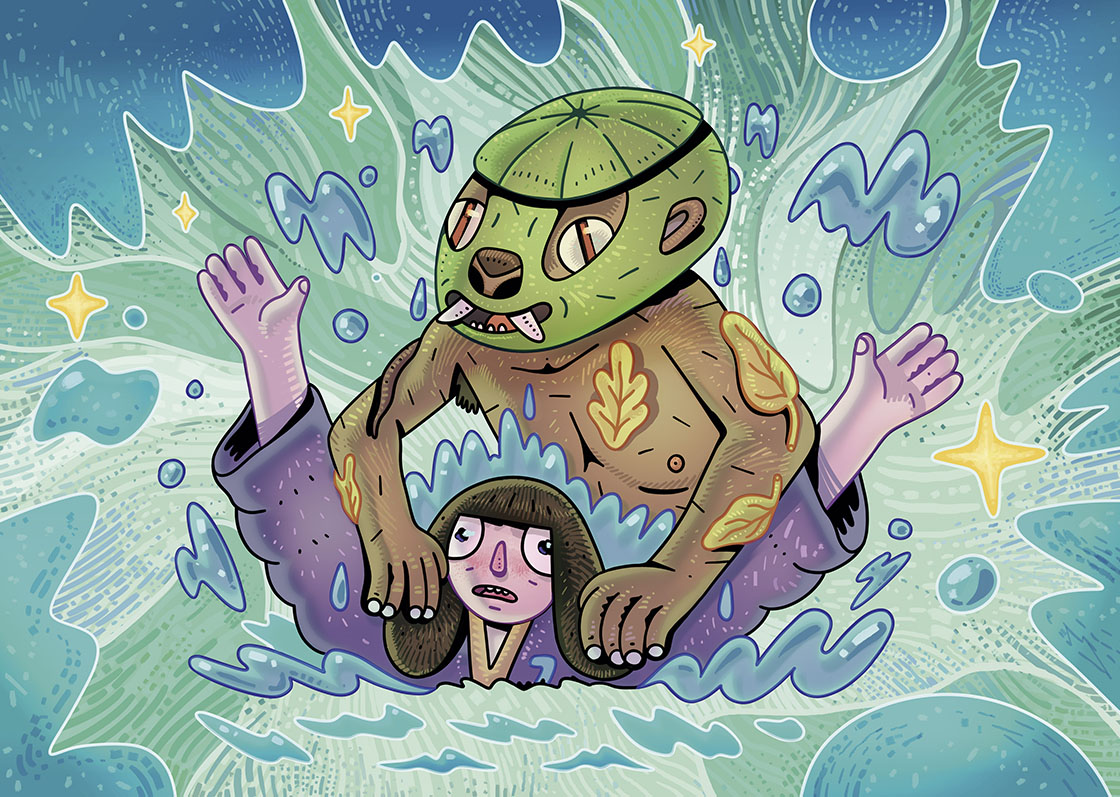
They tell of a monster that lives in the Parnaíba River in Piauí. Its long, thin body could almost pass for human. Then you see its enormous head, with hair falling straight over the forehead. That head earned it the name people know across Brazil: Cabeça de Cuia.
Crispim and the curse
They say that the monster was once a man. And that it even had a name: Crispim. The story tells of a river dweller who lived in a miserable hut on the banks of the Parnaíba. One day, after a long day's work, he returned home eager for dinner. The fishing, however, was getting weaker and weaker; there was no food to serve at the table. To trick his stomach, the boy's mother improvised with what she had: a soup made with beef bones to thicken the broth.
Hunger, we know, dehumanizes anyone. But Crispim went further. Revolted by the lack of food, he took a whole ox bone from the food and used it to beat his own mother. Hitting one's mother, as is known, is a sin. And, in popular culture, a sin paid for with a curse. Before dying from the unjust beating, Crispim was transformed into a beast-man, with aquatic habits, with a huge, round head like a gourd or calabash.
There is, however, a way for the monster to get rid of his curse. In the "Dictionary of Brazilian Folklore," we find the version that he should eat, every seven years, a girl named Maria – and this for 49 years. Others will be more specific and say that he needs to kill seven virgin Marias. Meanwhile, his mother will continue to live in the waters of the river (will she be in body or only in spirit?).
The meaning of the number seven
It is striking to think that, in order to recover humanity, it is necessary to commit inhuman acts. What would be the logic? In popular traditions, we know that seven is a mystical number, characterizing perfection. The "pleroma," in Gnosis, which means "that which is complete." For the mythologist Junito Brandão, seven represents "the culmination of the world and the fullness of time." And what happens when fullness is multiplied by itself?
Seven times seven could be a way of symbolizing infinity, permanence. In the Bible, Jesus speaks of forgiving 70 times seven times. In a Northeastern quatrain, mentioned by Brandão, we have the story of Sarah, also from a biblical account.
"Seven times I was married, Seven men I knew; And I swear by the faith of Christ, I am still as I was born."
Cursed, the Cabeça de Cuia will spend eternity murdering women; Reviving the act that made him a monster, in a vain attempt to be known as human again.