
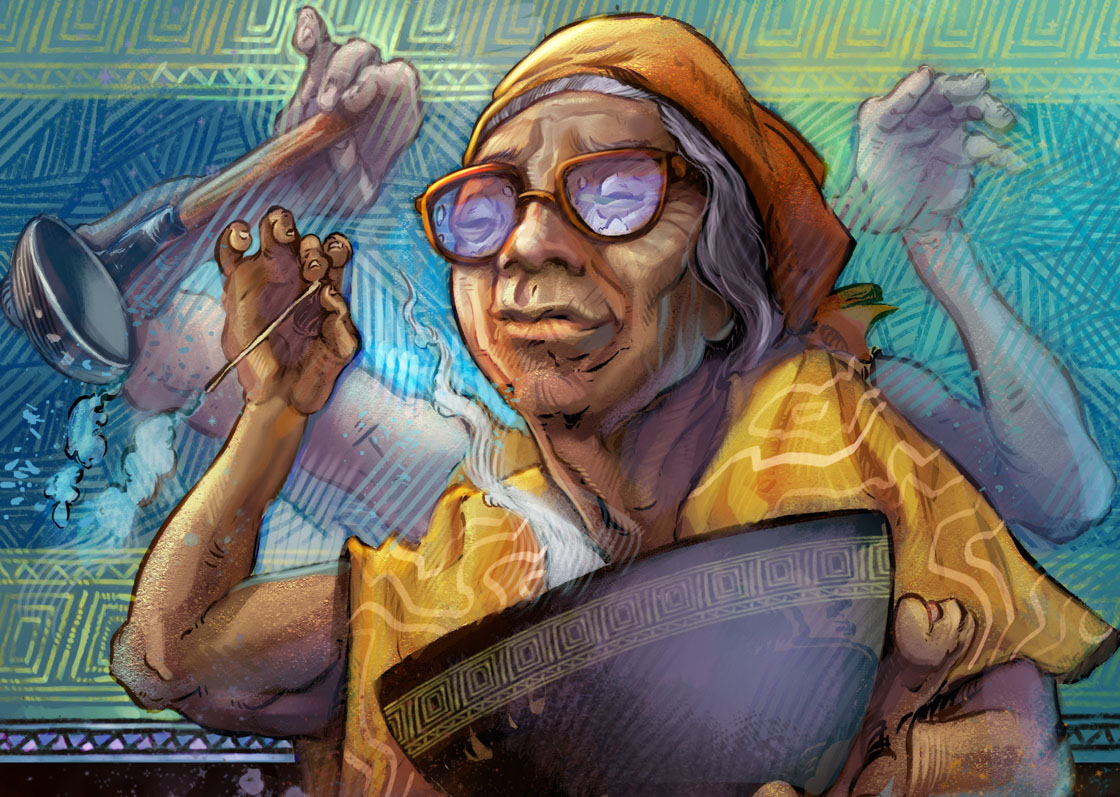
Illustration by Levi Gama
Tacacá
Folklore and history
Hey, stir, stir girl, you can stir without stopping You are now my tacacá girl Grate, grate the cassava, squeeze it in the tipiti Separate the tapioca, trim the tucupi Prepare my tacacá, delicious like açaí – Excerpt from "Tacacá Girl", by Pinduca
One dish and many stories
A soup or a broth? Is it eaten or drunk? Tacacá is a typical dish of Amazonian cuisine that has fascinated interpreters throughout the centuries. As we know it today, it is a preparation served in a gourd, where pepper, tucupi, tapioca gum, jambu leaves and dried shrimp are placed – with another ladleful of tucupi to cover the ingredients.
The dish is of indigenous origin, and there are variations of the recipe now considered traditional – especially when using fish instead of shrimp. According to José Veríssimo, in an article published at the end of the 19th century, the word "tacacá" seems to be a corruption of the Tupi term Mbae Tykycú, which would mean "thing to drink in gulps". This would be why tradition dictates that the dish be served in gourds or bowls.
Despite the strong indigenous influence, some researchers draw attention to the importance of understanding tacacá also as a process of dialogue between cultures. After all, the use of garlic (in which tucupi is seasoned) is a reference to Iberian cuisine. The dried shrimp, introduced later to the recipe, carries African influence.
The knowledge of the tacacá vendor
The knowledge of the tacacá maker appears in the details. Dona Teodora, interviewed by Pascale de Robert and Lucia van Velthem (2009), removed part of the jambu flowers because her customers didn't like their mouths to tremble too much. In the shrimp, she left the tail so that they could be picked up with the fingers without burning their hands. The point of the tapioca starch was recognized by the consistency as it dripped from the spoon. Preparing tacacá required this judgment: observing the ingredients, getting the point right, and knowing the taste of the clientele.
From cassava to tucupi
Tucupi and tapioca starch are products quite present in the cuisine of the original peoples, since both are byproducts of cassava, a root widely used by Brazilian indigenous people. Regarding cassava, it is common to divide it into two large groups, based on the amount of hydrocyanic acid it contains. Those with low levels of poison are known as sweet or mild cassava (such as manioc, aipim, etc.). Those with high levels of poison, which make them poisonous, are called bitter or bitter cassava.
To remove the "poison," the food must be prepared properly. Traditionally, grated bitter cassava is then pressed in a tipiti (a type of press made of straw). The dry mass becomes flour; and the liquid that runs off this press is manipuera, which is still poisonous. From it, the precipitate (tapioca gum) is extracted, and the remaining liquid, after fermenting for 24 or 48 hours, becomes tucupi.
To finish removing the poisonous substance, the tucupi is boiled and seasoned with salt, garlic, and herbs, such as chicory and basil. The leaves, which give rise to maniçoba, must be cooked for at least four days – although people usually say it takes seven.
How a gourd becomes a bowl
Finally, it is also worth mentioning the gourd in which tacacá is served, which itself goes through a traditional way of making. The artifact is produced from the fruits of the calabash tree, also called "coité" (Crescentia cujete). The plant produces rounded fruits, unlike the porongo or gourd, of Lagenaria siceraria, which serves as raw material for chimarrão gourds and has a more elongated neck. In addition, the coité is used for the production of berimbaus.
The ripe fruit of the calabash tree is split in two; then, the pulp is removed. With the green peel removed, the piece becomes very light in color. After drying in the sun, it's ready to use, and is then called a pitinga gourd (without pigment). Tacacá gourds, however, are a vivid black. How is this done?
The process continues with the use of cumaté – the resin of the cumaté tree (Myrciam Atramentifera) –, which serves as a natural varnish and reddens the pieces. Then, the gourds are placed on a bed (or puçanga), on top of a layer of ashes, over which human urine is sprinkled. Thus, they will be covered with a cloth or tarp for 12 hours, turning them halfway through, and they come out finished. The process is a natural way of extracting ammonia (present in urine), a product necessary for the fixation of the cumaté.

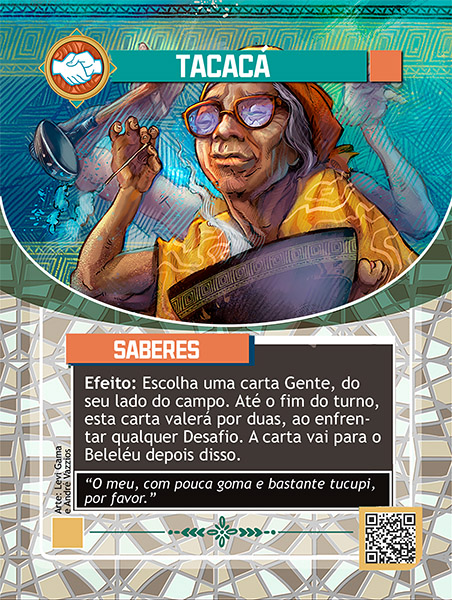
Tacacá
Lore
“Easy on the cassava starch, plenty of tucupi for me, please.”
Ready for Another! · Partnership
Choose a Folk card on your side of the field. Until the end of the turn, it counts as two when facing any Challenge. Send that card to the Beleléu (your discard pile) afterward.
Download the high-resolution artwork

References
- CARVALHO, Luciana Gonçalves. O artesanato de cuias em perspectiva – Santarém. Rio de Janeiro: Iphan, CNFCP, 2011, 192 p. (portal.iphan.gov.br)
- INSTITUTO DO PATRIMÔNIO HISTÓRICO E ARTÍSTICO NACIONAL. Modos de fazer: cuias no Baixo Amazonas. 2006. Vídeo (17 min). (www.youtube.com)
- ROBERT, Pascale; VAN VELTHEM, Lucia. A hora do tacacá. Consumo e valorização de alimentos tradicionais amazônicos em um centro urbano (Belém – Pará). Anthropology of food, S6, December, 2009, p. 1–13.
- VERÍSSIMO, José. A Linguagem Popular Amazônica. Revista Amazônica. 1º ano, tomo I, n. 4, janeiro e fevereiro, 1883, p. 138. (memoria.bn.br)