

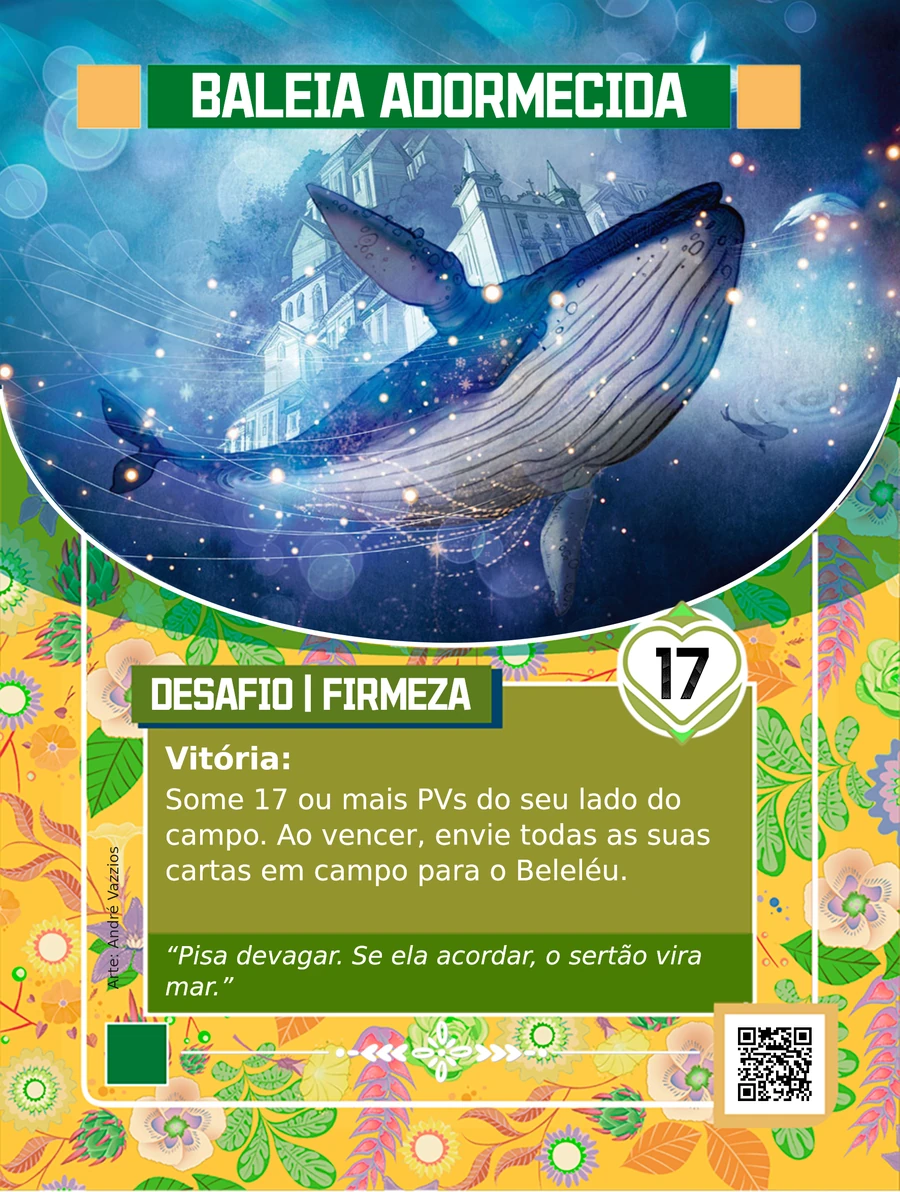
Illustration by André Vazzios
Sleeping Whale
Folklore and history
In Icó, Ceará, they say that at the beginning of everything there was a flood. When the waters receded, part of them remained underground. And who ended up in this subterranean sea? A whale so large that today it sleeps under the main altar of the Senhor do Bonfim church. As long as the image is there, the whale continues its sleep. But, if one day they take the saint away for good, it will wake up. The backlands, then, will turn into a sea.
It is said in Icó that the priests wanted to take Senhor do Bonfim to a larger church. The devotees protested. When they began to remove the image, the water rose inside the church. And when did it recede? When the foot of the image touched the water. For those who tell this story, what protects the city is faith.
In another Icó version, registered by Iphan, a stone attached by chains to a nearby mountain is what holds back the waters. If the stone comes loose, an arm of the sea will cover the city. Only then will the altar of Senhor do Bonfim become a whale's bed.
In Canguaretama, in Rio Grande do Norte, there's even a way to clear up the doubt. Around six in the afternoon, when the Matriz de Nossa Senhora da Conceição is silent, you just have to put your ear to the altar to hear the whale's heart. Some people skip the wait. They say that, on the church's platform, you can hear it at any time. And what would make the whale wake up? In this version, it's the attempt to steal the image of the patron saint.
In Valença do Piauí, they say that the whale is blue and that it arrived so thirsty that it drank all the water from the Caatinguinha River. Then, it fell asleep with its head under the church of São Benedito. If it wakes up, it will return all the water it drank at once. Also in Cristino Castro, in Piauí, there are those who say that a whale sleeps under the church.
How did the whale end up under the backlands? Regarding the path it traveled from mouth to mouth, the question remains. On the coast, the familiarity with these animals has a well-documented history. Between the 17th and 19th centuries, whaling and processing were part of life for many coastal communities. Even those who had never seen a whale could light a lamp or lantern with the oil extracted from it. It was with this oil that houses and streets were illuminated.
And the walls? “That wall will never fall, it was made with whale oil,” you still hear people say. To what extent the oil was actually mixed into the mortar of colonial buildings is an open question. In the laboratory tests cited by researcher Manuella Araújo de Souza, the oil helped the mortar repel water. The resistance that the phrase attributes to the wall is another story. Even the bones had a use: in some communities, they became fences or served as supports for washerwomen to beat clothes.
And what about the meat? In colonial Bahia, poor residents ate whale meat. In the sugar mills, it was also given as food to enslaved people. In the 17th century, whoever took care of the accounts of the Sergipe sugar mill even recorded this expense in the books.
Commercial whaling continued into the 20th century. In 1985, a decree mandated its suspension for five years, starting on January 1, 1986. In 1987, Law No. 7,643 prohibited fishing and any form of intentional harassment of all cetacean species in Brazilian jurisdictional waters, including whales, dolphins, and porpoises.

Sleeping Whale
Challenge / Endurance
“Tread softly. If she wakes, the sertão will turn to sea.”
Have at least 17 HP on your side of the field. When you win, send all cards on your field to the Beleléu (your discard pile).
Download the high-resolution artwork

References
- A LENDA da baleia da Igreja Matriz de Canguaretama. História de Canguaretama, abr. 2013. Disponível em: https://historiadecanguaretama.blogspot.com/2013/04/a-lenda-da-baleia-da-igreja-matriz-de.html. Acesso em: 12 nov. 2026.
- A LENDA da baleia que vive debaixo da igreja. Cristino Castro, 9 jul. 2009. Disponível em: https://catingadeporco-cristinocastro.blogspot.com/2009/07/lenda-da-baleia-que-vive-debaixo-da.html. Acesso em: 12 nov. 2026.
- BRASIL. Decreto nº 92.185, de 20 de dezembro de 1985. Proíbe as atividades de caça comercial da baleia no Brasil, a partir de 1º de janeiro de 1986, por um período de cinco anos. Disponível em: https://www2.camara.leg.br/legin/fed/decret/1980-1987/decreto-92185-20-dezembro-1985-442250-publicacaooriginal-1-pe.html. Acesso em: 12 nov. 2026.
- BRASIL. Lei nº 7.643, de 18 de dezembro de 1987. Proíbe a pesca de cetáceo nas águas jurisdicionais brasileiras, e dá outras providências. Diário Oficial da União: seção 1, Brasília, DF, 21 dez. 1987, p. 22079. Disponível em: https://www2.camara.leg.br/legin/fed/lei/1980-1987/lei-7643-18-dezembro-1987-368104-publicacaooriginal-1-pl.html. Acesso em: 10 nov. 2026.
- FURTADO, Rogério. Ribeira dos Icós: Icó – CE. Brasília: Iphan/Programa Monumenta, 2008. (Preservação e Desenvolvimento, 10).
- INSTITUTO DE ENSINO DOM QUIXOTE. Educação Infantil comemora o Dia do Folclore. Valença do Piauí. Disponível em: https://www.iedq.com.br/site/educacao-infantil-comemora-o-dia-do-folclore/. Acesso em: 12 nov. 2026.
- OLIVEIRA, Thiago Antonio de. Abundância de vale com matas à verdejante Canguaretama/RN. Natal: Editora do IFRN, 2016.
- REDAÇÃO ANI. Argamassa de óleo de baleia: mito ou realidade na construção colonial brasileira? Inventores.com.br, 2 jan. 2012. Atualizado em 18 ago. 2026. Disponível em: https://inventores.com.br/argamassa-de-oleo-de-baleia/. Acesso em: 10 nov. 2026.
- SILVA, Rhaul Leandro da. Letramento literário e valorização da memória local: uma proposta pedagógica com as lendas icoenses. 2022. Trabalho de Conclusão de Curso (Licenciatura em Letras – Língua Portuguesa) – Centro de Formação de Professores, Universidade Federal de Campina Grande, Cajazeiras, 2022. Disponível em: https://dspace.sti.ufcg.edu.br/handle/riufcg/27291. Acesso em: 10 nov. 2026.
- SOUZA, Manuella Araújo de. Adição do grude da gurijuba nas argamassas de cal: investigação histórica e científica. 2012. Dissertação (Mestrado em Arquitetura e Urbanismo) – Universidade Federal da Bahia, Salvador, 2012. p. 34.
- VIEIRA, Nina. Desvendando as baleias do Brasil, fantasmas na história global da baleação. Boletim do Museu Paraense Emílio Goeldi. Ciências Humanas, v. 19, n. 2, 2024. DOI: https://doi.org/10.1590/2178-2547-BGOELDI-2023-0021.