
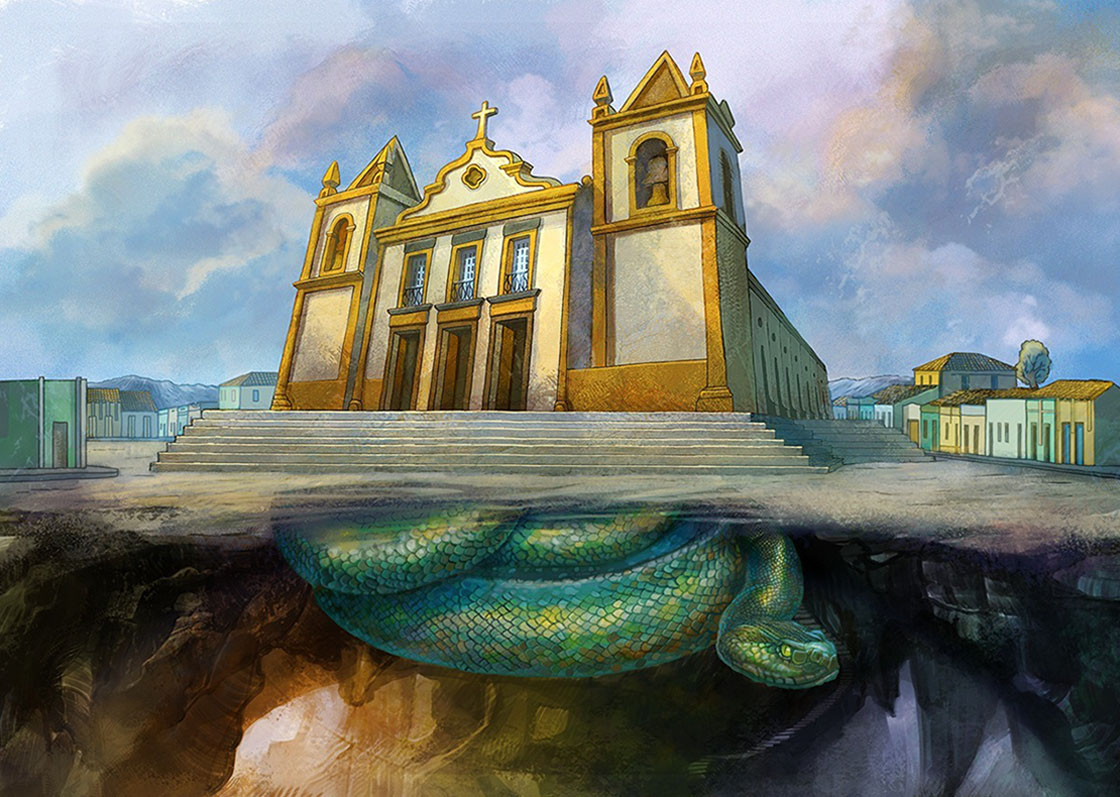
Illustration by Rafael Limaverde
Sleeping Serpent
Folklore and history
In popular tradition, the church usually plays a much more important role than that of holding masses. Its own physical space is responsible for containing the evils of the world, as we see in a legend widely spread throughout the country: that of the sleeping serpent.
The narrative speaks of a snake of immense proportions that sleeps just below the city. Often, to demonstrate its enormous size, it is said that its head is on the grounds of the main church while its tail is in a much more distant place – a park, a landmark on the land, a cemetery, or an equally important building.
The church and the serpent
Flávio Pereira Costa Junior, reflecting on the legend of São Luís, considers that the "underground" where the serpent is located refers to the underworld, to hell. The serpent, of course, carries the imagery of the Christian devil himself, the one who tempted human beings to violate God's laws.
The church, in turn, would be the physical manifestation of Jesus' influence. Positioning the serpent with its head just below it is a symbolic reference to the control of evil thoughts.
The Serpents of Maranhão
One of the best-known of these serpents is precisely the one that encircles the island of São Luís do Maranhão. In one version, legend says that the day this snake grows large enough for its tail to reach its head, it will embrace the earth and, in a display of stupendous strength, destroy the entire city.
But even within the state of Maranhão itself, there are other legends of serpents. Jomar Moraes records, for example, the Serpent of Viana, which has its head under the main church and its tail on Mororoca hill. They say that whenever an attempt is made to build a new chapel there, the snake's tail moves and the construction collapses.
Another one, also in Maranhão, is the Serpent of São João Batista, which has its tail in Lago do Coqueiro and its head also under the main church. However, even without moving from its place, it is able to use magnetic powers to attract birds, fish, and other animals to itself. It even has the ability to divert fishermen from their routes.
The snake of Belém
In Belém, Walcyr Monteiro (2000) records a snake with its head under the Sé Cathedral. The location of the tail varies: it may be under the Carmo Church, the Santo Antônio Church, or the Nazaré Basilica. The author suggests that these changes accompany the growth of the city. The connection between the Sé and the Basilica also reminds him of the route of the Círio de Nazaré.
In the early morning of January 12, 1970, when Belém felt an earthquake, some said that the snake was moving. According to legend, its emergence from its rest would cause the city to collapse and be engulfed by the waters of the Guajará Bay. Monteiro points out that, even without being seen, the snake had been felt by those who believed in it.
Sinhozinho and the snake of Bonito
From South to North we find narratives of the most varied kinds about sleeping snakes throughout Brazil. In Mato Grosso do Sul, the snake is not imprisoned by the church, but it was a religious figure who captured it. It is said that in Bonito, in the 1940s, a mute monk named Sinhozinho was in the region performing great miracles. One of his most notorious was the defeat of a huge snake that remains underground in the snake hill. The name appears in the report “Sinhozinho – In search of the prophet”, published by Revista Poranduba in 2011, with text by Andriolli Costa and research by Laryssa Caetano.
To keep it imprisoned, Sinhozinho ordered three wooden crosses to be erected, which he blessed on the slopes of the hill. The day the last cross falls, the snake will awaken and it will be the end of Bonito. In a visitation report published in 2020, Paulo Cattelan recorded that the residents pointed to only one remaining cross. She was propped up and protected, just in case.

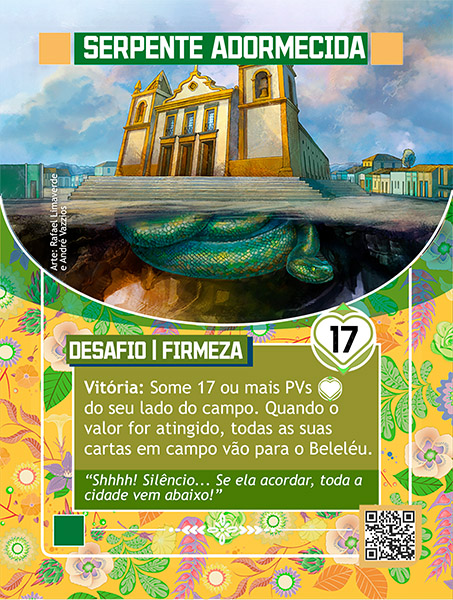
Sleeping Serpent
Challenge / Endurance
The earth trembles. The walls shake. If the serpent rises, not one stone will stand on another! Lull it back to its ancient sleep.
Win · Have at least 17 HP on your side of the field. Once you reach the target, send all cards on your field to the Beleléu (your discard pile).
Download the high-resolution artwork

References
- CATTELAN, Paulo. Sinhozinho e a maldição da cobra grande – Bonito – MS. Gastando Sola Mundo Afora, 4 nov. 2020. (www.abaretiba.blog.br)
- COSTA, Andriolli. Sinhozinho – Em busca do profeta. Reportagem de Laryssa Caetano; texto e edição de Andriolli Costa. Revista Poranduba, 20 set. 2011. Republicado no Overmundo. (www.overmundo.com.br)
- COSTA JUNIOR, Flávio Pereira. Entre Lendas e História: Narrativas que Representam a Identidade de São Luís. Curitiba: Appris, 2020.
- MONTEIRO, Walcyr. Visagens e assombrações de Belém. 3. ed. rev. e atual. Belém: Banco da Amazônia, 2000.
- MORAES, Jomar. O rei touro e outras lendas maranhenses. São Luís: Sioge, 1980.