
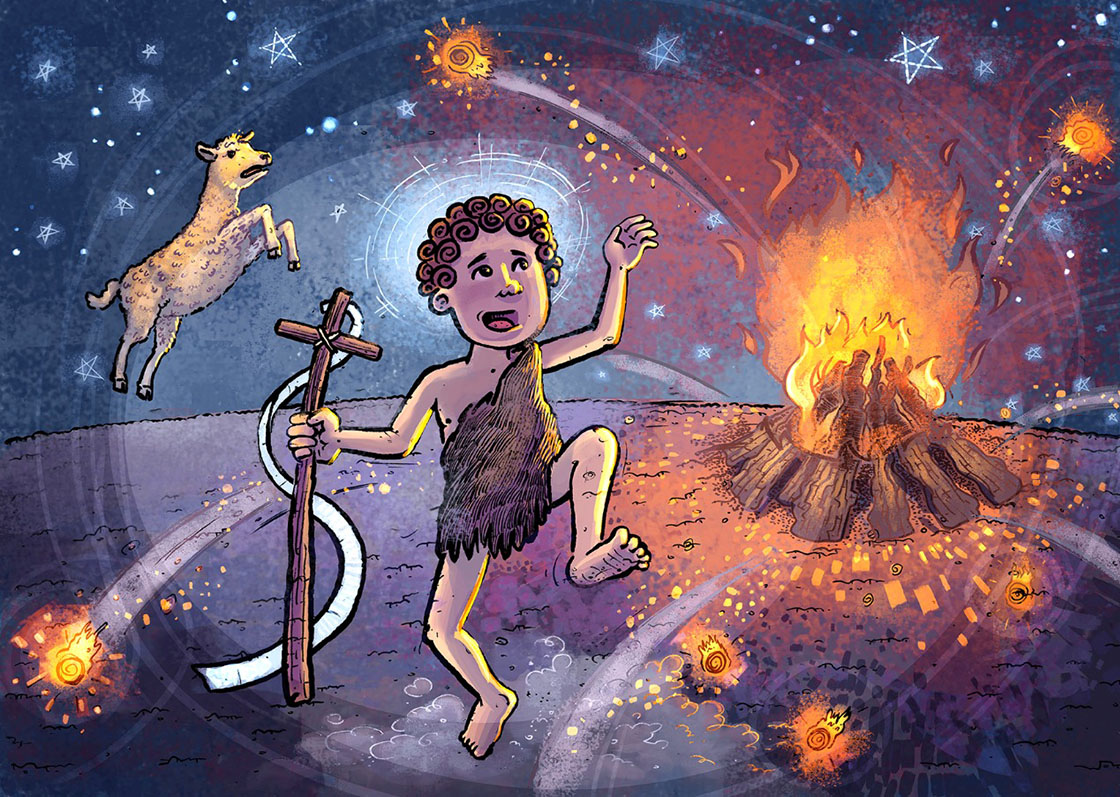
Illustration by Daniel Brás
Saint John Stirs
Folklore and history
Part of the June festival cycle, John is certainly one of the best-known saints in Brazil. His figure, often represented as a child with curly hair, pastoral clothes and a beautiful little lamb, differs greatly from the serious prophet with a tragic end that he is said to have been. How does this saint, whether a child or an old master, come from Jordan to inspire a country festival here in Brazil?
John the Baptist
The paths of culture are many. To begin, we need to understand who John the Baptist was. The last of the prophets, he was born six months before Jesus to prepare his way. His birth, in itself, would already be a miracle. His mother, Elizabeth, was an elderly woman who had never had a child. When the angel appeared to his father, Zechariah, the disbelief was so great that the man ended up mute as punishment for doubting divine designs.
John would later become a great preacher in the desert – converting many with his words. Two key moments mark his adult life: the baptism of Jesus, which he performs by immersing him in the waters of the Jordan River; and his execution by Herod. The prophet was already imprisoned for preaching against the king, but it is said that it was a request from Princess Salome that sealed his condemnation once and for all. Saint John was beheaded and his head was given as a gift. This head, even today, some churches in Europe claim to possess preserved in the form of a relic.
Luiz Antônio Simas points out that John is always with a little lamb in reference to having been the one to baptize Jesus, the Lamb of God. And although, in certain countries of the world, the beheading of John is a celebrated date on the Christian calendar (August 29), in Brazil we focus not on death, but on life. Not on the dead saint, but on the child who was born from a miracle. It is the cycle that begins again and is reborn.
Solstices and harvest festivals
The relationship begins to be established when we perceive the dialogues with the solstice festivals. Due to the Earth's rotation and tilt, there are times of the year when one hemisphere of the planet receives much more sun than the other. At the winter solstice, the nights are longer; at the summer solstice, the days are longer than the nights. Since the Earth takes 12 months to complete its rotation, the distance between the two solstices is exactly six months. The same distance that separated the birth of John and Jesus. That is why we have Christmas on December 25th and St. John's Day on June 24th.
There is nowhere in the Bible that says that Jesus was actually born on December 25th. This date was a convention, discussed after much interpretation of the texts. What guided this reading was a phrase spoken by John. After his disciples discover that Jesus, who had been baptized by him, was now also baptizing people, his cousin clarifies: “He must increase, but I must decrease” (John 3:30). In the metaphor, it would be a way of understanding the advance of the night in the Northern Hemisphere, which gets longer and longer until it reaches its peak on December 21. The church celebrates Jesus on the 25th because that is when the sun rises again, overcoming the darkness.
In Brazil, on the other hand, we are in the Southern Hemisphere. The darkest day of the year occurs precisely around Saint John's Day, which comes to break the darkness with its bonfires. With the end of the longest nights, the time is to celebrate with plenty of food, drink, music and dance. Seasonality explains the harvest festivals that exist in all peoples at the same time. Accompanying the idea of the fertility of the land are the celebrations of life: gifts, mock weddings, kissing booth, and love letters for lovers.
Between Water and Fire
A tradition that refers to the life of the Saint is the practice of bathing him in the waters of the river. The revelers carry a statue of the saint on a litter to a famous river in the city and bathe with it in the waters, asking for his blessings. During the journey, it is common to pass under the litter as well to ask for his intercession (especially for marriages). After the saint's bath, the devotees celebrate with much festivity.
However, the saint is best known for his connection with fire. So much so that he is syncretized with the orisha Xangô – who, incidentally, shares the day of the festival with him, on June 24th. Lighting bonfires and setting off fireworks in his honor became synonymous with the São João festival. Balloons, until they were banned, were also part of the celebration. But what was the reason?
One of the traditional explanations here in Brazil says that we light the St. John's bonfire in honor of his birth. It is said that in biblical times, Elizabeth, John's mother, and Mary were pregnant at the same time. As they lived in distant houses, the first to give birth should announce the news by lighting a large bonfire in front of her house. John the Baptist was born first, and his mother fulfilled her promise.
However, in the book Legenda Dourada, which he compiled in the 13th century, it was already mentioned that the tradition existed in Europe. The common practice at the time was to light bonfires with animal bones to ward off spirits and dragons. The reference is that John's bones were burned by the infidels after his death.
Why is John sleeping?
Câmara Cascudo, however, points to another tradition that reminds us of the request made in the song: "St. John is sleeping. Don't wake him up! Wake up, wake up, wake up, John!". Isabel, João's mother, would purposely put her son to sleep on his birthday. The researcher explains:
“The saint, according to tradition, falls asleep during the day that is so noisily dedicated to him by the people, throughout the centuries and countries. If he is awake, seeing the glow of the bonfires lit in his honor, he will not resist the desire to descend from heaven to accompany the offering, and the world will end in fire.”
Still, we play with danger. We light bonfires, set off fireworks, all to make the saint come down and celebrate with us.

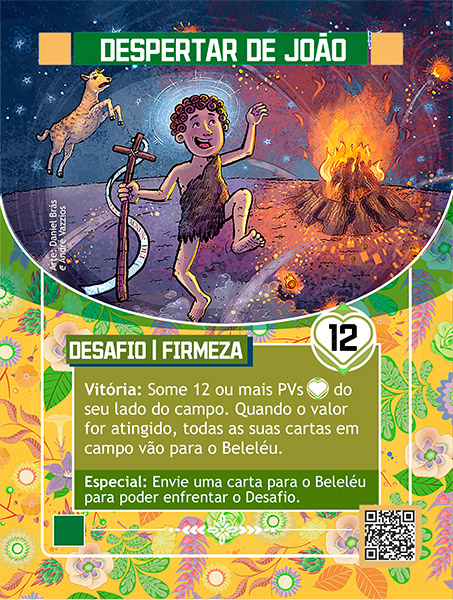
Saint John Stirs
Challenge / Endurance
If Saint John knew today was his feast day, he’d celebrate till the whole world went up in flames! Get a handle on the fireworks while there’s still time.
Win · Have at least 12 HP on your side of the field. Once you reach the target, send all cards on your field to the Beleléu (your discard pile). Effect · To face this Challenge, send one card to the Beleléu.
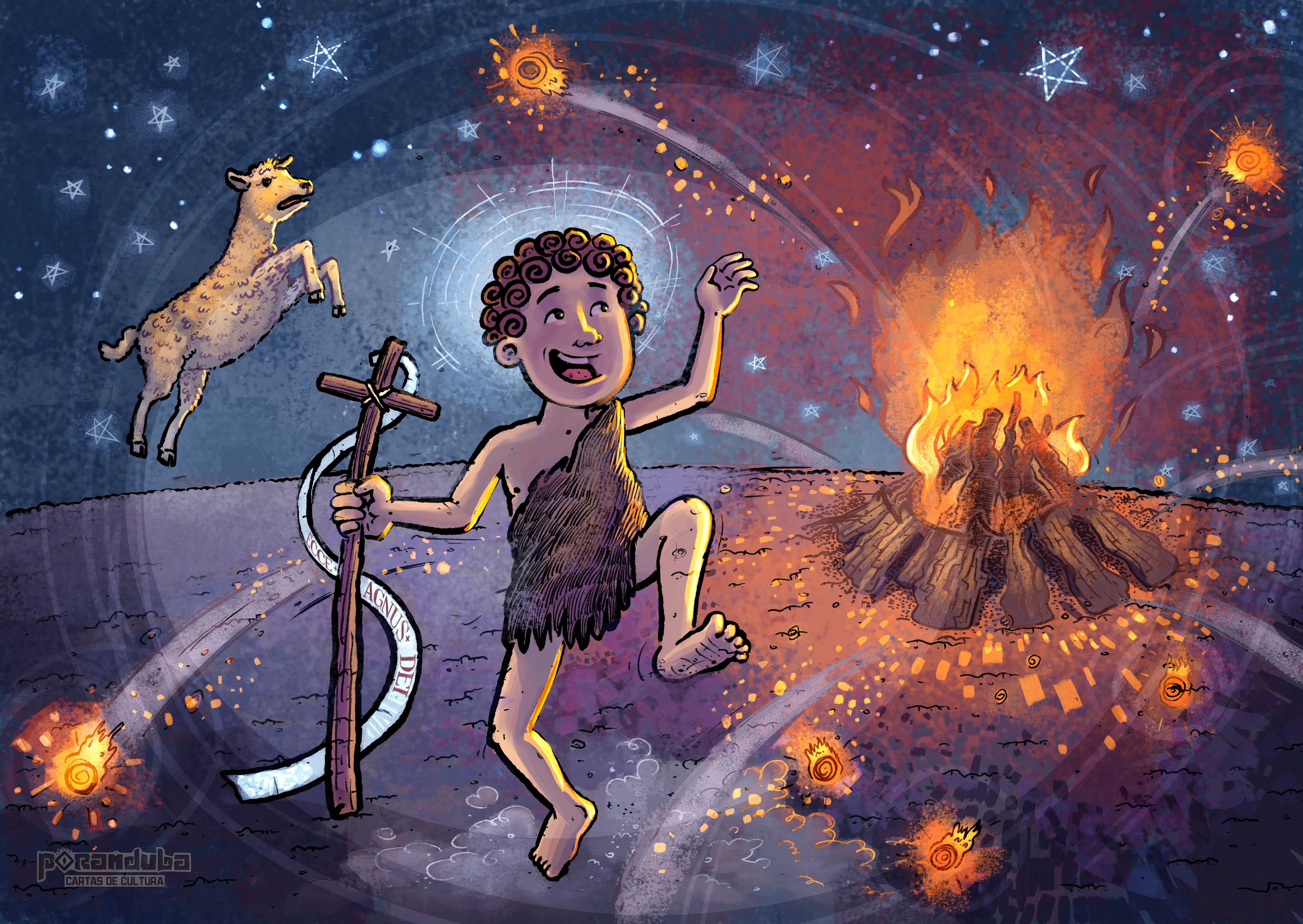
Download the high-resolution artwork
References
- CASCUDO, Luís da Câmara. Dicionário do Folclore Brasileiro. São Paulo: Global, 2002.
- SIMAS, Luiz Antônio. Santo de casa: fé, crenças e festas de cada dia. Rio de Janeiro: Bazar do Tempo, 2022.
- VARAZZE, Jacopo de. Legenda Áurea. Vidas de Santos. São Paulo: Companhia das Letras, 2003.