

Illustration by Bruno Brunelli
Saint Barbara’s Sword
Folklore and history
Supreme knight, dwells within the moon. His divine banner, mantle of the pure Virgin.
Plants and protection
The Sword of Saint George, or Sword of Ogum, is a plant practically ubiquitous in Brazilian homes. Magical, with it, you can cut away everything that is bad in your life: envy, evil eye, or even a poorly done living room decoration. When well cared for, in addition to letting good energies flow in the house, the plant rewards you with a beautiful flower.
Its scientific name has recently changed. All plants in its family that were considered Sansevieria now belong to the genus Dracaena. The traditional Sword, green and striped, is Dracaena zeylanica. When it has a yellow border on its leaves, it is Dracaena trifasciata, the Sword of Saint Barbara or of Iansã. There is also a third type, the Sansevieria (Dracaena angolensis), which is cylindrical and pointed.
Invariably, they all end up being treated as the same plant, due to the reference to George, but there are peculiarities. The Sword of Saint Barbara acts as protection against lightning, thunder, storms, and bad weather. The Sword of Saint George, on the other hand, is frequently associated with protection against the evil eye. This evil eye, envy, or curse, has physical consequences in popular culture. In addition to attracting bad luck, the person may become feverish, affected by an illness with no apparent cause.
Ogum and Saint George
The plant is of African origin and was introduced to Brazil during colonization. Its shape, which resembles a blade, symbolically refers to Ogum, who, as Marlúcia Rocha points out, is the deity who owns weapons, lord of armies, protector of the roads. He forges iron and transforms it into an instrument of struggle. "It is the representation of the repressed enslaved person, separated and isolated from their land."
Ogum, due to his warrior aspect, is syncretized with George of Cappadocia. His hagiography, in popular tradition, says that he was a fatherless boy who was taken to Palestine, where he served as a soldier in the court of Emperor Diocletian. The leader of the State was responsible for the last official persecution of Christianity by Rome. George is said to have prostrated himself against it and converted to Christianity. On April 23, 303, the emperor is said to have decreed his death.
The knight and the dragon
The devotion we have to George is a Portuguese inheritance, which, in turn, was received from the English – who had him as their patron saint. One of the best-known stories is that of his fight against a dragon. It is said that, to appease the beast's hunger, the inhabitants of a region offered two sheep, which it devoured whole. Once, the monster became more demanding and asked for the king's daughter as a sacrifice. Jorge interceded and defeated the creature.
Wounded, the dragon sought refuge on the Moon. Jorge pursued it with his horse, and the craters we see on the Earth's satellite are the marks of the steed's hooves.

Saint Barbara’s Sword
Lore
“At the first rumble of thunder, Grandma pulled the flowerpot closer to the door.”
Barrier · Protection
When one of your cards would be sent to the Beleléu (your discard pile), send this card instead. If a Challenge causes the loss, replace the card with the fewest HP.
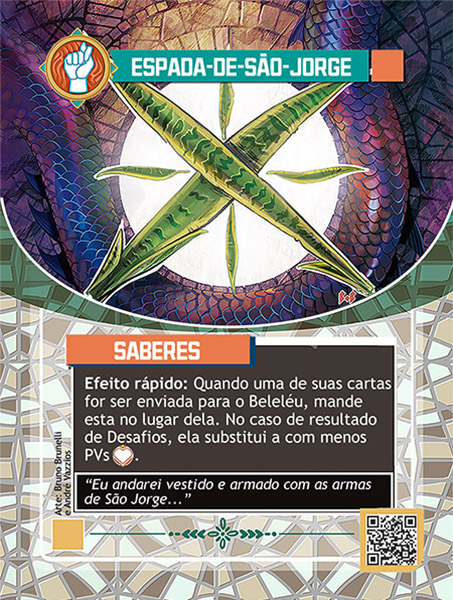
Download the high-resolution artwork

References
- BORGES, Adão. Usos, significados e conservação da planta Espada-de-São-Jorge na comunidade quilombola Benevides/PA. Revista Relegens Thrésketa, v. 9, n. 2, p. 270–283, 2020. (revistas.ufpr.br)
- CASCUDO, Luís da Câmara. Dicionário do Folclore Brasileiro. São Paulo: Global, 2002.
- ROCHA, Marlúcia Mendes da. Ogum. Revista KÀWÉ, n. 2, 2001, p. 14–16. (www.uesc.br)