

Illustration by Hugo Canuto
Saci Pererê
Folklore and history
“Pererê” is a word derived from the Tupi word “perereg”, meaning “that which jumps”. It is the same root that forms “perereca”. However, as nothing in the imagination has a single origin, “Pererê” is also an onomatopoeia of a bird's song. Since oral tradition has no fixed record, whoever hears the bird sing transcribes it in the way they understood it. Therefore, we have other names: Saci-Sererê, Taperê, Taterê, Tererê and so on.
Records and encounters between cultures
The first written records of Saci were made in the 1850s, published in the newspaper Correio Paulistano. In the article, it was already mentioned as belonging to a “tradition of grandmothers”. With this, we can trace the emergence of this apparition to near the end of the 18th century. This means that, unlike myths of indigenous origin such as Curupira or Boitatá, Saci was not spoken of in Brazil during the first 300 years after the arrival of the Portuguese in 1500.
We can therefore understand that the belief in Saci arises with the colonial imagination, in which each people shared some of the characteristics that today make Saci so well known. From the indigenous people, it inherits the dominion over the forests, the secrets of herbs and teas. From the blacks, it borrows the pipe of the old blacks, the whistle of Exu, and, from the orixás Ossain and Aroni, it receives the color of the skin, the single leg and, again, the reinforcement of the powers of the forests. Finally, from the Portuguese goblins, it receives the red cap as an object of power – something frequent among gnomes, goblins and other European apparitions. It is through Portuguese folklore that the Saci enters homes, making things disappear, spoiling food, and tying knots in everything that gets tangled up.
It is worth remembering that the Saci has nothing to do with demons, devils, or their variations; the records from the 19th and early 20th centuries that mention it in this way are interpretations from a time when racism demonized all elements of Black culture, relating everything concerning their skin, habits, hair, and beliefs as monstrous. A proper understanding would be to think of it as a goblin. A being capable of helping and tormenting, simply by falling into its favor.
Names and other apparitions
There are several possible origins for its name. One possibility is the onomatopoeia of the song of two birds; the Pavonino Fish-Frito (Dromococcyx pavoninus) and the Tapera Naevia, a bird that receives several names throughout Brazil: Matinta Pereira, Sem-Fim, and, of course, Saci.
Another possibility is the derivation of Yasy Yateré, a two-legged apparition of the Guarani people, whose first accounts also date back to the 19th century. Despite the similarity in name, the two myths are quite different. “Yasy Yateré” means something like “fragment of the moon,” and this influences its appearance. It is usually described as white, blond, and carrying a golden staff, which is its object of power.
Yasy has dominion over honey and is also the protector of siestas. It is said that he often kidnaps children who go out to play away from their parents while they sleep. Another interesting detail is that, being the son of the moon, he also inherits the influence that it has over the female body. He is capable of driving people mad, especially women, thanks to his ability.
What often happens, especially in border regions, is that the imaginary, as well as the culture, mixes beyond the borders. Yasy, Saci, and other border sprites, such as Pombero or Pomberito, exchange aspects of their narratives, forming unique versions for each storyteller. That is why, sometimes, we will find stories of Sacis that are so different, but with familiar elements.
To appease the Saci, as well as the other elves of the region, the custom is standard: offerings of tobacco, cachaça, honey, or cornmeal mush. To ward them off: blessed objects, rosaries, and garlic are the most frequent option.
Monteiro Lobato and the Saci
When talking about Saci, it is impossible not to remember Monteiro Lobato. The writer (1882-1948) incorporated the Saci into only one of the stories in his most famous series of children's books; the Yellow Woodpecker Farm. However, the character was so successful that, in the very first adaptations for audiovisual media, he became a co-protagonist – helping Dona Benta's grandchildren in their adventures through the magical lands of the Brazilian countryside.
The author's interest in the Saci dates back years before the publication of the first story of the Sítio, released in 1921. As early as 1917, Lobato published in the pages of the newspaper O Estado de SP the so-called "Inquiry about the Saci". In it, he asked readers to answer a set of questions by letter, with the aim of tracing the presence of the Saci in the Brazilian imagination. More than 70 letters were received, composing a very rich panorama of what is, to this day, one of the most famous myths in the country.

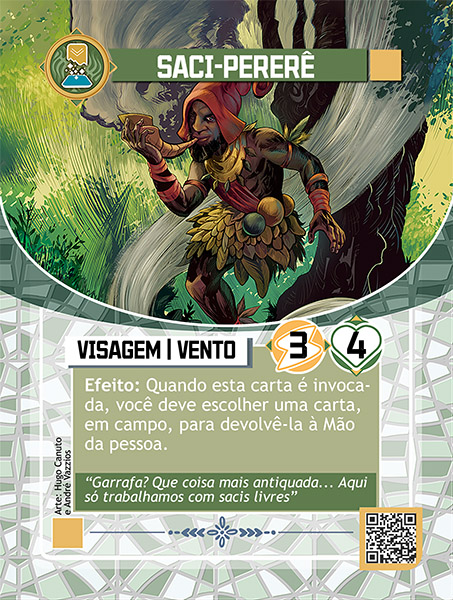
Saci Pererê
Strength: 3
Health: 4
Wonders / Wind
“A bottle? How old-fashioned… Around here, we only work with free sacis.”
Master of the Whistle · Return
When you summon this card, choose a card on the field and return it to its owner’s hand.
Download the high-resolution artwork

References
- AMBROSETTI, Juan B. Materiales para el estudio del folk-lore misionero. Revista del Jardin Zoologico, 1894.
- COSTA, Andriolli. Saci centenário: uma análise mitocrítica de Saci Pererê – resultado de um inquérito. Revista Boitatá, v. 16, n. 31, p. 26–36, 2021. (ojs.uel.br)
- LOBATO, Monteiro. O Saci-Pererê – Resultado de um inquérito. São Paulo: Globo, 2008.
- LOBATO, Monteiro. O Saci. São Paulo: Brasiliense, 2005.
- QUEIROZ, Renato. Migração e metamorfose de um mito brasileiro: o saci, trickster da cultura caipira. Revista do Instituto de Estudos Brasileiros. SP, n. 38, p. 141–148, 1995.
- QUEIROZ, Renato. O herói-trapaceiro. Reflexões sobre a figura do trickster. Tempo Social – Revista de Sociologia da USP, SP, v. 3, n. 1, p. 93–107, 1991.
- QUEIROZ, Renato. Um mito bem brasileiro: estudo antropológico sobre o Saci. São Paulo: Polis, 1987.
- TRADIÇÕES populares de Minas e S. Paulo. Correio Paulistano, São Paulo, 22 set. 1859, p. 2–3. (memoria.bn.br)