
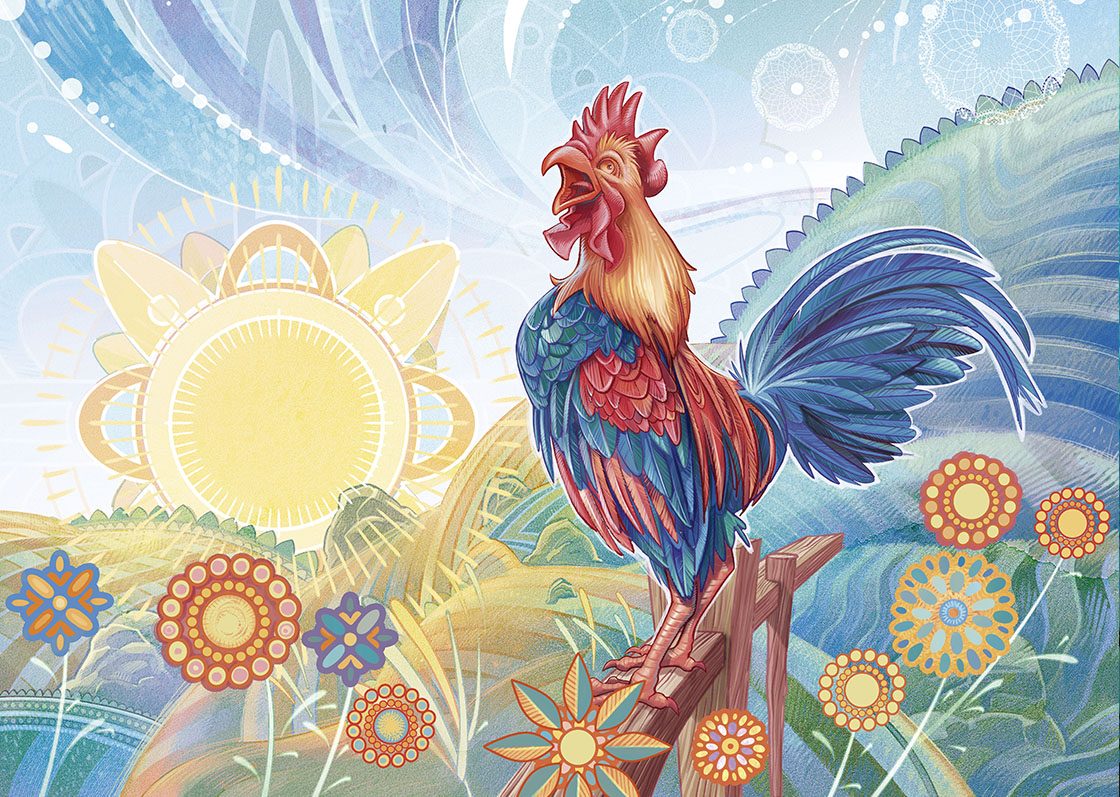
Illustration by André Vazzios
Rooster’s Crow
Folklore and history
The rooster used to speak. When the Apostles were at the table, they affirmed that Christ was not God, and Christ replied that he was as much God as the rooster speaks; it was then that the rooster said: Crowned. And it is still his language today. – Leite de Vasconcellos, quoted by Ana Paula Guimarães (2020).
The rooster that heralds daybreak
The Rooster's Song carries with it a series of symbolisms. It is the symbol of the birth of a new day, of renewed hope. It is also the resurrection, the defeat of darkness represented by the arrival of the sun that conquers the night. The apparitions run freely through the shadows, but interrupt their course when the sun arrives. Myths such as the Werewolf, the Headless Mule, and the Curacanga return to human form as soon as they hear the third crowing of the rooster.
In the story "Negrinho do Pastoreio of the Pasture," by Simões Lopes Neto, we have a powerful scene. After losing his herd of horses, the boy asks Our Lady of Aparecida for help. He then takes a candle from his godmother's oratory and walks through the dark night. With each drop of wax on the ground, a new light is born, which illuminates everything. Thus, even the roosters began to crow, thinking that the sun had risen earlier.
Animals in popular Catholicism
Stories involving animals with Jesus' family are very frequent in popular Catholicism. It is the rooster's role, for example, to announce the birth of the child on December 25th. That is when the animal, at the top of its lungs, sings, in onomatopoeia: "Christ is born! Christ is born!". This is where the expression "Midnight Mass" comes from.
The story, however, also involves other animals. The ox then asks: "Where?". The sheep immediately replies: "In Bethlehem". The pig, on the other hand, doubts: "I don't believe it, I don't believe it, I don't believe it". In other versions, cited by Câmara Cascudo, it is the turkey that retorts: "Lies, lies, lies!". That is why the pig is a disliked animal, and the turkey is eaten at Christmas.
Omens and customs
They say that when a hen starts crowing along with the rooster, it is because she is attracting death to her owners' house. On the other hand, they say that a rooster crowing at the wrong time is a sign that a girl is running away.
For a long time, it was common practice to raise these animals for fighting, the so-called "cockfights". The practice has been suppressed since the first Vargas government, in the 1930s. Today, cockfighting is prohibited by law and considered an environmental crime, punishable by two to five years in prison, in addition to a fine.
An old custom was to castrate a rooster so that it could fatten up considerably, becoming a dish for special occasions. The "capon", as it is called, was offered especially to women who had just given birth, so that they could regain their energy. Therefore, the expression "When are we going to eat the capon?" was common, to ask when the baby would be born.

Rooster’s Crow
Lore
“The rooster is always first to herald the morning light. Look closely: he wears spurs, and that makes him a knight.” — Francisca Júlia, 1912
An Early Sunrise · Return
The sun is up early. Return all Wonder cards on your opponent’s field to their hand.

Download the high-resolution artwork

References
- CAMPOS, Eduardo. Os Incomedidos Glutões – a hipérbole da culinária e outras considerações. In: CAMPOS, Eduardo. A Gramática do Paladar − antepasto de velhas receitas. Fortaleza: Editora UFC, 1996. p. 43–53. (www.eduardocampos.jor.br)
- CASCUDO, Luís da Câmara. Dicionário do Folclore Brasileiro. São Paulo: Global, 2002.
- CASCUDO, Luís da Câmara. Licantropia Sertaneja. Revista do Brasil, São Paulo, Ano VIII, n. 94, p. 129–133, out. 1923. (periodicos.ufrn.br)
- GUIMARÃES, Ana Paula. Galo – dantes e daqui em diante. Dobra, n. 6, 2020. (run.unl.pt)
- LOPES NETO, João Simões. Contos gauchescos e lendas do sul. 3. ed. Porto Alegre: Globo, 1965.