

Illustration by Rafael Limaverde
Repente Duel
Folklore and history
"Repente" is a type of sung poetry typical of the northeastern states, where it is also known as "Cantoria". Often accompanied by music, it is a demonstration of the singer's skill and improvisation, who must follow a series of metric rules that vary from region to region.
The rules of improvisation
In 2021, the National Institute of Historical and Artistic Heritage (Iphan) registered repente as Brazilian intangible heritage. Its dossier lists more than 50 types of repente, including the two best known: heptasyllabic verses and decasyllabic verses. In the first case, in addition to rhyming, it is mandatory that the tonic accent of the phrase be on the seventh syllable of the verse. In the second case, the accent is on the third, sixth and tenth syllables.
As Câmara Cascudo writes in his book "Vaqueiros e Cantadores" (Cowboys and Singers), the repentistas (improvisational poets) cannot resist the powerful suggestion of singing, of fighting, of intellectual display before the public. "They walk leagues and leagues, the viola or the rabeca (a type of fiddle) inside a dirty bag (…) ruminating on the debate, preparing questions, arranging their memory. They are knights-errant whom no Cervantes demoralized."
The researcher was not exaggerating. The singers' names became notorious, circulating by word of mouth, their fame reaching legendary levels. And when that happens, what the people look forward to most is the dispute between the greats. It is no coincidence that clashes between singers remain in popular memory more than a century later.
Battles and racial disputes
Two of the best-known disputes involved more than the rhyming skills of their singers. These were battles that also went down in history because of race. This is the case of the notorious dispute between the black man Inácio da Catingueira against Romano da Mãe d’Água in Patos, Paraíba, in the 1870s, and between Zé Pretinho dos Tucuns, a versifier from Piauí, and Cego Aderaldo, a famous repentista in Ceará in 1914.
The battle between Inácio and Romano continued to be recreated after the encounter. In Cantadores e poetas populares (1929, pp. 57–58), Francisco das Chagas Batista identifies versions written by other poets and attributed to the two adversaries. Among them, he mentions that of Leandro Gomes de Barros, published in a pamphlet in 1910. For his book, he chose a version provided by Silvino Pirauá, a disciple of Romano. The memory of the dispute was also built in these retellings.
In both cases the offenses are intense, and it doesn't take long for whites to try to use their race to belittle the other. “Black man, sing with more finesse, See your quality / I am white and I am of stature / Before society / Coming to sing with you / Low on dignity,” Romano said. Just one more of the many examples of what black singers had to face during their disputes, using their intelligence to win over an audience that was already against them.
Verses that live on
In the dispute against Cego Aderaldo, which reaches us through the cordel pamphlet written by Firmino Teixeira do Amaral, Zé Pretinho ends up losing the battle. At the end of the dispute, the singers begin to challenge each other to repeat a tongue twister in the middle of the song and Zé would not have been able to fit the classic “Quem com cara paca compra, paca cara pagará” into the rhyme.
In one version of the duel, Inácio da Catingueira pushed Romano to his limit with each new rhyme, reaching its climax when the latter tries to show his fierceness: “When Romano gets angry, / The North trembles, the South shakes…”.
As soon as the stanza ends, Inácio retorts:
"For when Inácio sings, stars fall, the earth trembles. The sun disrupts its course, the sea sways and rages. The world is surrounded by fire, and the black man fears none of this."

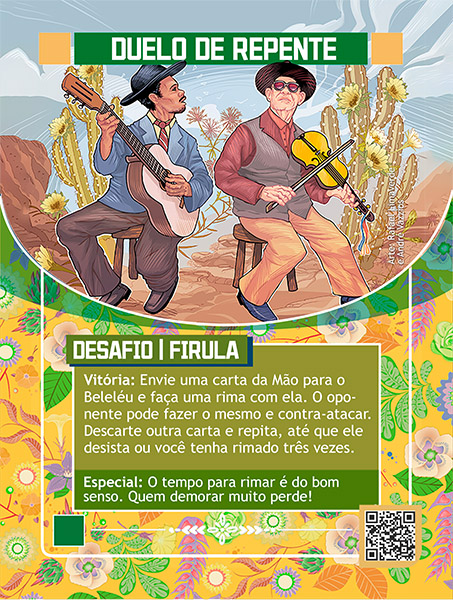
Repente Duel
Challenge / Trickery
Zé Pretinho against Cego Aderaldo? Inácio da Catingueira against Romano de Mãe d’Água? Think again! The greatest repente duel starts now!
Win · Send a card from your hand to the Beleléu (your discard pile) and make up a rhyme about it. Your opponent may do the same to answer you. Discard another card and repeat until your opponent gives up or you have rhymed three times. Special · Use your judgment about how long a rhyme should take. Take too long and you lose!
Download the high-resolution artwork

References
- AMARAL, Firmino Teixeira do. Peleja do cego Aderaldo com Zé Pretinho. Juazeiro do Norte: Filhos de José Bernardo da Silva, 1974. 16 p. (rubi.casaruibarbosa.gov.br)
- ANDRADE, Mário de. Aspectos do folclore brasileiro. São Paulo: Global, 2019.
- BAPTISTA, Francisco das Chagas. Cantadores e poetas populares. Parahyba: F. C. Baptista Irmão, 1929. (digital.bbm.usp.br)
- CASCUDO, Luís da Câmara. Vaqueiros e Cantadores. São Paulo: Global, 2005.
- INSTITUTO DO PATRIMÔNIO HISTÓRICO E ARTÍSTICO NACIONAL; UNIVERSIDADE DE BRASÍLIA. Dossiê de registro do repente: fundamentação do processo de registro do repente como patrimônio cultural imaterial do Brasil. Coordenação e redação final: João Miguel Manzolillo Sautchuk. Brasília, DF: Iphan; UnB, set. 2020. (bcr.iphan.gov.br)