

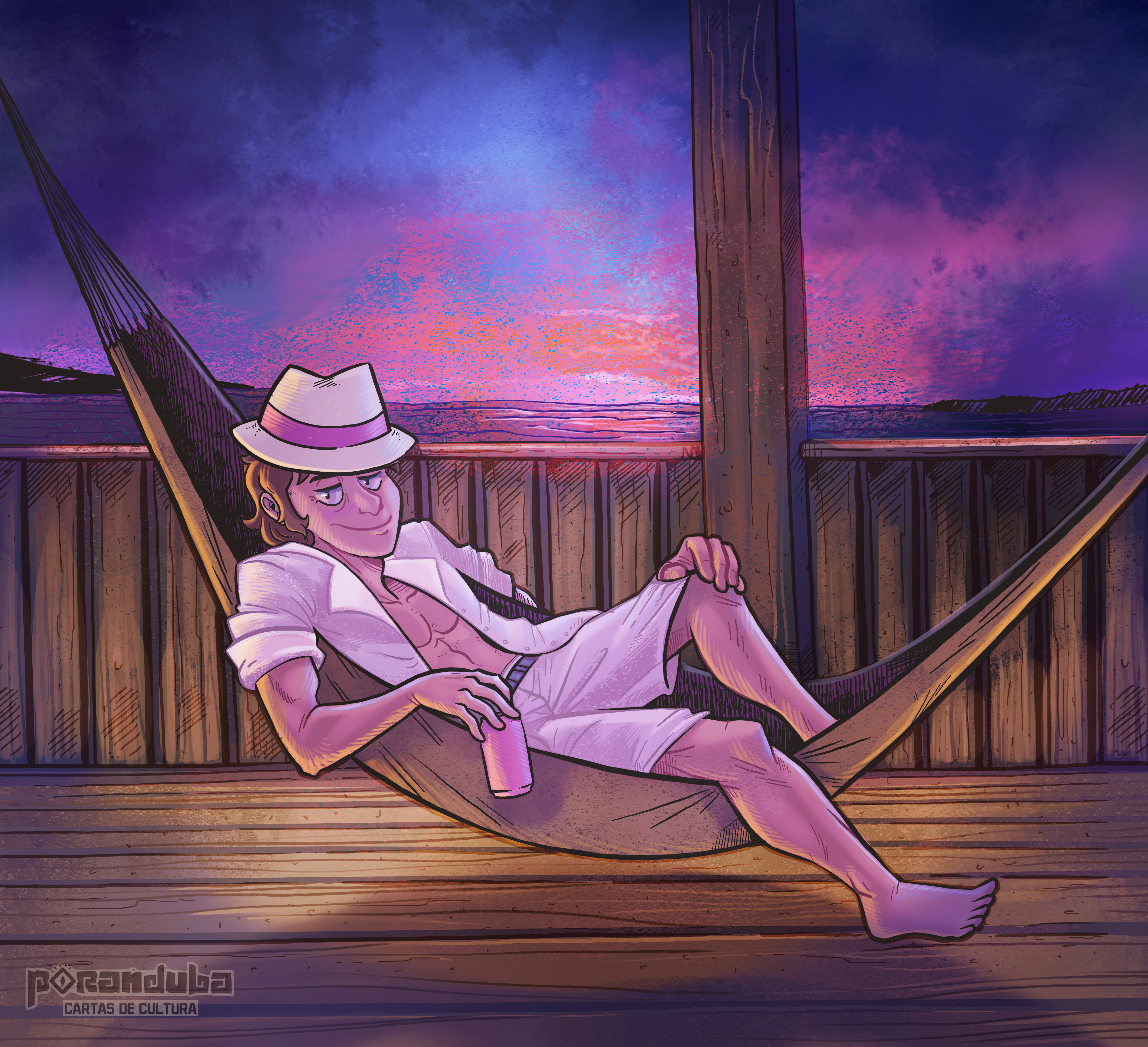
Illustration by Nilberto Jorge
Pink River Dolphin
Folklore and history
“[…] there was even a case around here of a married woman getting pregnant by a boto. And to top it off, she went to the registry office to register the child with the father's name, the Boto, but Seu Raimundo, the registry office official, didn't register it because he said he needed the father's presence” – Testimony of Vanderval dos Santos, in the book “Cultura cabocla-ribeirinha”, by Therezinha Fraxe, 2004
The transformations of the Boto
The myth of the seductive Boto is probably one of the best known in Brazilian popular culture. Yet, from a historical perspective, it is not one of the oldest. When we follow the notes of chroniclers from Colonial Brazil, we notice that the first mentions of a boto capable of assuming human features date only from the beginning of the 19th century. The animal, however, had long inspired other narratives among indigenous peoples. Still, the one you probably know best has been circulating in our country for just over 200 years.
At that time, when the narrative we know was still being established, the animal's human form itself was still uncertain. In the records of the English naturalist and explorer Henry Walter Bates, for example, it was said that the Boto turned into a beautiful woman, who trapped men between her legs and then drowned them at the bottom of the river.
The Man in the Hat
Nowadays, the best-known story is that the Amazon River Dolphin (scientific name: Inia geoffrensis) takes the form of a man. Yes, Red is how it is known in riverside communities. Pink River Dolphin, it is often said, is the media name the animal received after TV programs turned their attention to the Amazon. And, about Red, there are several versions regarding his appearance, but, normally, he is described as a white man, with light and elegant clothes – accompanied by a hat that he never takes off his head.
The accessory masks the only detail of his anatomy that he cannot hide: the blowhole. This is the name of that respirator on top of the head that every dolphin, whale and, of course, river dolphin has. This is what reveals his true animal nature. In some versions, each of the Boto's clothing items is made from a river fish, transformed by his illusory powers. The hat is a stingray, the shoes are catfish, and so on. When the enchanted being happens to die on dry land, the animal form soon takes over, revealing the true origin of all.
The Boto being described as a white man has a reason. He is the representation, in the imagination, of the foreigner; of the person who comes from outside the community, with beautiful clothes and sweet words. It is there, however, that the danger lies. After all, after seducing his object of interest and getting what he wants, the Boto disappears without looking back. It is no coincidence that the figures of the Boto's children are notorious: fatherless children, metaphors for abandonment.
As popular imagination is traversed by variations, it is possible to find some versions of dolphins that transform into women, and others that equally seduce men and women and take them to their land, at the bottom of the waters. It is yet another intersection with the myth of Iara and Mãe-d’Água.
Interpretations of the myth
Recently, there have been some hasty interpretations that the myth of the Boto was invented to conceal situations of child abuse in riverside communities. Regarding this, caution is needed. It is possible that, in some situation, this really happened, but the myth precedes its distortions – and not the other way around. If it were just a matter of inventing a culprit, why the Boto? Why specifically the Boto?
Consider, for example: since Antiquity, dolphins have been considered animals linked to Aphrodite, the goddess of love. Why? And how does this relate to our amorous dolphins? The imagination constructs this explanation that unites observation of nature, biology, and imagination. Researchers point to two things: the first is its long body, with a rounded head and a blowhole right on top, from where it ejects water in a suggestive way. The second is the movement the animal makes, going up and down, reminiscent of sexual rhythm.
Professor Jesus Paes Loureiro tells a story of indigenous origin, but unfortunately does not specify which ethnic group it belonged to. In the story, the first boto would be the son of a Tapuia* indigenous woman and a tapir. That is why the Boto's sexual organ is so virile and still used today in spells and charms.
*Tapuia was a term used to refer to indigenous people who did not speak Old Tupi. It does not refer to a specific people.

Pink River Dolphin
Strength: 2
Health: 3
Wonders / Water
“It was the boto, ma’am. It was the boto, sir. He came a-courting and went away with her…”
Charm · Enchantment
When you summon this card, call heads or tails and flip the coin. If you call it correctly, take control of one of your opponent’s Folk cards until the current Challenge is won.

Download the high-resolution artwork
References
- BATES, Henry Walter. The naturalist on the river Amazons. 2. ed. London: John Murray, 1864. (books.google.com)
- CARVALHO, José. O matuto cearense e o caboclo do Pará. Belém: Officinas Graphicas, 1930.
- CASCUDO, Luís da Câmara. Dicionário do Folclore Brasileiro. São Paulo: Global, 2012.
- FARES, Josse. O boto, um dândi das águas amazônicas. Moara, Belém, n. 5, p. 47–63, 1996. DOI: 10.18542/moara.v0i5.2866. (www.periodicos.ufpa.br)
- FRAXE, Therezinha de Jesus. Cultura cabocla-ribeirinha: mitos, lendas e transculturalidade. São Paulo: Annablume, 2004.
- LOUREIRO, João de Jesus Paes. Cultura amazônica: uma poética do imaginário. 4. ed. Belém: Cultural Brasil, 2015.
- SIMÕES, Maria do Socorro; GOLDER, Christophe. Belém conta. Belém: UFPA, 1995a.
- SIMÕES, Maria do Socorro; GOLDER, Christophe. Santarém conta. Belém: UFPA, 1995b.