
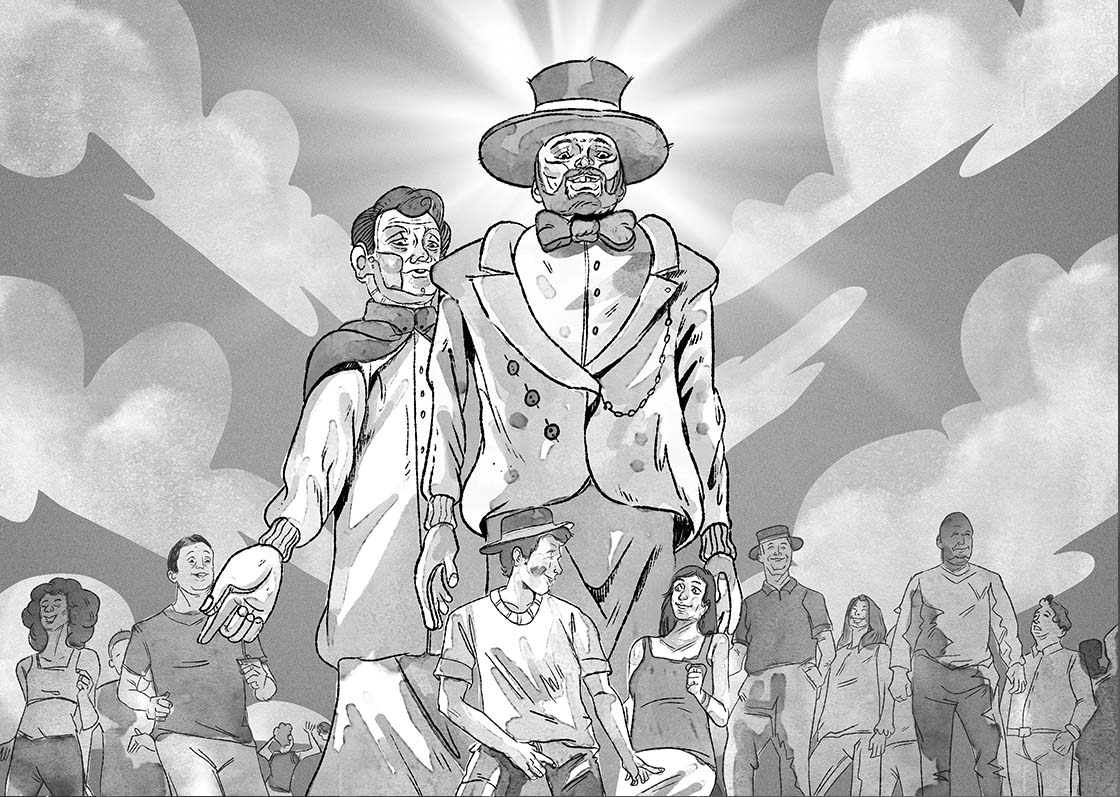
Illustration by Doug Retícolo
Olinda Giant Puppet
Folklore and history
Olinda’s famous Carnival giants are huge, brightly coloured puppets. They can portray a familiar local figure, a celebrity or someone from history or fiction. Today they average four metres in height and weigh about twenty kilograms.
Olinda is famous for its giant puppets, but oversized figures, including figures with giant heads, appear around the world. The tradition reached Brazil through Portugal, where gigantones are recorded as early as the thirteenth century, particularly at Corpus Christi and other religious festivals.
In Pernambuco, the first recorded giant doll was built in 1919 in the city of Belém do São Francisco. Guimercindo Pires created the doll, named Zé Pereira, inspired by the Belgian priest Norberto Phallampin. The priest used giant dolls to attract the attention of the faithful and thus convert more of them to Christianity.
For many years, makers built the puppets with wooden bodies and papier-mâché heads. Today fibreglass is the most widely used material.
Olinda’s own tradition began in February 1932 with an unmistakable figure: a broad smile, gold teeth, a sharply defined goatee, tailcoat, tie and top hat. O Homem da Meia-Noite, the Midnight Man, became a symbol of Carnival in Olinda. In 2006 Pernambuco recognized him as part of the state’s intangible cultural heritage.
The founders had broken away from another Carnival group in the city. Their inspiration was The Midnight Man, an eighteen-part film serial directed by James W. Horne. It premiered in the United States in 1919 and reached Brazilian cinemas from 1927.
After the pioneering doll, the other members of his family were created: the Midday Woman and the Afternoon Boy. The artist Silvio Botelho, creator of “Menino”, is considered one of those largely responsible for popularizing the game, creating the parade of dolls that became a staple of every Shrove Tuesday.
Adolpho Alves da Silva now leads the Clube Carnavalesco de Alegoria e Crítica O Homem da Meia-Noite. His father, Tárcio Botelho e Silva, helped found the tradition. For the family, the Midnight Man is a calunga, an ancestral figure whose meaning is bound up with Candomblé. Like the calunga carried by the dama do paço in maracatu, he protects the people who go out with him.

References
- PERNAMBUCO. Secretaria de Cultura e Fundarpe. Homem da Meia-Noite. [s. d.]. Disponível em: https://www.cultura.pe.gov.br/pagina/patrimonio-cultural/imaterial/patrimonios-vivos/homem-da-meia-noite/. Acesso em: 10 nov. 2026.