
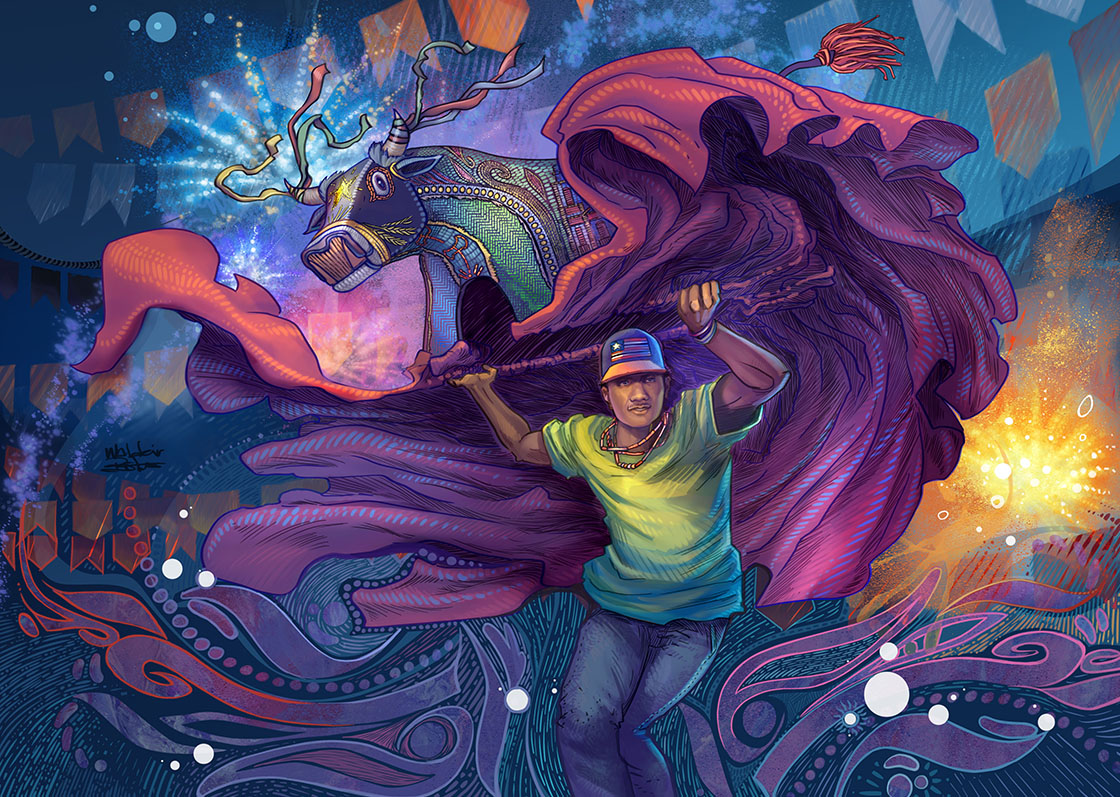
Illustration by Waldeir Brito
Miolo do Boi
Folklore and history
Miolo de Boi
The ox is dead. Its absence from the daily life of the community reaches its peak during Lent. During these forty days of seclusion, there is no singing, no dancing, no laughing. It is respect for the suffering of Jesus, who faces the temptations of the flesh in the desert. The fasting is mirrored, as are the consternation and the silence. But death is not the end, it is the interval until the beginning again.
The cycle of the festival
The cycle of the ox in Maranhão usually resumes on Holy Saturday, with the first rehearsals. Bumba, my ox! The master gathers the community. These are meetings where they talk about the ox, but also about themselves. The songs are chosen, the preparations are arranged, and the playmates reunite. It is the festival that returns and, along with it, life.
The rehearsals continue until June. On the eve of Saint John's Day, June 23rd, many groups perform the baptism of the ox. The ritual marks the saint's permission for the animal to go out and perform. Then begins the most intense period of the presentations, with music, dance, and devotion throughout the festival grounds.
The drums are tuned over the bonfire of Saint John. The ox's brains, which give life to the ox-puppet, become even more agitated, moving a retinue of characters. People, animals, and animal-people. The guests at this festival vary from place to place, but the structure is repeated. It is an encounter of Brazil. Blacks, indigenous people, and whites; animals, monsters, and even the dead. Everyone has a place in this festival that, year after year, resumes a cycle of life, death, and rebirth.
This is Bumba Meu Boi, the most “strange, original, and complex” of Brazilian dramatic dances, as Mário de Andrade said. A survey by Iphan in 2009, cited by Aline Ferreira Paes (2014, p. 12), identified more than 430 groups in 79 municipalities in Maranhão. Divided, in some way, into at least five “accents,” which are styles of celebrating and singing about the ox: island accent, lowland (or Pindaré) accent, hand-back accent, bass drum accent (or Guimarães accent), and orchestra accent.
Who gives life to the ox
“Miolo” is the name of the performer who enters the ox's frame and gives it movement. It is his body that makes the animal dance, charge against the cowboy, and escape his attempts at capture. Underneath the embroidered leather, a fabric skirt hides his legs. In the eyes of those who follow the celebration, the ox comes to life.
In Maranhão, this performer can also be called “tripa,” “alma,” “fato,” or “espírito.” The names say a lot about his function: he is the one who animates the ox. For some, taking on this role is also a way of fulfilling a promise.
A major highlight of the Maranhão festival is the "ox hide," the richly decorated fabric that goes over the capoeira or carcass (the frame of the piece). The decorations that adorn it are made of colorful beads, forming varied designs – often in homage to saints and other devotional themes.
The Farewell
June is the peak of the festival, but the ox cycle extends over other months. In the plays, the stories enacted by the performers, the death and resurrection of the animal are part of the plot. The death festival has another place on the calendar: it marks the end of each group's season. In Maranhão, these rituals take place between July and December.
It's time to say goodbye. In the tradition linked to Saint John, the saint asks for his ox back. The animal resists: it runs away, hides, confronts the cowboy who tries to lasso it and lead it to the post. The community accompanies the farewell with their songs. Afterward, the ox rests until it's time to play again. Death is the interval until the beginning.

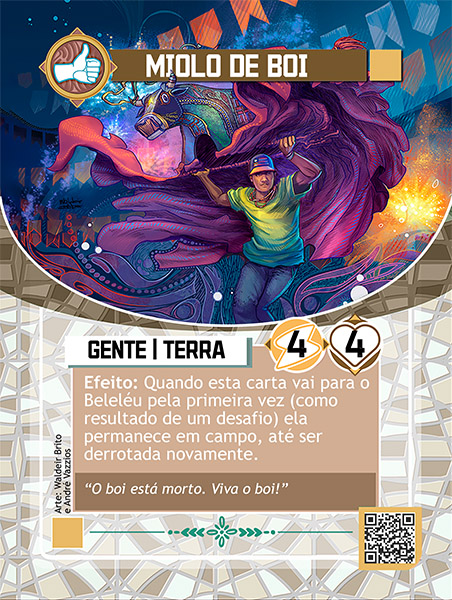
Miolo do Boi
Strength: 4
Health: 4
Folk / Earth
“The ox is dead. Long live the ox!”
The Ox Is Back! · Persistence
The first time a Challenge would send this card to the Beleléu (your discard pile), it stays on the field. It can be defeated again.
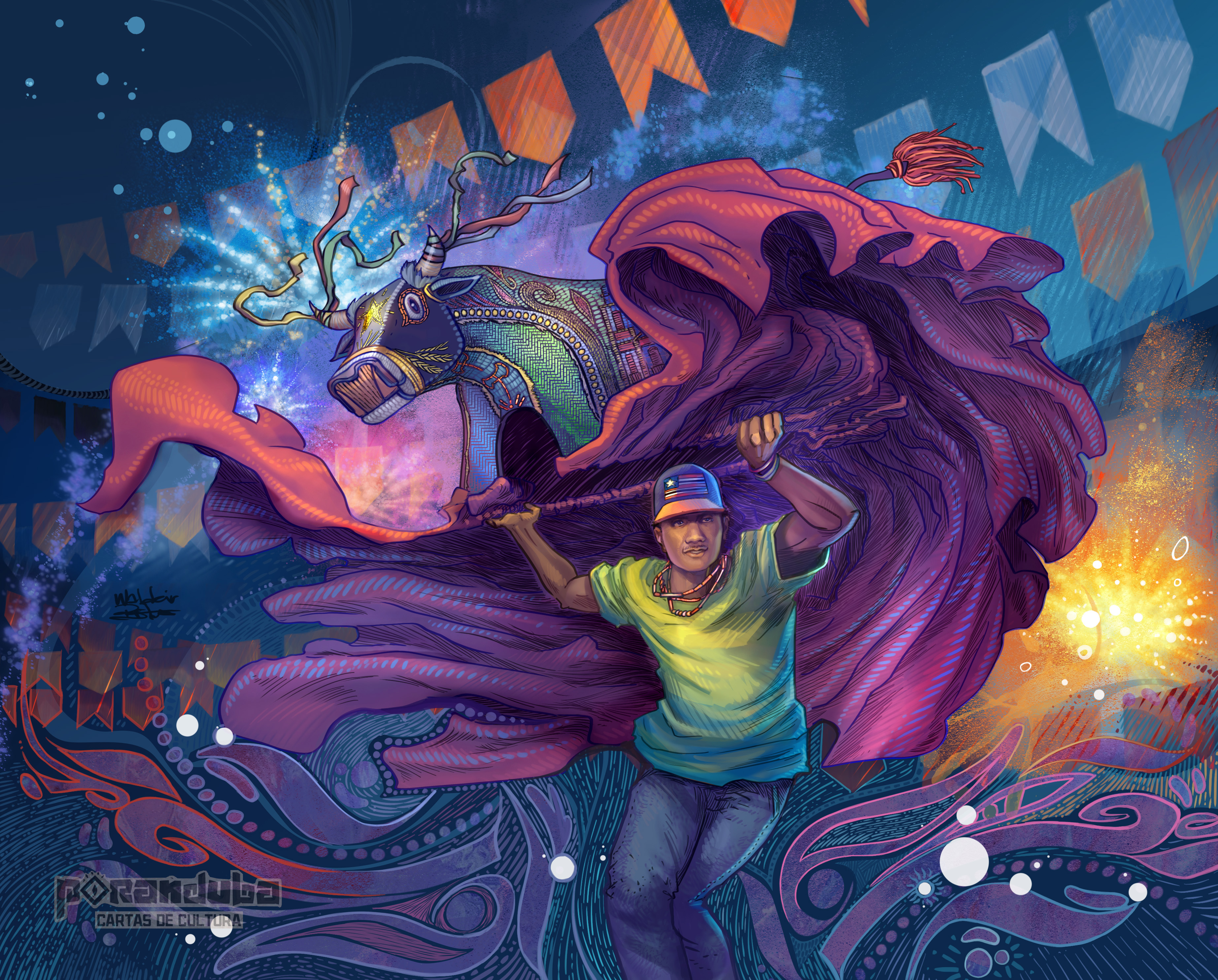
Download the high-resolution artwork
References
- ANDRADE, Mário de. As danças dramáticas do Brasil. São Paulo: Itatiaia/Instituto Nacional do Livro/Fundação Pró-Memória, 1982.
- CAVALCANTI, Maria Laura Viveiros de Castro. O Boi em dois tempos. O Bumba-meu-boi em Mário de Andrade e o Bumbá de Parintins na Amazónia hoje. Todas as Artes. Revista Lusobrasileira de Artes e Cultura, n. 1, v. 1, 2018, p. 112–129.
- INSTITUTO DO PATRIMÔNIO HISTÓRICO E ARTÍSTICO NACIONAL. Complexo Cultural do Bumba-meu-boi do Maranhão: dossiê do registro. São Luís: Iphan, 2011. (bcr.iphan.gov.br)
- PAES, Aline Ferreira. Um bumba-boi carioca: memória e identidade maranhense em Parada de Lucas – Rio de Janeiro. 2014. Trabalho de Conclusão de Curso (Graduação em Produção Cultural) – Universidade Federal Fluminense, Niterói, 2014. p. 12. (procult.sites.uff.br)