
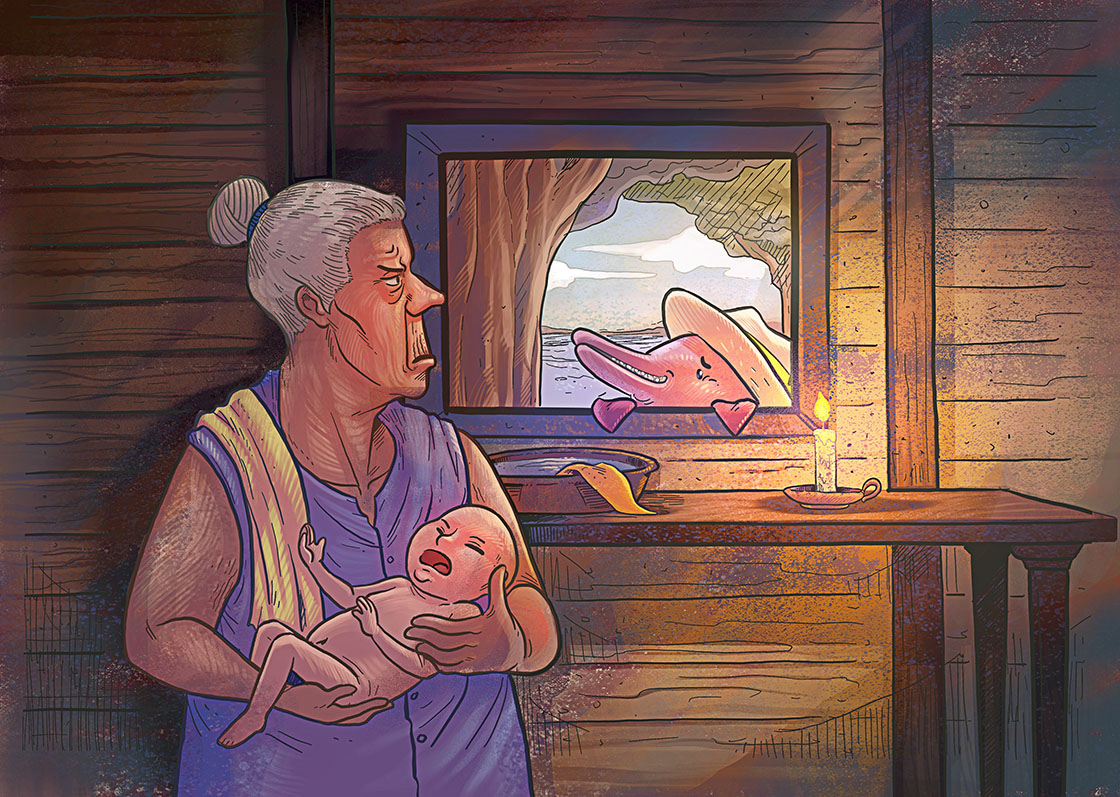
Illustration by Nilberto Jorge
Midwife
Folklore and history
Hands calloused by work could not be more gentle when it comes to bringing a new life into the world. This is the work of midwives, who cradle, with songs, prayers, herbs, and precise hand movements, the birth of the child. Every detail of the popular prenatal care is accompanied with attention and affection by this master of traditional knowledge; fundamental, especially for women in places where public health is deficient.
Customs and narratives about childbirth
Among the customs related to childbirth, we find the use of opossum (or possum) skin to line the bed and the animal's fat on the woman's belly. These practices are attributed with the power to alleviate the mother's suffering. The custom refers to a popular Christian tale from the cycle of the flight to Egypt. In it, it is said that, while escaping from Herod's soldiers, Joseph and Mary became so stressed that the milk of Jesus' mother dried up.
Desperate, seeing her son hungry, she asked the animals of the earth for help. The only one that approached was the female opossum, who let the baby Jesus feed on her milk. In gratitude, Mary blessed her so that her offspring would never suffer the pains of childbirth. The use of opossum fat in childbirth today is a superstition: an action in the physical world that seeks a magical effect.
Body care
In addition to assisting with childbirth, another of the midwife's tasks is to provide guidance on the female body, both in terms of menstrual cycles and the postpartum period. Midwife Zenaide de Souza Carvalho, in Acre, for example, has a project in which she teaches how to make homemade sanitary pads. The goal is to combat so-called "menstrual poverty," offering more dignity to these people. (g1.globo.com)
Traditionally, it is said that the menstruating body is open to bad influences. Hence the precautions of not stepping over garbage or animal remains. Fear also involves the surrounding beings: in the Amazon, it is said that the Pink River Dolphin is attracted by the smell of menstruating women and is capable of impregnating them with just a glance. Another animal that is said to cause pregnancy is the taturana caterpillar, which is attracted to urine with blood and ends up causing the woman's death, with a belly full of caterpillars.
Prayers, remedies, and folk remedies are also part of popular care for menstrual cramps. One of these folk remedies consists of placing two coriander leaves (Eryngium foetidum) in a cross shape under the woman's sheet. The next day, the leaves are removed and thrown away. According to the logic of the remedy, the cramps will go away with them.
Postpartum care and knowledge
In the postpartum period, one of the great complaints of women is about the presence of the Mother of the Body or Owner of the Body, which is what the entity that was taking care of the baby in the woman's womb is called. After the baby is born, she continues to look for the child, generating movements in the belly. This is one of the traditional explanations for the organs that return to their original positions after birth.
In Piratini, Rio Grande do Sul, midwife Cecília dos Santos performed the ritual of “closing the bones” after birth. In an interview with Eduarda Borges da Silva (2015, p. 117), she recounted that she laid the woman on her side and pressed her body. In the midwife's understanding, the bones opened for the child to be born and needed to return to their place.
Midwives and health care
The knowledge of midwives can work in conjunction with medicine and science. In the manual Effective Perinatal Care, published in 2010, the European office of the World Health Organization (WHO) estimates that 85% of births proceed normally and require support and observation, rather than medical interventions. This presupposes monitoring and the ability to recognize complications. Attention, guidance, and affection make a difference, especially in communities where access to basic services is difficult.
Midwives also need to recognize when to refer the woman in labor for medical attention. Complications require evaluation, and a cesarean section may be necessary when clinically indicated. In Brazil, the percentage of cesarean sections reached 60.6% of live births in 2024, according to preliminary data from Sinasc presented in the 2026 Annual Socioeconomic Report on Women.

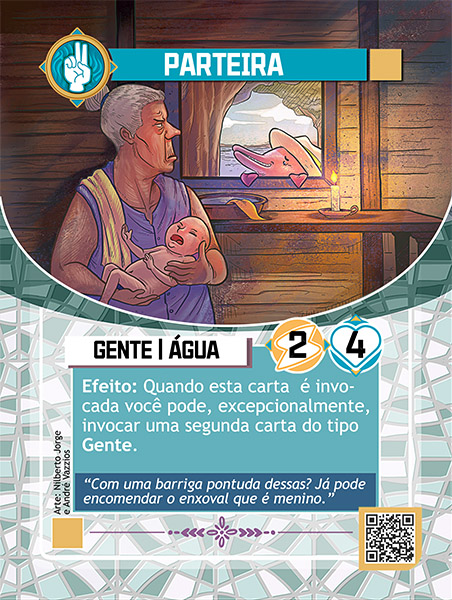
Midwife
Strength: 2
Health: 4
Folk / Water
“With a belly that pointy? Go ahead and order the baby clothes. It’s a boy for sure.”
New Life · Double Play
When you summon this card, you may summon a second Folk card.
Download the high-resolution artwork

References
- BRASIL. Ministério das Mulheres. Relatório Anual Socioeconômico da Mulher: RASEAM 2026. Brasília, DF: Ministério das Mulheres, 2026. p. 98. (www.gov.br)
- CASCUDO, Luís da Câmara. Dicionário do Folclore Brasileiro. São Paulo: Global, 2012.
- EM PROJETO, parteira ensina outras mulheres a confeccionarem absorventes ecológicos em Rio Branco. G1 Acre, 2 maio 2023. (g1.globo.com)
- LEWINSOHN, Ilana. Jaçanã − causos e a vida de uma pajé pataxó. São Paulo: Baraúna, 2016.
- ORGANIZAÇÃO PAN-AMERICANA DA SAÚDE. OMS lança nova recomendação sobre intervenções não clínicas para reduzir número de cesarianas desnecessárias. 11 out. 2018. (www.paho.org)
- SILVA, Eduarda Borges da. Parteiras pampeanas e seus saberes de ofício: deslivrar placentas, queimar umbigos e fechar corpos. In: GILL, Lorena Almeida; SCHEER, Micaele Irene (org.). À beira da extinção: memórias de trabalhadores cujos ofícios estão em vias de desaparecer. Pelotas: Editora da UFPel, 2015. p. 113–124. (www.researchgate.net)
- SILVA, Eduarda. Partejar e narrar: o ofício de parteira ao sul do Rio Grande do Sul (1960–1990). Porto Alegre: Editora Fi, 2021. (www.editorafi.org)
- XIDIEH, Oswaldo Elias. Narrativas Pias Populares. São Paulo: Itatiaia, 1993.
- WORLD HEALTH ORGANIZATION. Regional Office for Europe. Effective Perinatal Care (EPC): facilitator’s manual. Copenhagen: WHO Regional Office for Europe, 2010. (iris.who.int)