
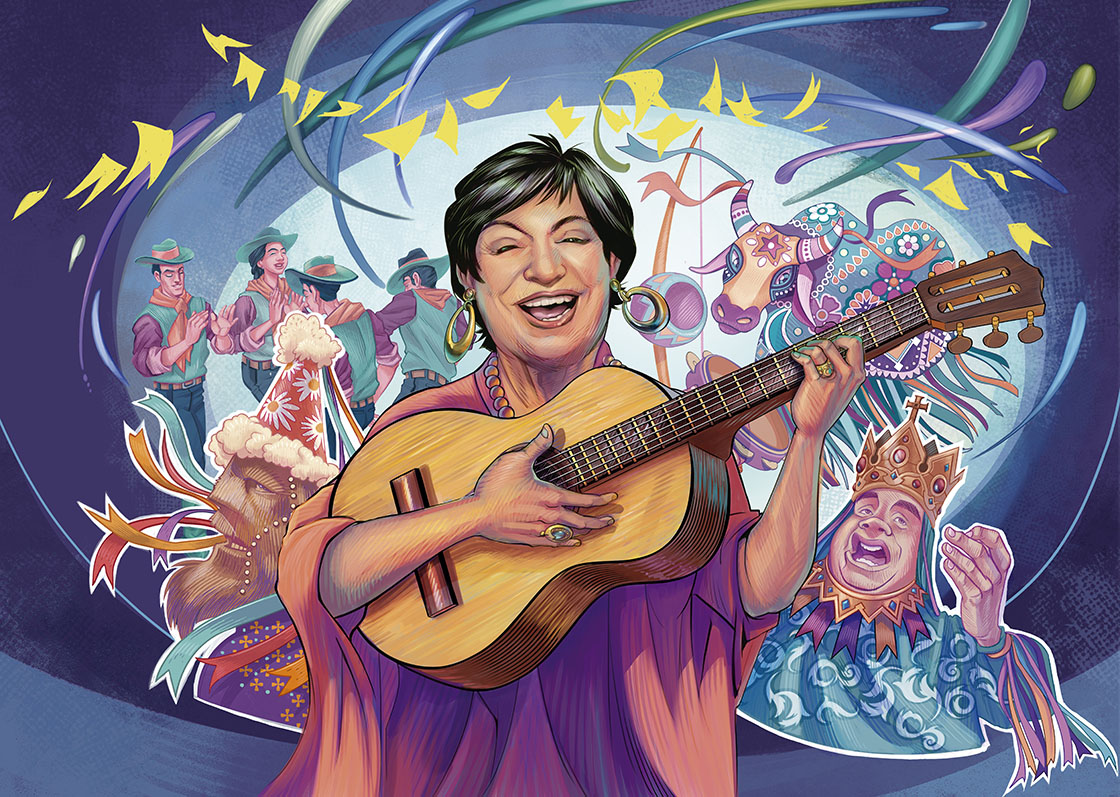
Illustration by Edgar Santo Moretti
Mestra Inezita
Folklore and history
Ignez Magdalena Aranha de Lima was her baptismal name. However, it was under another name that the actress, singer, folklorist, and, of course, viola player entered the history of Brazilian popular culture: “Inezita Barroso.” Born in 1925 and the daughter of a traditional São Paulo family, she was the first to become an artist.
Childhood and the first instruments
The trajectory, she would say later, was inevitable. Born on March 4, 1925, Inezita liked to tell that she came into the world to the sound of the revelers of the Cordão da Barra Funda, which passed through the neighborhood. She grew up between the city and her uncles' farms, fascinated by the strumming of the viola that accompanied the catiras and the Folia de Reis.
“The best time on the farm was at five in the afternoon when I would sneak out of the big house and go to the yard to watch the farmhands gather after work to form the big circle of guitar players. They would arrive slowly, tie up their horses, sit here and there, and suddenly the music would begin, and it wouldn't last long. That's when I started hearing my first guitar songs. I learned from them. I liked it so much that I didn't want to leave the farm, I cried to stay longer and not go back to the city when the holidays were over. And in São Paulo I dreamed of the day I would go back there” (Jorge, 2012, p. 14).
Still, it took her a while to play the guitar. The guitar was her first instrument, at the age of seven. At that time, it was very frowned upon for a woman to play the viola caipira. She learned in secret, amidst traditional music lessons, etiquette and good manners (which she joked she never really learned properly).
Her stage name, Barroso, comes from her marriage to her first husband, Adolfo. It was through her brother-in-law, a radio announcer, that she began frequenting Rádio Tupi. And so, at the age of 25, she began performing on São Paulo radio.
The music
In 1998, she was honored by the samba-enredo of the Pérola Negra samba school, which was in the Access Group and won third place. The title of the samba could not be more self-explanatory: “Inezita Barroso, a trajectory of success”.
This success began almost half a century earlier. Back in 1951, Inezita released the first of her nearly 100 records, on 78 rpm. In it, she performed “Funeral de um Rei Nagô”, by Hekel Tavares and Murilo Araújo, and “Curupira”, by Waldemar Henrique, composed by the Pará maestro 15 years earlier. From the beginning, she showed signs of her vocation for music inspired by our oral tradition.
It was in Pernambuco that she established herself as a professional artist. In an interview with Aloisio Milani and Georgia Nicolau in 2010, Inezita recounted that she went to Recife to gather folkloric themes. At the invitation of Governor Agamenon Magalhães, she performed at the Santa Isabel Theater. The success led to three recitals. Later, Capiba took her to Rádio Clube, where, according to her, she received her first payment as a singer.
Later, she achieved success with her interpretation of “A Moda da Pinga”, a song from the folklore of São Paulo's guitarists that was recorded by Ochelsis Aguiar Laureano and Raul Torres. Inezita made recordings of songs by Mário de Andrade, of Gaucho folklore, of sambas and even of Candomblé chants.
Other paths in folklore
Inezita didn't stop at music. In 1977, for example, she created a restaurant called "Casa da Inezita," which operated on Avenida Santo Amaro in São Paulo. The place served typical dishes with curious names, such as "Bife à Curupira" (Curupira Steak), "Arroz à Negrinho do Pastoreio" (Negrinho do Pastoreio's Rice), and "Filé de Peixe à Sereia" (Mermaid's Fish Fillet). Her dream was for the place to become a folklore school.
She never succeeded, but she did become a professor of the subject at some private colleges. From the University of Lisbon, she received an honorary doctorate in Folklore and Digital Arts. In addition to her musical career, Inezita Barroso also acted in some films and plays. She even won the famous Saci Cinema Award in 1955.
Viola, minha viola
On television, Inezita became especially known as the presenter of the program "Viola, Minha Viola" (Viola, My Viola). And she used to say she wasn't fond of television. Inezita replaced musician and composer Nonô Basílio in the early 1980s and shared the presentation with radio host Moraes Sarmento. Later, she continued alone at the helm of the program. She stopped presenting it in 2014 and died on March 8, 2015.
The program was one of the great meeting points, in the mainstream media, for traditional music in Brazil. But what kind of traditional music was that?
“We realize that the musicality that emerges in the 18th and 19th centuries was gradually gestated in a slow cooking of cultural fusions, in the hands and voices of the bandeirantes, tropeiros and pioneering farmers. And this slow cultural cooking, in which information from different places and cultures gradually amalgamated, is a characteristic present in all Brazilian music” (Vilela, 2013, p. 62).
For a long time, caipira music was looked down upon as a lesser form of knowledge, as happens with everything linked to the popular classes. However, it is in this music that we hear the legacy of our history; the non-negotiable values of solidarity and belonging. Inezita permeated all of this, overcoming prejudices and inspiring more and more women to play the viola and occupy spaces that were said not to belong to them.

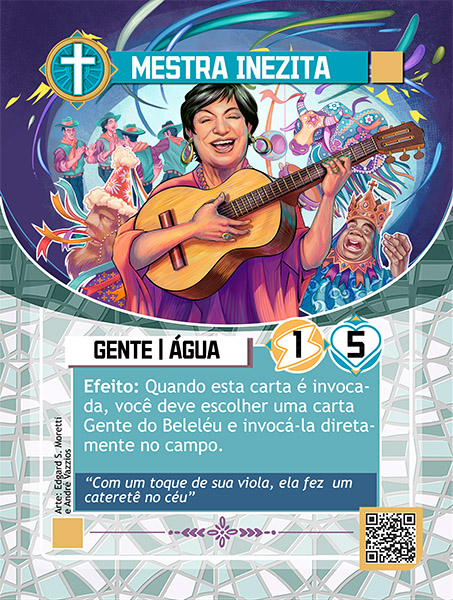
Mestra Inezita
Strength: 1
Health: 5
Folk / Water
“One strum of her viola and heaven was dancing the cateretê.”
Wake the Dead · Rescue
When you summon this card, choose a Folk card in the Beleléu (your discard pile) and summon it directly to the field.
Download the high-resolution artwork

References
- BARROSO, Inezita. Entrevista Inezita Barroso: cantora e apresentadora de TV. Entrevista concedida a Aloisio Milani e Georgia Nicolau. São Paulo, 29 jun. 2010. 6 p. Acervo da Fundação Casa de Rui Barbosa. (rubi.casaruibarbosa.gov.br)
- BARROSO, Inezita. Minh’alma está arada e loteada. Entrevista concedida a e editada por Aloisio Milani. Grupo Anchieta, 2013. Entrevista composta a partir de encontros realizados em 2010, 2012 e 2013. Reprodução consultada no Livrozilla. (livrozilla.com)
- FREIRE, Paulo. Inezita Barroso, a vida: capítulo A menina. In: ITAÚ CULTURAL. Ocupação Inezita Barroso. São Paulo, 2017. (www.itaucultural.org.br)
- ITAÚ CULTURAL. No Gravador de Inezita. São Paulo, 2017b. (www.inezita.com.br)
- ITAÚ CULTURAL. Ocupação Inezita Barroso. São Paulo, 2017a. (www.itaucultural.org.br)
- ITAÚ CULTURAL. Um legado. In: Ocupação Inezita Barroso. São Paulo, 2017c. (www.itaucultural.org.br)
- JORGE, Valdemar. Inezita Barroso: com a espada e a viola na mão. 1. ed. São Paulo: Imprensa Oficial do Estado de São Paulo, 2012.
- MILANI, Aloisio. Inezita de braços abertos. In: ITAÚ CULTURAL. Ocupação Inezita Barroso: A artista. São Paulo, 2017. Texto de apresentação de entrevista gravada em 2014, acompanhada de 13 trechos de áudio. (www.itaucultural.org.br)
- MILANI, Aloisio; PAVAN, Alexandre. Mestiçagem, caipirices, trajetórias. In: ITAÚ CULTURAL (org.). Ocupação Inezita Barroso. São Paulo: Itaú Cultural, 2017. Catálogo da exposição. ISBN 978-85-7979-098-0. Reprodução disponibilizada pelo editor Thiago Rosenberg. (fliphtml5.com)
- SOUZA, Tarik. MPBambas Volume 2. Rio de Janeiro: Kuarup, 2016.
- VILELA, Ivan. Cantando a própria história. Música caipira e enraizamento. São Paulo: Edusp, 2013.