
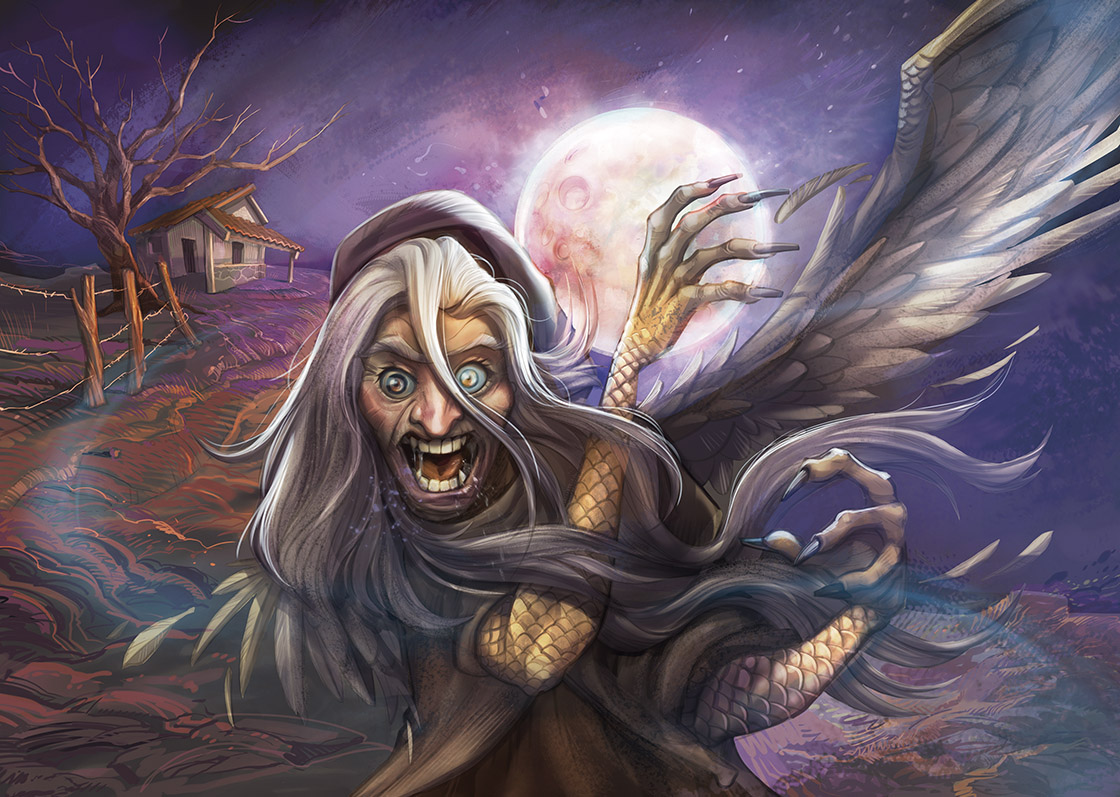
Illustration by André Vazzios
Matinta Pereira
Folklore and history
The Tapera naevia gives rise to a series of superstitions and beliefs throughout the territories where it sings its mournful song. In neighboring countries, it gives form, especially, to Silbon (the Whistler), as well as to Yasy Yateré, with his whistle on his golden staff. In Brazil, the whistling is attributed to Saci-Pererê. The ominous nature of its song gives rise to another apparition: the witch-bird Matintapereira.
Notice how the last names mentioned are very similar in sound. Yateré, Pererê, Pereira… all are, among other etymological meanings, variations of the onomatopoeia of one of this bird's vocalizations. The higher-pitched ones can be heard as Saci, Crispim, Sem-Fim, Mati; while the longer ones have the cadence of compound surnames.
The Forms of the Matinta
Although the Tapera naevia belongs to the cuckoo family, it is very common for other birds to be linked to the transformation of this apparition. People often speak of a "black bird," like a crow, referring to an already popularized image of a witch. Others, as Câmara Cascudo refutes in the "Dictionary," will say that the Matinta is a small "owl." Sometimes, it is likened to the Barn Owl or the Death-Shroud (which is anything but small).
The Matinta can also assume other forms. In "The Matinta Perera of the Camp," a story collected by Walcyr Monteiro (2000) in Belém, two residents tried to trap her with an open pair of scissors buried in the yard, a key in the middle, and a rosary on top. After the prayers, they heard pig grunts. When questioned by the researcher, the narrators explained that Matinta could turn into any animal she wanted.
At the end of the story, a woman was found in the backyard and taken to the Pedreira police station. She claimed not to know what she was accused of and was eventually released. The whistling continued, and some residents began to say that she was taking revenge.
Tradition says that whoever hears Matinta's song will suffer a series of misfortunes. To get rid of the curse, it is common to offer her a gift. People ask the apparition to return the next day to fetch tobacco or salt. This is how you find out who the neighborhood's Matinta is.
The bird and the ancestors
This is one of the ways of narrating the myth, the best known in the country. But Matinta already appears in records from the 19th century. In "Studies on the Munduruku Tribe," published in 1877, the engineer Antonio Manoel Gonçalves Tocantins describes the Munduruku belief in the transformation of the spirits of the dead into matim-tapirera.
According to Tocantins, these spirits could produce storms or return to earth in the form of matim-tapirera, to hunt during the night. The bird's song seemed to continuously repeat its name. We then understand that Matinta was an ancestor.
Métraux, in 1950, writes: “The Tupinambá felt superstitious fear for a certain species of bird which, judging by the descriptions, can be identified with the matim-tapirera”. The bird was considered a messenger of deceased relatives, and its trills were interpreted as orders from beyond the grave. An incarnation of the spirit of the dead. Métraux's choice of words makes the action of the matintas somewhat confusing. By “posing as a messenger”, was he saying that this attribute was false? Were the bird's messages a deception?
Records of sinister birds for the indigenous people permeate the accounts from the beginning of Portuguese colonization. As an example, the Calvinist Jean de Léry, still in the 16th century, speaks of the fear that the indigenous people had of the Acauã – a bird known for its mournful song. Even today, the bird is considered one of the most cursed in the backlands.
The transmission of the curse
They say that, when she is about to die, the Matinta sings a song in which the message is heard: “Who wants it? Who wants it?”. The person who is greedy enough to accept what she is offered, without even knowing what it is about, will assume the curse and become the new Matinta.

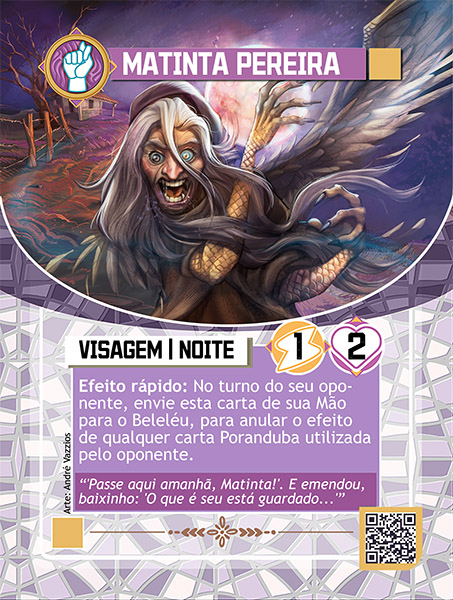
Matinta Pereira
Strength: 1
Health: 2
Wonders / Night
“‘Come by tomorrow, Matinta!’ Then, under her breath: ‘I’ve set something aside for you…’”
Who Wants It? · Protection
On your opponent’s turn, send this card from your hand to the Beleléu (your discard pile) to cancel the effect of any Poranduba card your opponent uses.
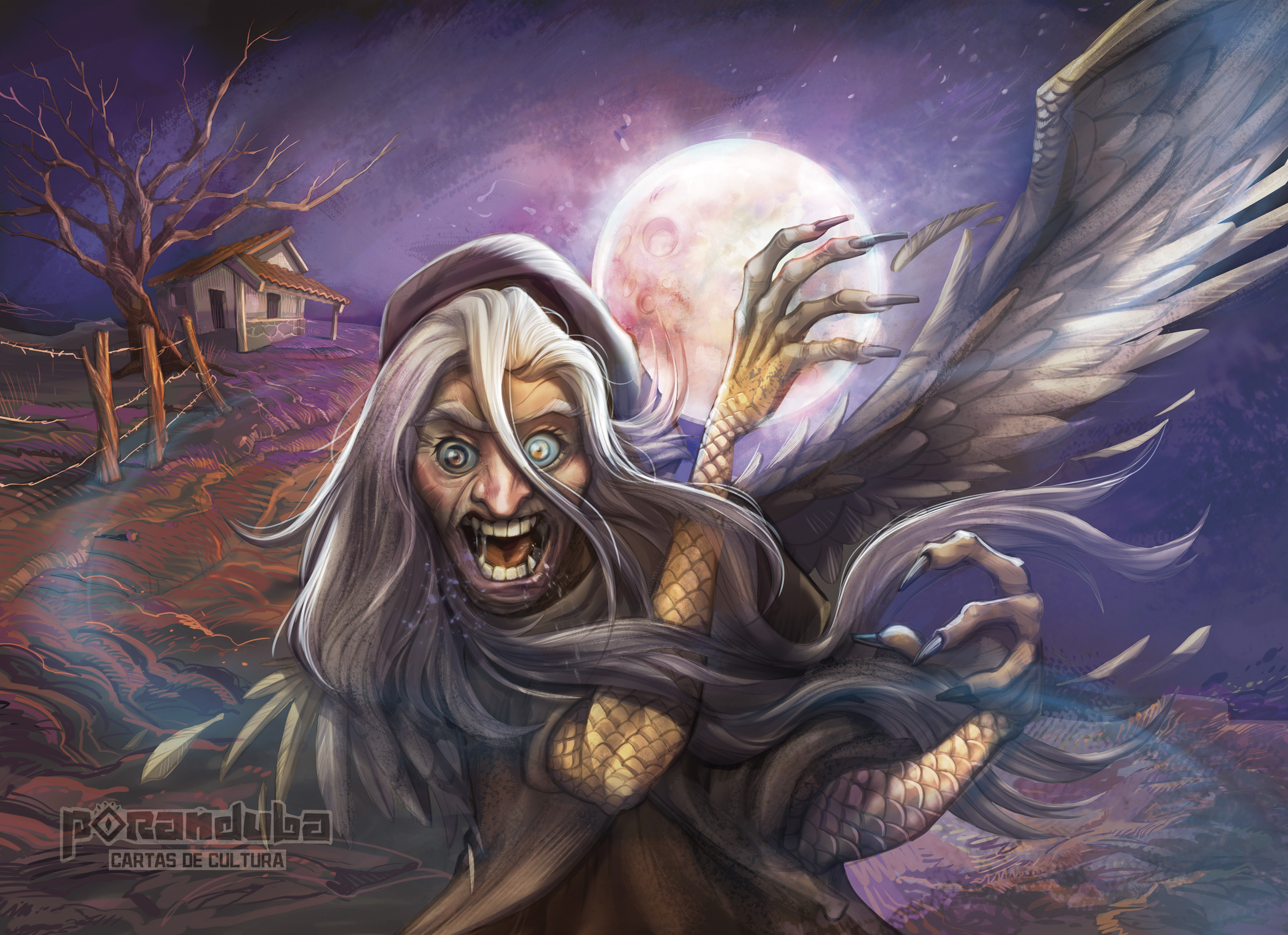
Download the high-resolution artwork
References
- CASCUDO, Luís da Câmara. Dicionário do Folclore Brasileiro. São Paulo: Global, 2002.
- FARES, Josebel. Imagens da mitopoética amazônica: um memorial das matintas pereras. 1997. 180 f. Dissertação (Mestrado em Letras) – Centro de Letras e Artes, Universidade Federal do Pará, Belém, 1997.
- MÉTRAUX, Alfred. A religião dos Tupinambás e suas relações com a das demais tribus Tupi-Guaranis. São Paulo: Companhia Editora Nacional, 1950. (bdor.sibi.ufrj.br)
- MONTEIRO, Walcyr. Visagens e assombrações de Belém. 3. ed. rev. e atual. Belém: Banco da Amazônia, 2000.
- SILVA JÚNIOR, Fernando Alves da. Representação feminina no mito da matintaperera em Taperaçu Campo, Bragança (PA). 2014. Dissertação (Mestrado em Linguagens e Saberes na Amazônia) – Universidade Federal do Pará, Bragança, 2014. (pplsa.propesp.ufpa.br)
- TOCANTINS, Antonio Manoel Gonçalves. Estudos sobre a tribu “Mundurucú”. Revista Trimensal do Instituto Historico Geographico e Ethnographico do Brasil, Rio de Janeiro, t. 40, parte 2, p. 73–161, 1877. Passagem citada: p. 116. (etnolinguistica.wikidot.com)