
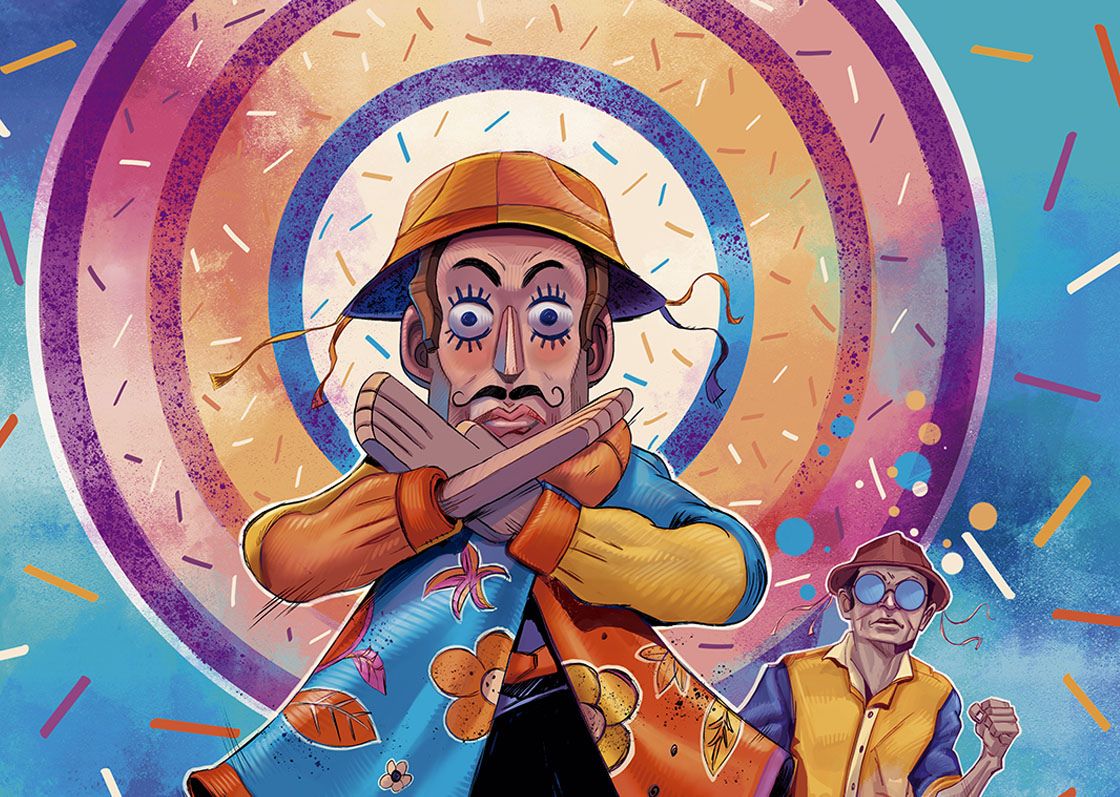
Illustration by Doug Retícolo
Mamulengo Puppet
Folklore and history
Mamulengo
Mamulengo is the name given to puppet theater, especially in Pernambuco. However, there are other variations that encompass other regions: Cassimiro Coco, Babau, João Redondo, which are often the name of a single type of puppet that become synonymous with the entire tradition.
In an effort to encompass the entire phenomenon, in 2015 the National Institute of Historical and Artistic Heritage (IPHAN) registered all these manifestations as Brazilian intangible heritage under the umbrella: "Popular Puppet Theater of the Northeast".
The names and origins
No one knows for sure the origin of the term "Mamulengo". The most common version says that it is a derivation of "mão molenga" (limp hand), referring to the technique necessary for the puppeteer to move the puppet. Nei Lopes, cited in the Iphan dossier (2014, p. 25), ventures an influence from the Kikongo language, "milengo", meaning "wonder, miracle". There are also those who suggest a Bantu influence, "malungo," which means "companion."
The tradition has religious roots, and it is believed to have originated with the arrival of Christians in the Northeast, bringing with them the tradition of mechanical nativity scenes, in which the puppets performed small movements to attract the public's attention. Later, the puppet theater culture itself would gain the name "presepe".
How the puppets gain movement
Today, automaton puppets are also part of the theater, but as part of the scenery. They can make movements such as pounding a mortar, grinding corn, or even stabbing an enemy. The main scene, however, belongs to the manipulated puppets.
There are several ways to manipulate the puppet. It is possible to use rods or dress it like a glove. By pulling a string, it is possible to move the mouth or raise the eyes to increase the comic effect. Some puppets are made in real size and are moved with the whole body to simulate dancing with the puppeteer – causing amusement for the audience.
The puppet is usually made with a wooden head, especially from the plant known as mulungu (Erythrina Mulungu), and a body made of fabric, fiber, and cardboard. There is only one rule: the uglier, the better. The goal, after all, is to make the audience laugh.
Characters, voices, and music
Each location will have its most frequent characters in the performance. In Glória de Goitá/PE, for example, it is very common to have stories involving puppets of Death (represented by a skeleton with a scythe), with policemen or soldiers who always want to beat others and impose authority through violence; Mateus and Catirina, imported from the Bumba meu Boi festivities, and so on.
The puppeteer also works with voice and improvisation. Hermilo Borba Filho (1966) describes the performance of Januário de Oliveira, Ginu, creator of Professor Tiridá, in Recife. He manipulated the puppets himself and made five different voices. To set up his theater, all he needed was a sheet hung on a string. He installed loudspeakers, hung a microphone around his neck, and addressed the audience as "my dear listeners." The story had a script, but the dialogues were improvised on the spot, according to the circumstances and the audience's reaction.
Music plays a fundamental role in the puppet show. It is what attracts the audience's attention, bringing them together for the show that is about to begin. On the other hand, it is also responsible for making the puppeteer enter the story. In a record made by the National Center for Folklore and Popular Culture, Gilberto Souza Lopes da Silva, Bel, summarizes: "There is a tradition that says that the puppet sleeps and only wakes up when we call it, the music is what calls the spirits of the puppets."

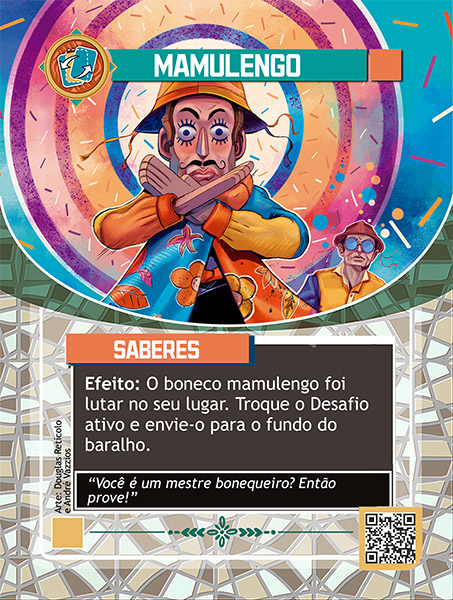
Mamulengo Puppet
Lore
“You’re a master puppeteer? Prove it!”
Tiridá’s Apprentice · Swap
The mamulengo puppet fights in your place. Swap the active Challenge and put it on the bottom of the deck.
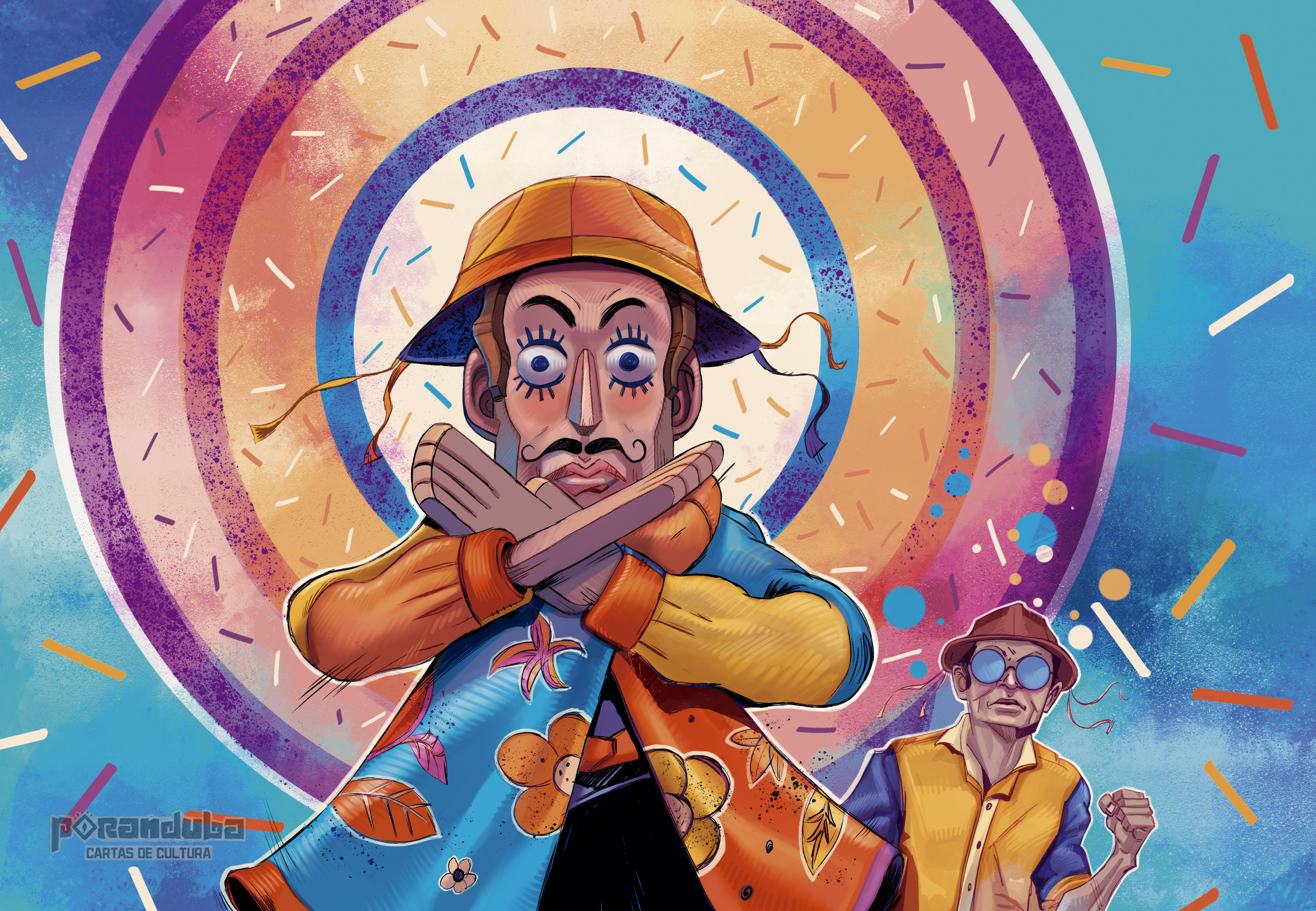
Download the high-resolution artwork
References
- BORBA FILHO, Hermilo. Fisionomia e espírito do mamulengo: o teatro popular do Nordeste. São Paulo: Companhia Editora Nacional; Editora da Universidade de São Paulo, 1966. (Brasiliana, v. 332). (bdor.sibi.ufrj.br)
- INSTITUTO DO PATRIMÔNIO HISTÓRICO E ARTÍSTICO NACIONAL. Registro do teatro de bonecos popular do Nordeste: Mamulengo, Cassimiro Coco, Babau e João Redondo. Dossiê interpretativo. Brasília, DF: Iphan, jun. 2014. (bcr.iphan.gov.br)
- TEIXEIRA, Raquel Dias. A música é que chama os espíritos dos bonecos. Mamulengos em Glória do Goitá. Rio de Janeiro: IPHAN, CNFCP, 2012.