
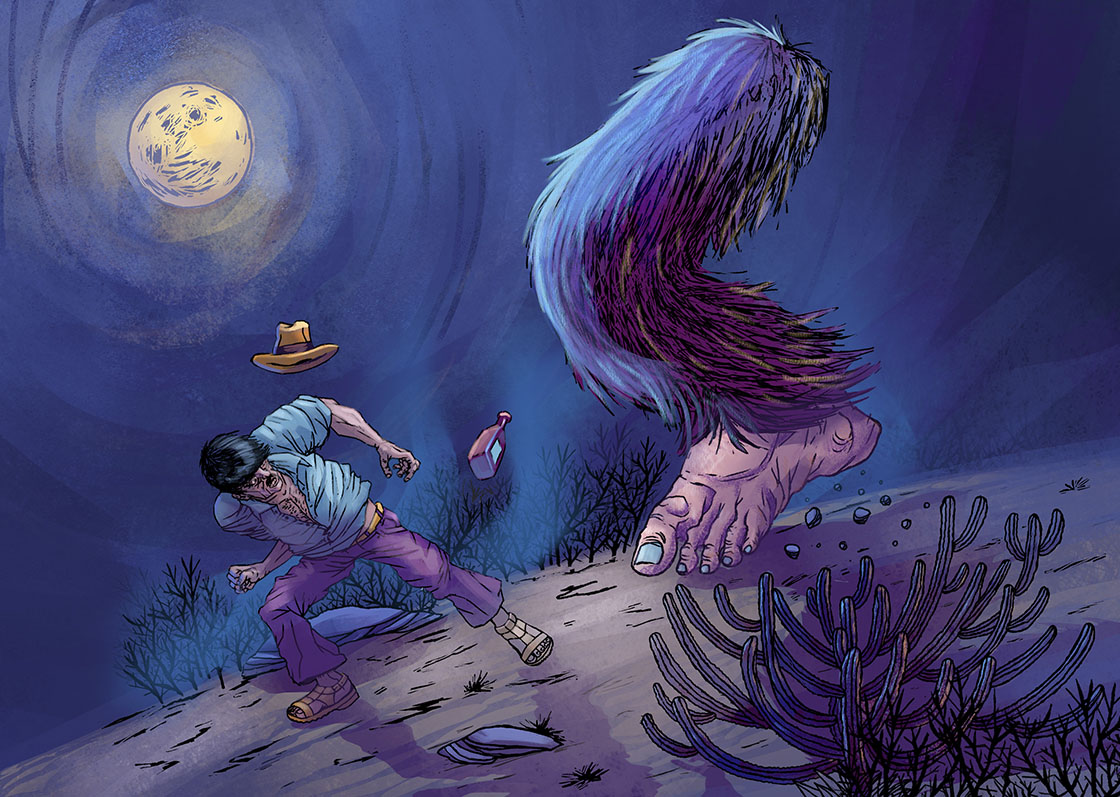
Illustration by Rafael Limaverde and André Vazzios
Legs, Don’t Fail Me Now!
Folklore and history
The Hairy Leg
A phantom leg, without a body, that haunts the nights of Recife and pursues night owls. This is the Hairy Leg; an urban legend that began to circulate around the capital of Pernambuco in the mid-1970s and that, today, is already an icon of popular culture throughout Brazil.
Cordel and popular tales
Guaipuan Vieira published the cordel pamphlet “The terrible story of the Hairy Leg: omens of the Beast-Beast”. The digital reproduction consulted indicates a first edition from 1998 and a second from 1999. The verses give some characteristics that serve as a starting point for our discussion. The monster would be taller than an adult man, standing two meters tall. It has a cyclopean eye right in the crease of its knee, which burns like a burning ember. Just below it is its nose, a mouth with sharp fangs, a ferocious tongue, and a goat-like beard. Each of its nails is curved, and when it jumps, it makes a dreadful noise like the grinding of teeth. On its heel, as if that weren't enough, it carries a spur, like those of a rooster, and a horn in the middle of its shin.
It certainly seems to be a sight worthy of the hosts of hell. However, very little of this is present in popular accounts. What was most talked about at the time was the appearance of a leg, covered in black and greasy hair. Its nails were large and dirty, but without further macabre details. The Leg roamed the city, attacking people with trips and kicks.
Who came up with the Hairy Leg?
But how did this belief arise? Apparently, this is a media legend; that is, a creation of the media of the time that became folklorized, losing its authorship, and was adopted by the people.
There are two people who dispute, at the level of discourse, the "paternity" of the Hairy Leg. The first is the journalist Jota Ferreira, who worked on Geraldo Freire's program on Rádio Repórter. The program aired at 4 am and lasted until 8 am. With a popular and police-like tone, it did a shift at the Hospital da Restauração, to interview the drunkards who passed through there and make the hours on the microphone last.
Once, with nothing to report, Jota Ferreira says that he invented, on the spur of the moment, the story that a man had been admitted to the hospital a victim of "Hairy Leg". Days later, during his shift, a woman also arrived at the infirmary claiming to be a victim of the haunting. From there, the story is said to have spread.
Another possible originator of the urban legend is the journalist and writer Raimundo Carrero, who published, on February 1, 1976, the short story "The Hairy Leg," in the Police Romance column, in the Diário de Pernambuco. For the author, the public did not understand the joke and took the narrative as true. This would have been the birth certificate of the apparition.
Tiúma's records
As for the radio, we have no record of when (or if) Jota Ferreira's story aired. However, Carrero's assertion is not entirely correct. Two months before his text, on December 10, 1975, the same Diário de Pernambuco published a news item: "Ghost leg appears in Tiúma's dwelling." It turns out that, around the Tiúma power plant, in São Lourenço da Mata – metropolitan area of Recife –, a young man reports having seen a spiritual leg in the shadows of the wall of his house.
Throughout that week, the news spread. And it is the following day, December 11, that a new article gives the final characteristic: the ghost appeared in the form of a hairy leg. Several other residents also claimed to have seen the monster, which was revealing itself little by little: first, the foot and, then, the rest.
The text describes the apparition as a leg of about one and a half meters, which hung from the roof and was able to assume the form of other animals: bats, butterflies, etc. Those who mocked the story received an invisible blow as payment. Frightened, those interviewed asked for the intercession of the priest (who refused) and of spiritist mediums.
On December 13, the Diário de Pernambuco published “Ghost Leg” is an invention of the people. The article contrasted two explanations: Monsignor Isnaldo Fonseca rejected the apparition, while the babalorixá Pai Edu interpreted it as the action of a spirit. The newspaper coverage already showed the dispute over meanings surrounding the apparition.
From news reports to cordel literature and carnival
For this was precisely the case that José Soares records in "The Hairy Leg of Tiúma and São Lourenço". A cordel poet from Alagoas, José signed as the "poet-reporter" and specialized in transforming the news he read in newspapers into cordel pamphlets. This is what he did with his greatest successes, such as "The Death of the Bishop of Garanhuns, Dom Expedito Lopes," which sold 108,000 copies in Pernambuco alone, and "The Resignation of Jânio Quadros," which sold 60,000.
In the text dedicated to the Leg, the poet-reporter recounts hearing the story on the radio and seeing a newspaper cliché. The consulted copy of the pamphlet does not indicate the publication date.
The poet also wrote another cordel, "The Hairy Leg of Olinda," released just three days after Raimundo Carrero's column. This shows how José always worked with hot topics and with great speed. In it, he mentions the journalist-writer by name: "As Carrero said in the Sunday newspaper, she attacked a group that was playing bingo." In the cordel, the story is treated as a journalistic fact, indistinguishable from the previous article.
Another interesting piece of news was published on February 5, 1976. In it, we discover that the Hairy Leg became the inspiration for a frevo-song: "If you haven't seen it, come and see! Don't be fooled. Don't be afraid. Of the hairy leg." The inspiration, the artists say, was the cordel (folk poetry) of José Soares. Five days later, the Diário de Pernambuco newspaper reported the organization of the "Hairy Leg" carnival group by residents of the Sertãozinho neighborhood, in Nazaré da Mata. The group had already rehearsed in the streets and was preparing a large leg for the parade. The apparition was also gaining space in the carnival.
We realize, therefore, that as important as the traditional mass media was the cordel literature, which reverberated the event to the popular classes. And what did the texts say about the leg? Let's look at the text in the pamphlets to see who the victims of the apparition were, those who were subjected to kicks, blows, and blows.
In José Soares's folk tales, the leg pursues men who dance in shorts, gigolos, and pregnant women. A false individual who wanders the streets late at night. José Costa Leite, in "The Old Woman Under the Bed and the Hairy Leg," mentions the troublemaker, the liar, the rowdy one, and the girl who walks around with her navel showing. These verses are reproduced by Natália Eunice Paiva Moreira (2010, p. 54). It was a way for writers to point out behaviors they considered deserving of punishment.
A legend in times of dictatorship
A documentary about the Hairy Leg was produced in 1996 by Gil Vicente, Marcelo Gomes, Beto Normal, and João Jr. The film, like many of the folk tales, does not shy away from sexual puns. However, the main highlight is an element explored in just a few minutes of the film: the relationship with the Military Dictatorship.
When the stories about the Hairy Leg "went viral," we were in the midst of the government of Ernesto Geisel, the fourth president of the dictatorial regime. Evidence of this can be seen in the testimony of radio broadcaster Jota Ferreira, who recounts that the head of the Public Entertainment Censorship Service of Pernambuco, Demerval Barreto de Matos, threatened to shut down the newspaper if they continued to talk about Hairy Leg.
For Raimundo Carrero, in the documentary, it was precisely the climate of oppression created by the military that allowed the story of the Hairy Leg to resonate more strongly with the population. People were able to dream again, to think about the absurd, in the midst of a state of exception. All thanks to a phantom leg without a body.

Legs, Don’t Fail Me Now!
Challenge / Toil
Recife’s Hairy Leg can’t stand night owls. Outrun it on your way home from a night on the town!
Win · Send two Night cards from your hand or field to the Beleléu (your discard pile).

Download the high-resolution artwork
References
- BENTO, Emannuel. Perna Cabeluda: o que a lenda de ‘O Agente Secreto’ diz sobre a ditadura. Jornal do Commercio, Recife, 10 nov. 2025. Atualizado em 12 jan. 2026. Inclui reprodução de recortes históricos. (jc.uol.com.br)
- CARRERO, Raimundo. A perna cabeluda. Diário de Pernambuco, Recife, ano 151, n. 31, 1 fev. 1976. Suplemento Domingo, coluna Romance Policial, p. 7. (memoria.bn.gov.br)
- GOMES, Marcelo; JÚNIOR, João; NORMAL, Beto; VICENTE, Gil. A Perna Cabeluda Documentário. 1996. (www.youtube.com)
- MOREIRA, Natália Eunice Paiva. Lendas urbanas: atualização, persistência e “realidade” nessas narrativas multimídia. 2010. Dissertação (Mestrado em Comunicação e Semiótica) – Pontifícia Universidade Católica de São Paulo, São Paulo, 2010. p. 54. (repositorio.pucsp.br)
- “PERNA Cabeluda” vira troça. Diário de Pernambuco, Recife, ano 151, n. 40, 10 fev. 1976. Segundo caderno, p. 5. (memoria.bn.gov.br)
- “PERNA fantasma” é invenção do povo. Diário de Pernambuco, Recife, ano 150, n. 335, 13 dez. 1975. Primeiro caderno, p. 12. (memoria.bn.gov.br)
- PERNA fantasma surge em moradia de Tiúma. Diário de Pernambuco, 10 dez. 1975. (memoria.bn.br)
- “PERNA fantasma” já é problema policial. Diário de Pernambuco, 11 dez. 1975. (memoria.bn.br)
- SOARES, José. A perna cabeluda de Olinda. Recife: [s.n.], 1976. 8 p. (rubi.casaruibarbosa.gov.br)
- SOARES, José. A perna cabeluda de Tiuma e São Lourenço. [S.l.: s.n.], [197-?]. 8 p. (rubi.casaruibarbosa.gov.br)
- TEMA musical é a “perna”. Diário de Pernambuco, Recife, ano 151, n. 35, 5 fev. 1976. Primeiro caderno, p. 5. (memoria.bn.gov.br)
- VIEIRA, Guaipuan. A terrível história da Perna Cabeluda: prenúncios da Besta-Fera. 2. ed. [S.l.]: Centro Cultural dos Cordelistas – Cecordel, 1999. 8 p. Reprodução digital. (www.netmundi.org)