
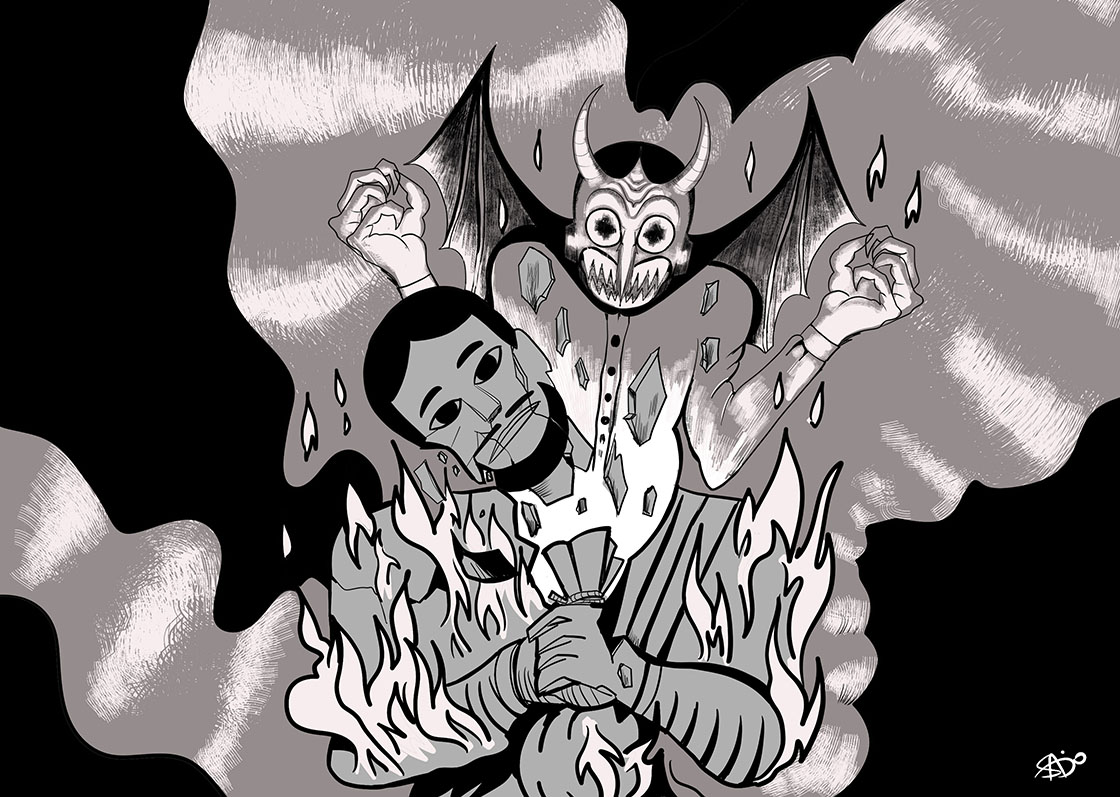
Illustration by Samuel Sajo
Judas Goes Up in Smoke
Folklore and history
In some places, the traditional beating of Judas, the malhação de Judas, ends with a bang. A straw or cloth effigy represents Judas Iscariot, the apostle who betrayed Jesus. Depending on local custom, people beat the effigy, burn it or, as they do in Itu in the interior of São Paulo state, blow it up.
The custom came from the Iberian Peninsula and spread through Latin America during colonization. In many places the beating takes place on Holy Saturday, the day before Easter. The rivalry could start well before then. Each group made its Judas in secret in case a rival group tried to steal it.
Sometimes the way the effigy was dressed was enough to get the joke across. In 1809 word spread through Rio de Janeiro that someone in the São José district had hanged a straw Judas wearing the insignia of two orders of the monarchy. The intendant ordered witnesses questioned to find out who had done it. Debret recounts that on Holy Saturday in 1821 the effigies hanging in Rio’s squares stood in for the intendant-general and the police commander. Today a Judas might wear the face of a politician or even a footballer who has fallen out of favour with the fans.
In Itu, people gather at noon on Easter Sunday in Praça Padre Miguel, better known as Praça da Matriz. Two effigies share the stage, Judas and the Devil. Once called Estouro do Judas, the festival is now billed as Queima do Judas, the Burning of Judas. Fireworks are still part of the show, with changes to keep the noise down.
Judas and the Devil were also a pair in nineteenth-century Rio de Janeiro. Câmara Cascudo writes that the Judas effigies carried fireworks in their bellies and appeared alongside devils, “all ablaze in a multicoloured finale.”

References
- CASCUDO, Luís da Câmara. Dicionário do folclore brasileiro. 10. ed. Rio de Janeiro: Ediouro, [s. d.].
- DEBRET, Jean-Baptiste. Voyage pittoresque et historique au Brésil. Paris: Firmin Didot Frères, 1839. t. 3, prancha 21 e texto explicativo. Disponível em: https://brasiliana.usp.br/handle/bbm/4716. Acesso em: 13 nov. 2026.
- GASPAR, Lúcia. Malhação de Judas. Pesquisa Escolar, Fundação Joaquim Nabuco, 2022. Disponível em: https://pesquisaescolar.fundaj.gov.br/pt-br/artigo/malhacao-de-judas/. Acesso em: 13 nov. 2026.
- ITU (SP). Prefeitura Municipal. Tradição da Queima do Judas se mantém na Páscoa em Itu. 30 mar. 2026. Disponível em: https://itu.sp.gov.br/tradicao-da-queima-do-judas-se-mantem-na-pascoa-em-itu/. Acesso em: 11 nov. 2026.
- SILVA, Maria Beatriz Nizza da. Cultura e sociedade no Rio de Janeiro: 1808–1821. São Paulo: Editora Nacional, 1977. Disponível em: https://bdor.sibi.ufrj.br/handle/doc/412. Acesso em: 13 nov. 2026.