
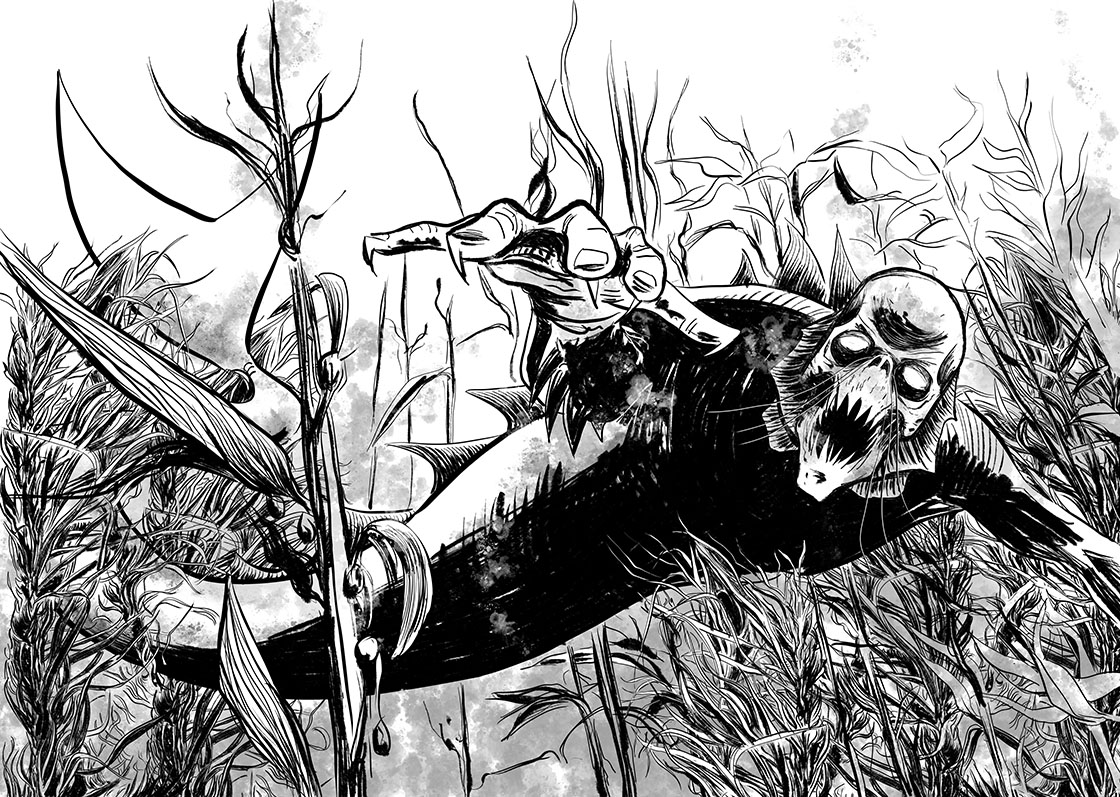
Illustration by Daniel Souza
Ipupiara
Folklore and history
In his Dicionário do folclore brasileiro, Câmara Cascudo was emphatic: “No chronicler of colonial Brazil records the Mãe-d’água as a mermaid luring people with her song, or even in the simple guise of a woman. It is always the Ipupiara, fierce, hungry and brutish.” So what is an Ipupiara? In a letter by Anchieta, the name itself offers a clue.
The Ipupiara is one of the oldest recorded myths in the country’s history. His account is present, along with those of Curupira and Boitatá, in a letter written by the Jesuit José de Anchieta in 1560. He writes: "There are also other ghosts in the rivers, which they call, Ipupiara, that is, who live in the water, who kill the Indians in the same way".
In 1576, Pero de Magalhães Gândavo published his history of the province of Santa Cruz. In it he narrates an encounter with an Ipupiara in São Vicente. Gândavo translates the name as “water demon” and describes an animal fifteen feet long, with a hairy body and bristles on its snout that resembled mustaches.
The person who first saw the creature, according to Gândavo, was an enslaved indigenous woman. It was night in São Vicente, in 1564. Upon hearing the screams and seeing the figure near the sea, she went to call Baltasar Ferreira, the captain’s son. He doubted it and told her to look again. Only when the woman returned, even more frightened, did Baltasar leave the house, sword in hand. He found the animal on the beach. In the confrontation that followed, the creature even raised itself on its tail to confront him. Other enslaved people, who came to the woman’s screams, took the already dying animal to the village.
Centuries later, Afonso Taunay offered a zoological reading of this encounter. In Zoologia fantástica do Brasil (1934), he suggested that Gândavo had described a large sea lion that had reached São Vicente from Patagonia, carried by the currents or swimming under its own power. His hypothesis concerns this particular episode. It raises the possibility that the witnesses understood an unfamiliar animal as a water monster.
Two years after Gândavo’s book appeared, Jean de Léry recounted another encounter on the water in his account of his travels in Brazil. One of his Indigenous interlocutors told him that a huge fish had seized his boat. To break free, the man cut off the creature’s hand with a sickle. It fell into the boat. It had five fingers. When the creature raised its head and groaned, its face looked human too. Léry leaves his reader to choose among the beings he knew from books: a triton, a mermaid or a sea ape?
Fernão Cardim, in turn, distinguishes males and females among the ipupiaras that he describes in river banks. The males would resemble men with sunken eyes. Females would have long hair. What is most impressive in his account is the creature’s embrace, so tight it could kill. When he realized that the victim was dead, Ipupiara would sometimes let go of him, moaning as if he regretted what he had just done.

References
- ANCHIETA, José de. Carta de São Vicente: 1560. São Paulo: Conselho Nacional da Reserva da Biosfera da Mata Atlântica, 1997. Disponível em: https://www.rbma.org.br/rbma/pdf/Caderno_07.pdf. Acesso em: 10 nov. 2026.
- CARDIM, Fernão. Tratados da terra e gente do Brasil. Rio de Janeiro: J. Leite & Cia., 1925. Disponível em: https://digital.bbm.usp.br/handle/bbm/4788. Acesso em: 10 nov. 2026.
- CASCUDO, Luís da Câmara. Dicionário do folclore brasileiro. 10. ed. Rio de Janeiro: Ediouro, [s. d.].
- GÂNDAVO, Pero de Magalhães. História da província Santa Cruz a que vulgarmente chamamos Brasil. Lisboa: Officina de Antonio Gonsalvez, 1576. Disponível em: https://pt.wikisource.org/wiki/Hist%C3%B3ria_da_Prov%C3%ADncia_de_Santa_Cruz. Acesso em: 10 nov. 2026.
- LÉRY, Jean de. Viagem à terra do Brasil. Tradução de Sérgio Milliet. 2. ed. São Paulo: Livraria Martins Editora, 1951. Disponível em: https://catalogue.bnf.fr/ark:/12148/cb323770876. Acesso em: 10 nov. 2026.
- TAUNAY, Afonso de E. Zoologia fantástica do Brasil: séculos XVI e XVII. São Paulo: Companhia Melhoramentos, 1934.