
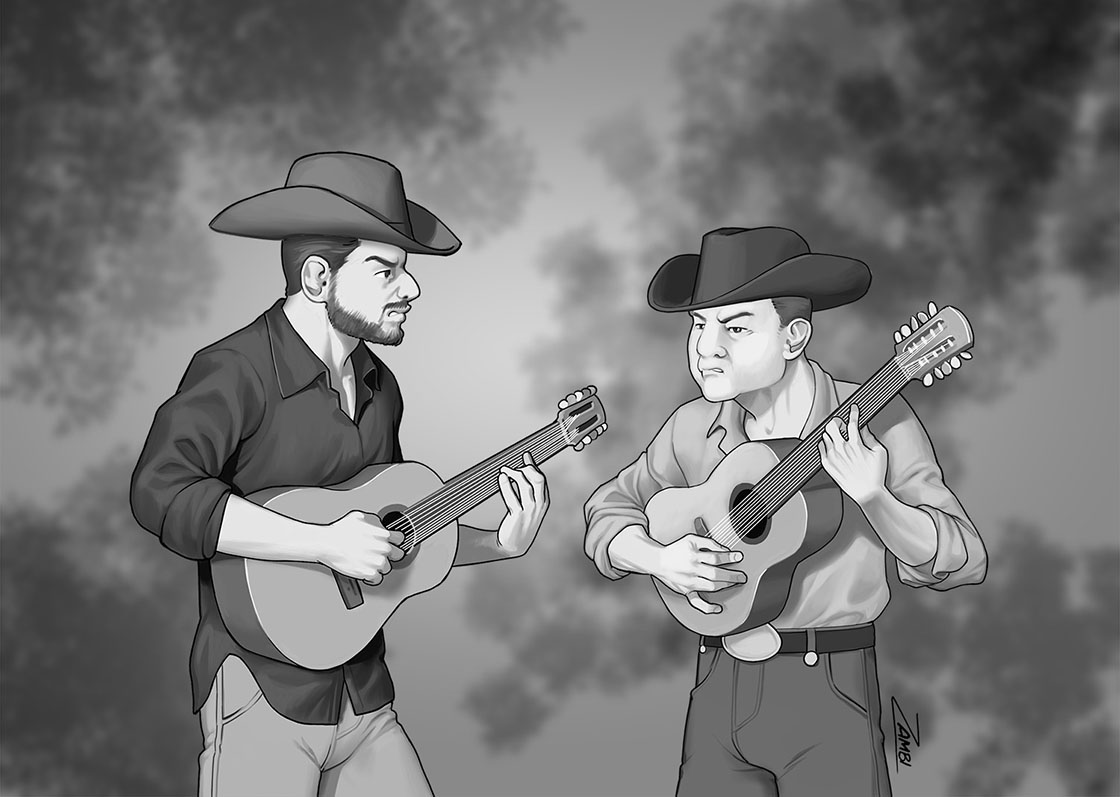
Illustration by Zambi
Improvisation Duel
Folklore and history
When Manoel Raimundo arrived
at a house in Pedra Fina,
the crowd could hardly wait
to see the carnage.
They asked him if he wanted
to sing against Manoel Campina.
Manoel Raimundo answered,
“Gladly, sir, I’ll sing.
I’m new to this singing game,
but no singer frightens me.
Once my blood warms up,
I’ll sing against anyone.”
They sent for Campina,
then started saying,
“The beating this man’s in for
will shame whoever sees it.
That whip of Campina’s
can sting like the devil.”
Then Campina came in,
viola in hand,
and asked the people in the house,
“Show me this tough fellow.
I’ll strip him of his reputation
with a crack of my belt.”
— Peleja de Manoel Raimundo com Manoel Campina,
By João Martins de Ataíde, 1941
Listen to the words at the ends of the second, fourth and sixth lines in Portuguese: Fina, carnificina, Campina. As Ataíde tells us how eagerly the crowd awaited the bout, he holds the scene together with a rhyme that returns every other line. In the booklet we read a challenge already set down on paper. In a live repente duel, each singer has to hear the other’s stanza and compose a reply on the spot, in front of everyone. The singers name three demands of their craft: métrica, rima e oração — metre, rhyme and sense. What good is a perfect rhyme if it leaves the other singer’s taunt unanswered?
The impromptu duel is a very frequent element in Brazilian popular culture. We find this ability in sung duels accompanied by viola and, today, in MC battles. As Paul Zumthor reminds us, improvising offers the freedom to endlessly tweak the text.
Francisco das Chagas Baptista gives an example in Cantadores e poetas populares (1929). In 1908, in the village of Serraria in Paraíba, he heard Manoel Cabeceira improvise six-line stanzas for half an hour, landing every rhyme to the delight of his listeners. The freedom to make it up as he went depended on command of the form.
Partido-alto samba has its own way of improvising. The circle sings the refrain, a partideiro improvises a verse, and everyone comes back in on the chorus. At a cantoria de viola, the listeners can join the game too. Someone calls out a subject or offers a mote, a line or theme the singers must take up. Sometimes the challenge comes from the audience.

References
- ATAÍDE, João Martins de. Peleja de Manoel Raymundo com Manoel Campina. Recife: Impressão do Autor, 1941.
- AZEVEDO, Ricardo. Samba, improviso e oralidade. In: LEITE, Eudes Fernando; FERNANDES, Frederico (org.). Trânsitos da voz: estudos de oralidade e literatura. Londrina: Eduel, 2012. p. 89–119. Disponível em: https://files.ufgd.edu.br/arquivos/arquivos/78/EDITORA/catalogo/transitos-da-voz-estudos-de-oralidade-e-literatura-eudes-fernando-leite-e-frederico-fernandes-orgs.-6.pdf. Acesso em: 10 nov. 2026.
- BAPTISTA, Francisco das Chagas. Cantadores e poetas populares. Paraíba: Baptista Irmão, 1929.
- ZUMTHOR, Paul. Introdução à poesia oral. Tradução de Jerusa Pires Ferreira, Maria Lúcia Diniz Pochat e Maria Inês de Almeida. São Paulo: Hucitec, 1997.