

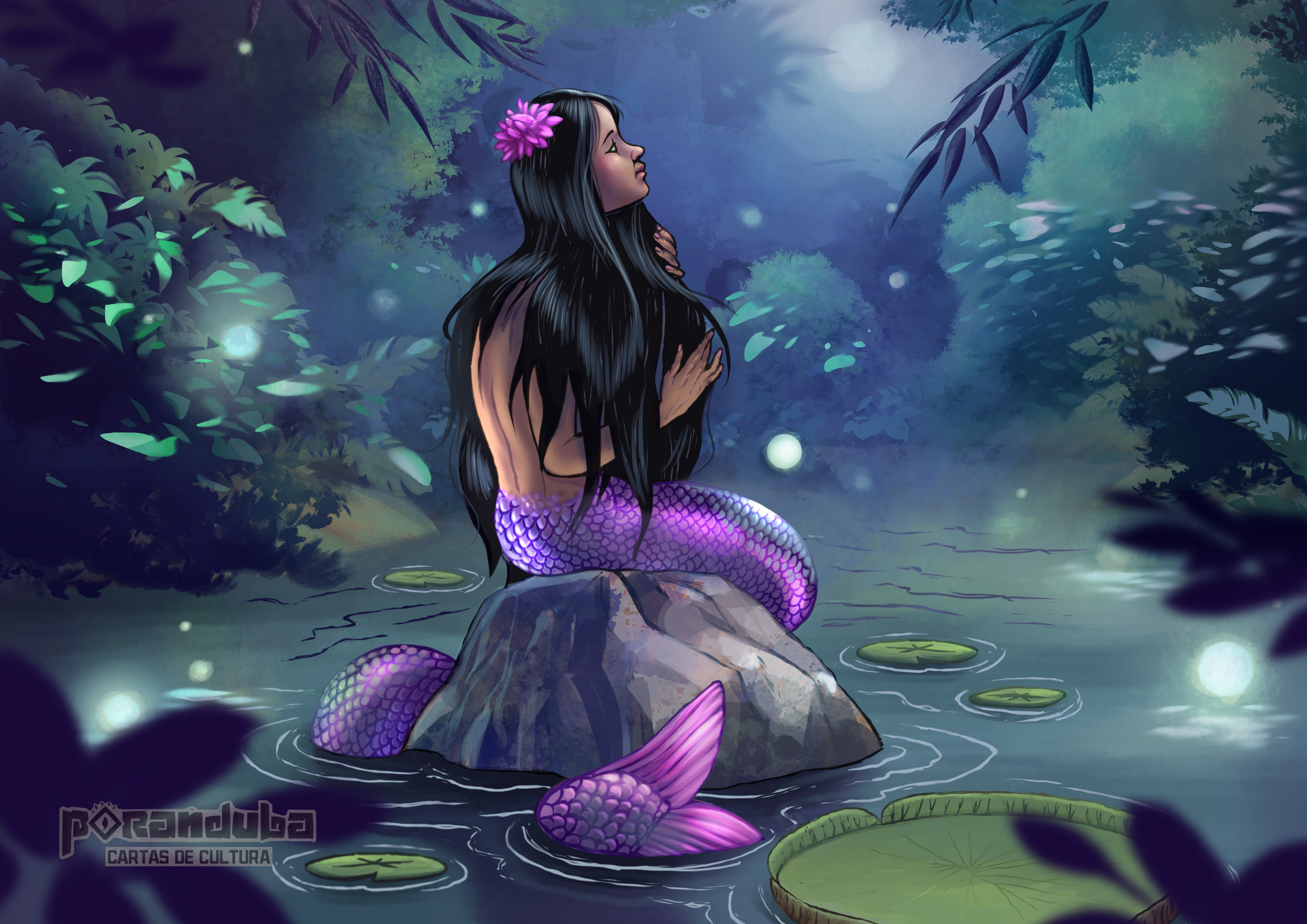
Illustration by Rafael Limaverde
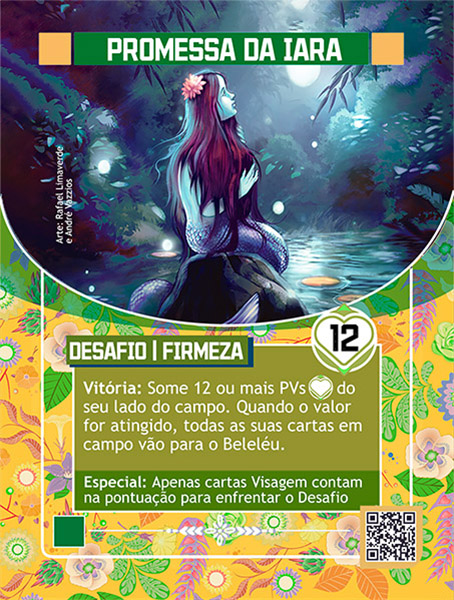
Iara’s Promise
Folklore and history
Iara
Half woman, half fish, endowed with stunning beauty and capable of leading men to ruin with a single glance. Although certainly one of the most popular myths in Brazil, frequently related to indigenous culture, Iara – as we know her – emerges from the relationship with the Portuguese colonizers.
From Ipupiara to Iara
In his "Dictionary of Brazilian Folklore," Câmara Cascudo was categorical: "No chronicler of colonial Brazil records the Mother of the Waters as a mermaid, attracting by song or simply transformed into a woman. It is always the Ipupiara, fierce, hungry and brutal." Ipupiara is one of the first myths recorded in the country, already mentioned by Father José de Anchieta in 1560. The accounts speak of a monstrous, brutal sea creature, endowed with long whiskers and frequently masculine.
It is only in the 19th century that the first records of a Y-Iara, "lady of the waters" in Tupi, appear. Curiously, the apparition is no longer described as horrendous, but as beautiful; it is not violent, but its victims die in the same way. Iara is a euphemized version of Ipupiara, which combines the myth of the Water Monster with the imagery of the European mermaid, in vogue thanks to the romantic poets of the period.
Because of the influence of Romanticism, it is curious to see how Iara is frequently described as being completely foreign. For Gonçalves Dias, it is a “beautiful creature with long golden hair”. For Melo Morais Filho, they appear “whiter than the teeth of tapirs, blonder than the skin of jaguars”. Not to mention Olavo Bilac, who overflows with illusory love for the creature with golden hair, moist green eyes, and a soft, white breast. The European influence is clear; and all artistic interpretations of a iara with indigenous features are from more contemporary times.
The power of the face
For Jesus Paes Loureiro, a great researcher of the Amazonian imaginary, the great source of the iara's power is neither in her song nor in her body, but rather in her face. “The other myths of the Amazon express themselves through the whole body,” he writes. “But the iara is the reality of her face. A synthesis of a legend of an indigenous soul revealed in a Europeanized face.”
Paes Loureiro’s informants say that whoever sees Iara’s face can never forget it. “Sooner or later he will end up throwing himself into the river in search of her, driven by the ardent desire to join his body to hers.” They say that Iara sings promises of an eternal life by his side at the bottom of the waters, leading the unwary to be eternally lost in her domain.
A recent version and its sources
A version of the Iara legend that attempts to give her an indigenous origin is quite common on search engines and social media. In this story, Iara is a beautiful and courageous warrior who, because of her skill, attracted the envy of her brothers, who ambushed her. Iara survived, but ended up killing her brothers in self-defense. Disgusted, her father sentenced her to death, and her body was thrown into the Solimões River. Taking pity on the girl, the fish asked the moon to watch over her. Thus, she was reborn as Iara, the Brazilian mermaid.
Despite the uplifting and empowering message, it was not possible to locate this story in the accounts consulted: neither in the ancient chroniclers nor in research with communities. The record found is on a blog from the early 2000s. Without an identified earlier source, there is no basis to present this version as a traditional narrative of an indigenous people.
Iara and Mãe D’água
Nowadays, Iara and Mãe D’água are commonly considered synonymous. However, the myth of Mãe D’água is often described as a formless apparition, like an elemental spirit of water. At the beginning of the 19th century, the botanist and anthropologist Von Martius recorded the narrative of a “Paranamaia,” Mãe D’água in the translation he presents, which had the form of a serpent. A very common symbolism, since the snake is sometimes considered a living metaphor for the river itself.
There are also accounts of those who see Mãe D’água as an old woman, while Iara is a young woman. Mãe D’água is silent while Iara has a voice and sings. Or even that Mãe D’água is ugly and shy while Iara is a beautiful apparition. Everything will vary depending on the region where the story is heard.

Iara’s Promise
Challenge / Endurance
The lady of the waters promises you eternal life beneath the river… as her servant. Resist her call.
Win · Have at least 12 HP on your side of the field. Once you reach the target, send all cards on your field to the Beleléu (your discard pile). Special · Only Wonder cards count toward the target.
Download the high-resolution artwork
References
- CASCUDO, Luís da Câmara. Dicionário do Folclore Brasileiro. São Paulo: Global, 2012.
- CASEMIRO, Sandra Ramos. A lenda da iara: nacionalismo literário e folclore. 2012. Dissertação (Mestrado em Literatura Brasileira) – Faculdade de Filosofia, Letras e Ciências Humanas, Universidade de São Paulo, São Paulo, 2012.
- HAUG, Martha Johanna. Espíritos da água: Nossa Senhora da Guia, Cuiabá-MT. UNICiências, v. 9, p. 73–88, 2005.
- LOUREIRO, João de Jesus Paes. Cultura amazônica: uma poética do imaginário. 4. ed. Belém: Cultural Brasil, 2015.