
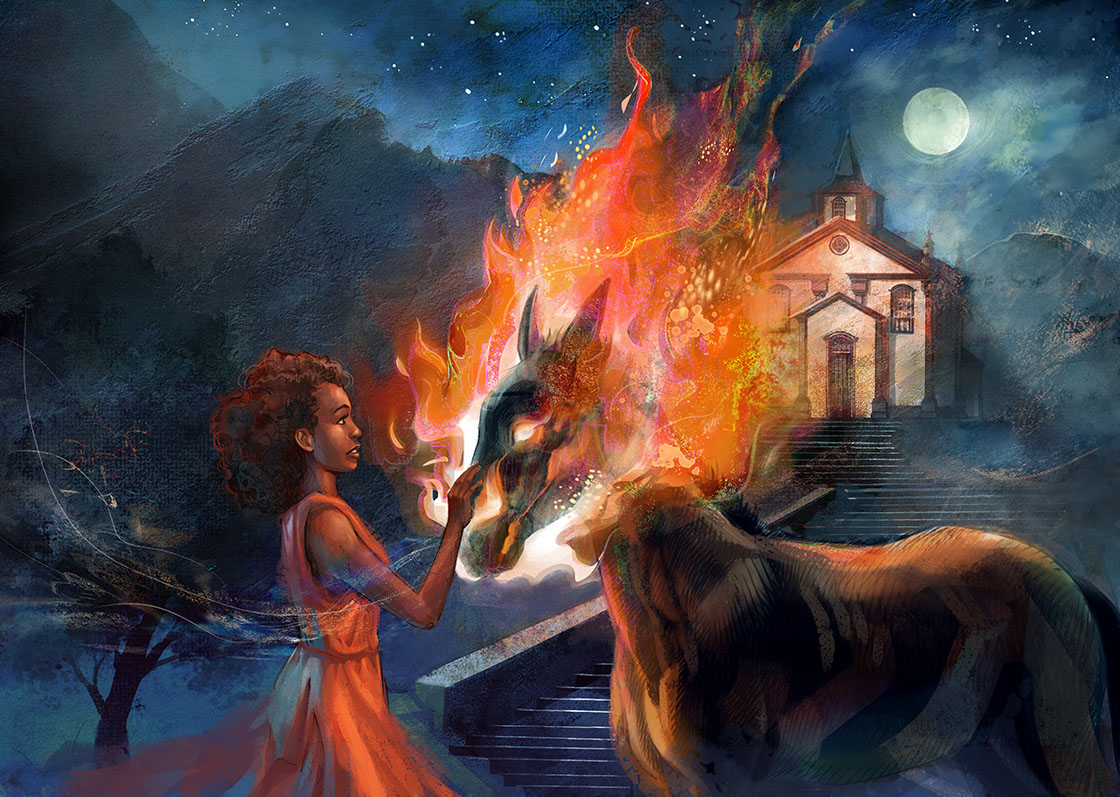
Illustration by Pâmela Vianna
Headless Mule
Folklore and history
The Headless Mule is a Brazilian myth that arose from strong Catholic influence during the colonial period. It tells the story of a curse that befalls women who commit an interdict, a forbidden act. Because of this, on Thursday nights, they take the form of a large, headless black mule. In its place, it expels flames from hell itself that burn it from the inside out.
When transformed, the mule must run an enormous distance, passing through seven churches, seven cemeteries, and seven parishes (villages). It is the same route that the werewolf must take during its ordeal. On this journey, the Mule tramples everything and is capable of destroying the eyes, teeth, and nails of anyone who looks at it. That is why, according to tradition, one should lie on the ground and hide their nails when this apparition is passing by.
The taboo and its punishment
The best-known versions say that the interdiction that the mule breaks is the relationship with a Catholic priest. However, there are other examples. Alceu Maynard Araújo says that the unmarried girl who has sexual relations before marriage receives the curse. Simões Lopes Neto, when describing the type of person who becomes a Mule, says that they are "women of ill repute." Gustavo Barroso is more objective and relates the mule to a metaphor with prostitutes.
The lack of a head on the mule is symbolic. It represents the abandonment of reason. As if these women had abandoned the faculties of thought to give vent to the pleasures of the flesh. It is not without reason that they abandon the human form and assume that of a beast. The transformation is, above all, a martyrdom. Câmara Cascudo points out that many accounts say that the mule's neigh sounds like a groan, as if it were dying of pain. Sometimes, the apparition is even mounted and tortured by the devil himself, who tears open its belly with his fiery slippers.
To prevent the person from transforming, accounts say that every Friday, for seven years, the priest must curse the woman he slept with before mass. Manuel Ambrósio, quoted by Cascudo, says that the priest should, in truth, curse her seven times seven times, which traditionally refers to infinite quantities. One of the moments, the folklorist points out, is to excommunicate her right before putting on the slippers; to metaphorically "step" on the woman throughout the day of prayers.
Recognition and the breaking of the spell
In Brasil Interior, Manoel Ambrósio describes a way to discover who was transformed into a mule. When the woman passed by on her way to mass, one of her footprints in the sand was covered with a piece of tile. It was necessary to wait hidden until she returned by the same path. Upon removing the tile, the mark of a shod hoof would appear in place of the human footprint.
It is curious to note how, in the case of the breaking of the interdicts, the woman is transformed into a monster while the priest – who also broke his vows – receives no punishment. In truth, there are, in the work of certain scholars, some accounts of a "headless horse," which would be the male version of the myth that arises after the priest's death. However, the very popular ignorance of this version shows how the punitive imagery of the woman is much more significant. Today, finally, these narratives are being questioned more.
There are two ways to definitively disenchant a woman turned into a headless mule. The first is by drawing her blood with a virgin pin. The blood will act as a redeeming element, as a baptism, a mark of the suffering brought about by the supposed learning that the cursed punishment brought. The second possibility is more promising: removing the mule's enchanted iron bridle, which rests amidst the infernal flames of her neck. An act of courage, removing the mule's bridle is a metaphor for returning the woman's freedom.
Another version
In Monteiro Lobato's "O Saci," when Pedrinho asks Uncle Barnabé what the story of the Headless Mule is, he hears an answer that is unfamiliar to us.
“They say that long ago there was a king whose wife had the mysterious habit of strolling through the cemetery on certain nights, not allowing anyone to accompany her. The king was bothered by this and one night decided to follow her without her noticing. In the cemetery he came across a horrendous thing: the queen was eating the corpse of a child buried the day before, which she herself, with her own hands full of rings, had unearthed! The king screamed. Seeing herself caught, the queen screamed even louder — and immediately turned into that headless mule, which from that moment on never stopped galloping through the world, always vomiting fire from its nostrils.”
It was not possible to identify any other record of the Mule like this, in which the taboo has nothing to do with the body and sexuality, but rather with the devouring of corpses. Everything indicates that it is a creation of the writer.

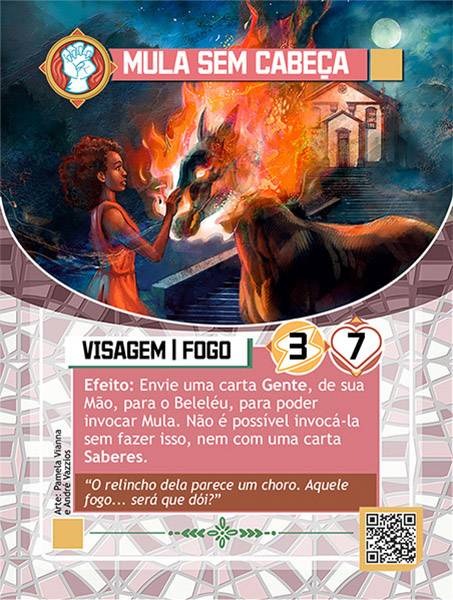
Headless Mule
Strength: 3
Health: 7
Wonders / Fire
“Her whinny sounds like crying. All that fire… I wonder if it hurts.”
Transformation Ritual · Fated Burden
To summon the Headless Mule, send a Folk card from your hand to the Beleléu (your discard pile). You must pay this cost even when using a Lore card to summon her.
Download the high-resolution artwork

References
- AMBRÓSIO, Manoel. Brasil interior: palestras populares e folk-lore das margens do São Francisco. Organização de Ramiro Esdras Carneiro Batista, Ros’elles Magalhães Felício e Maria do Socorro Vieira Coelho. 3. ed. rev. e ampl. Formiga, MG: Editora Unigala, 2024. (educapes.capes.gov.br)
- CASCUDO, Luís da Câmara. Dicionário do Folclore Brasileiro. São Paulo: Global, 2012.
- CASCUDO, Luís da Câmara. Geografia dos mitos brasileiros. São Paulo: Global, 2002.
- COSTA, Andriolli. A mulher do padre: tradição e misoginia na adaptação audiovisual do mito da mula sem cabeça. In: CONGRESSO BRASILEIRO DE CIÊNCIAS DA COMUNICAÇÃO, 40., 2017, Curitiba. Anais […]. São Paulo: Intercom, 2017. p. 1–14. (www.portalintercom.org.br)
- LOBATO, Monteiro. O Saci. São Paulo: Brasiliense, 2005.
- MAGALHÃES, Basílio de. O Folclore no Brasil. Rio de Janeiro: Imprensa Nacional, 1939.
- NORTE, João do. Mulas sem cabeça. O Jornal. Rio de Janeiro. 19 jan. 1922. (memoria.bn.br)
- PEREIRA, José Carlos. O encantamento da Sexta-Feira Santa. São Paulo: Annablume, 2005.