
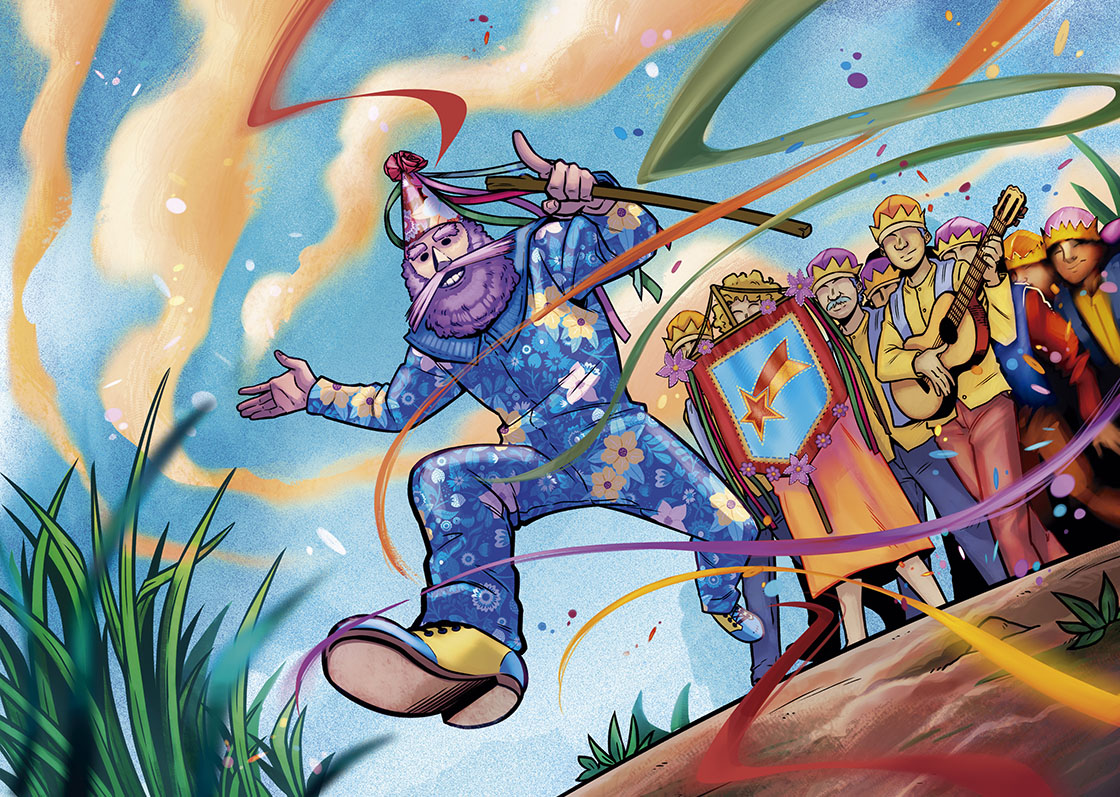
Illustration by Lorena Herrero (HET)
Folia Clown
Folklore and history
Folia Clown is one of the several names by which the masked revelers who are part of the Folias de Reis are known. Depending on the region of Brazil, they may also be known as Bastiões, Cireneus or Marungos. And each one reveals, in its meaning, a little more about this mysterious character.
The names of the clown
Cyrene refers to “Simon of Cyrene,” the cross-bearer. He was a man forced by Roman soldiers to carry Christ's cross to Golgotha—the place where Jesus was crucified. The masked Cyrene is, therefore, a penitent. It is not without reason that it is very common for people to assume the figure of the clown (one of the most controversial in the folia) precisely to fulfill a promise.
Bastião is one of the generic names by which characters linked to the black population are usually baptized in folk tales and games. It is a corruption of “Sebastião” and serves to show us how the Folia, despite being a fundamentally Catholic festival introduced by the Portuguese, received so much influence from the black population that its most notorious performer came to be recognized as one.
This influence is in the dances, the rhythm, the drums, and the people themselves. It is also interesting to note that many folias visit Umbanda and Candomblé terreiros and pay homage to the orixás, just as they would to the saints they would find when visiting a Catholic house. An important sign of respect and integration.
But what really reveals the Afro-Brazilian influence in the Folia Clown is the last name: Marungo. Its origin is from the word “malungo”, used by enslaved blacks in Colonial Brazil in the sense of companion, foster brother, person in the same condition. My malungo. My marungo. The etymology would come from the Congo language: sharing roots with words that would mean neighbor and ship. Intellectuals such as Pereira da Costa from Pernambuco would then suppose that it is a reference to those who went through the same experience of slave ships.
The names and forms of the folia
As for the Folia de Reis, it also has several names. It can be generically called “Reisado”, but it is important not to confuse it with the “Reisado do Congo” – as the coronation festivals of African kings and queens are called. Other times, they are called “Terno de Reis”, which refers to the Three Wise Men, those who came from the East guided by the Star of Bethlehem, to present gifts to the baby Jesus.
There is also another name, perhaps less common: “Caravan of Saint Francis of Assisi”. The basis for this is historical: the festivities arrived in Brazil through the Jesuits, during the efforts of catechizing the colonization of the indigenous peoples. And there were two main influences: the Portuguese theater of Gil Vicente and the living nativity scenes – a staging created by Saint Francis of Assisi in 1223.
There are some attempts to identify a rule in the nomenclature. The “Terno de Reis” supposedly has no clowns, and so on. In practice, however, the people are much less rigid with these limits. It varies from group to group. Some Folia masters have more than a dozen clowns in their companies. Others, in turn, have none and reject the performer both for their irreverence and their profane character.
From Herod's soldiers to the procession
There are several traditional narratives that explain the emergence of clowns. In some places, they are seen as devils; in others, as Herod the Great himself – the one who ordered the killing of all children under 2 years old when he learned of Jesus' birth. In one of the best-known versions, they would actually be Herod's soldiers – sent to spy on the Three Wise Men in their search for Jesus. Their goal was, upon discovering the birthplace of Christ, to return and reveal their position so that the king of Judea would kill them.
However, tradition says that they repented, converted right there, and began to mislead their pursuers. That is why, in some regions, tradition dictates that Folia participants never return by the same route they took when visiting the nativity scenes from house to house. In addition, the role of the festival organizer is, symbolically, to distract from the threats and allow the procession to pass.
The calendar and the participants
The Folia de Reis takes place, especially, between December 24th and Epiphany, on January 6th. In some cities where Saint Sebastian is the patron saint, as is the case in Rio de Janeiro, the saint's day is also included in the celebration, which has a special departure on January 20th. The folias continue to be active, visiting houses and gathering resources for their Festa de Arremate: the grand closing, open to the community. There are arremates that take place until the month of June.
A Master leads the folia, accompanied by a Countermaster and the ensign, who carries the flag. For the most traditionalists, the clown should never pass in front of the Flag – which always generates malicious comments when it happens.

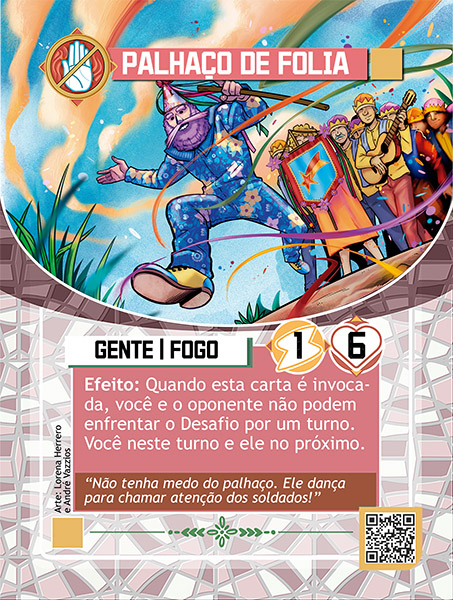
Folia Clown
Strength: 1
Health: 6
Folk / Fire
“Don’t be afraid of the clown. He’s dancing to draw the soldiers’ attention!”
Distraction · Pause
When you summon this card, you cannot face a Challenge this turn. Your opponent cannot face one on their next turn.
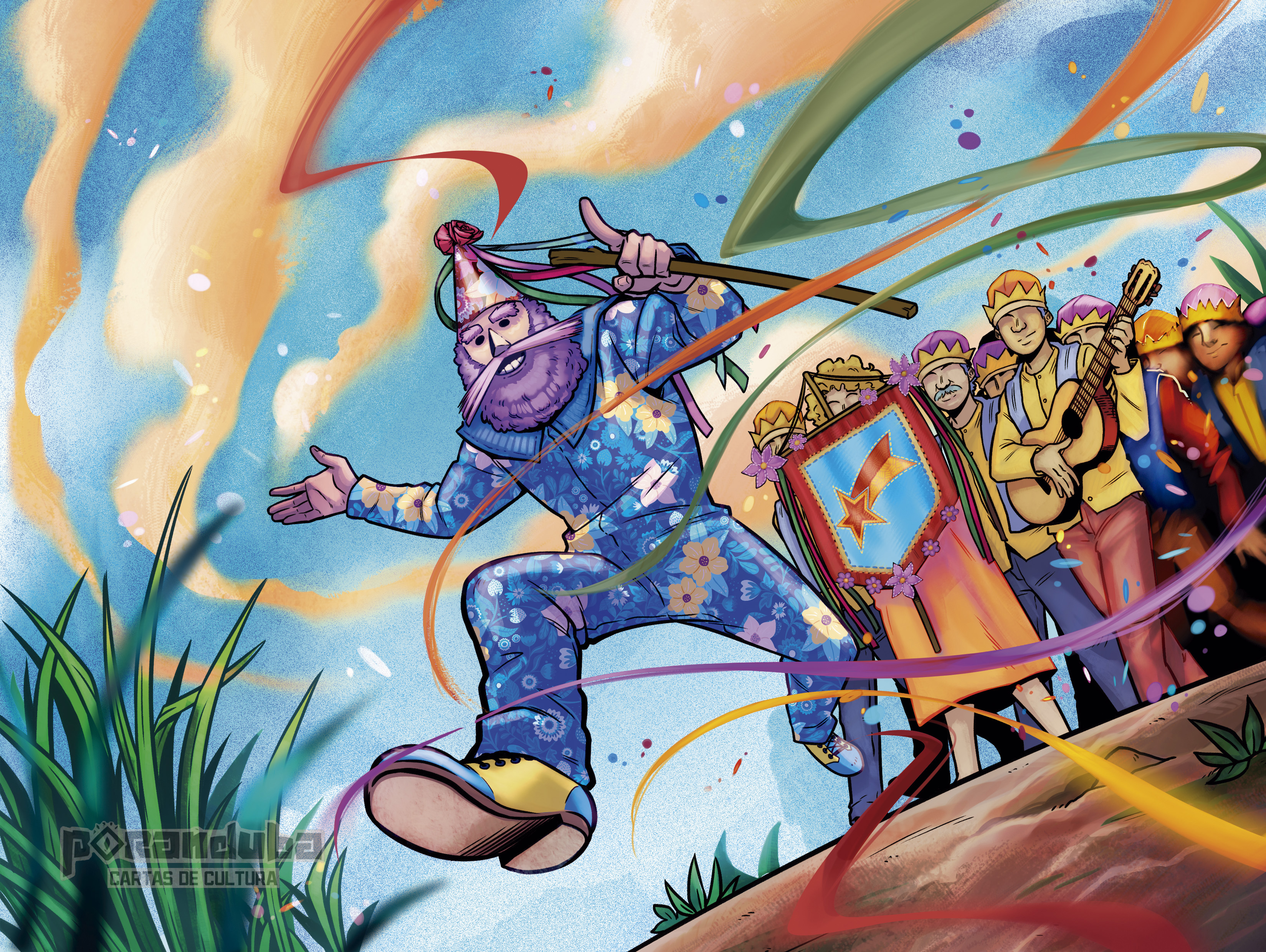
Download the high-resolution artwork
References
- CASCUDO, Luís da Câmara. Dicionário do Folclore Brasileiro. São Paulo: Global, 2012.
- GORZONI, Priscila de Paula. Os mascarados das Folias de Reis: uma análise das máscaras da Companhia Santa Cecília, de São Caetano do Sul no ABCD paulista, e da Companhia da Serraria, de São Thomé das Letras, no Sul de Minas Gerais (2009–2012). 2014. Dissertação (Mestrado em Ciências da Religião) – Pontifícia Universidade Católica de São Paulo, São Paulo, 2014. (tede2.pucsp.br)
- LIMA, Rossini Tavares de. Folguedos populares do Brasil. São Paulo: Ricordi, 1962.
- NORONHA, Regina. O Natal no folclore brasileiro. Revista Geográfica Universal. Rio de Janeiro: Bloch, v. 109. n. 12, p. 17–25, 1983.
- PERALTA, Patricia. Palhaços & Personagens da Folia de Reis do Estado do Rio. Revista Interfaces, v. 8, n. 1, 2002.