
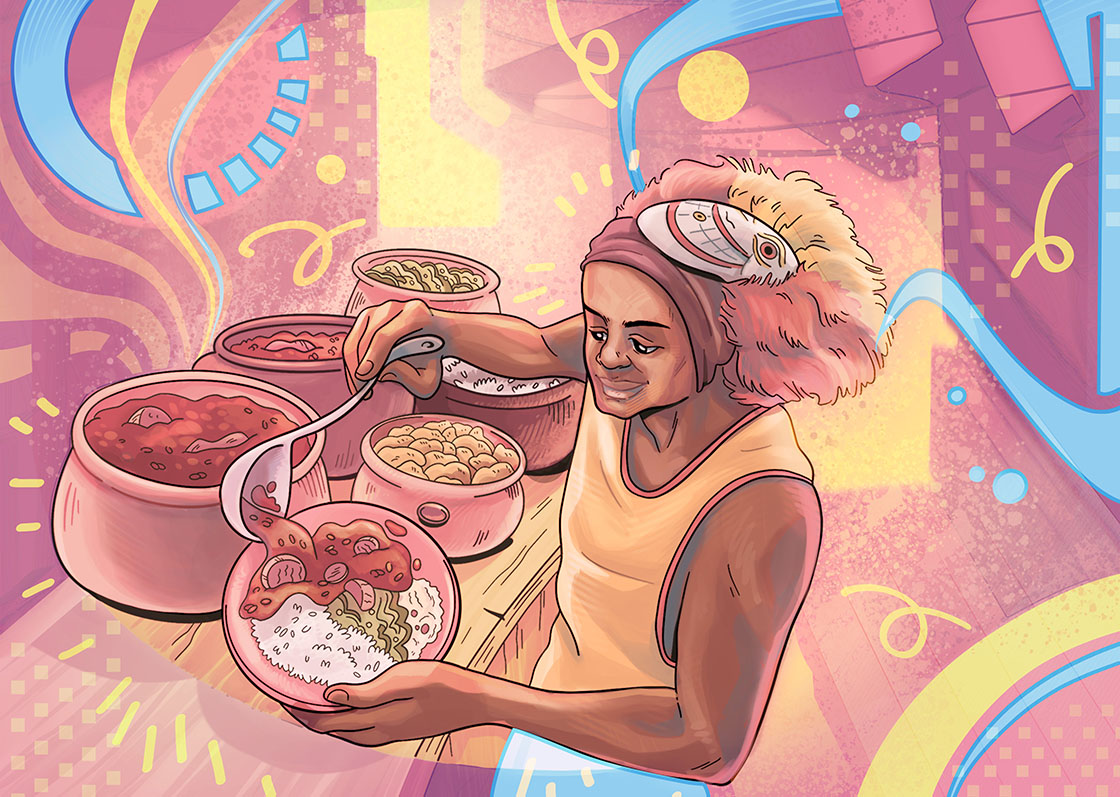
Illustration by Mayara Lista
Feijoada
Folklore and history
More than a dish, feijoada is culture! Beans with sausages and pieces of pork are just a fragment of tradition. A complete feijoada can include rice, kale, and pork rinds among its accompaniments. The dish is accompanied by the gathering to prepare and serve it; a mark of a special moment for family and friends.
Stories about the origin of feijoada
There are two common misconceptions regarding this typical dish. The first is that feijoada is a result of the cuisine of the slave quarters, since – according to this version – the rich kept the prime cuts of pork, while the offal was destined for the enslaved Black people. This is not true. The fundamental food in the slave quarters was beans with flour. Dried meat, at most.
Offal, of all kinds, is widely used in Portuguese cuisine as a delicacy. It is not without reason that in the cookbook "Cozinheiro Nacional" we find delicacies such as pig's ear pudding, prepared with 20 units of pork parts.
The second misconception that has frequently circulated is that feijoada is not a typical Brazilian dish. Proponents of this version say that, "in fact," other dishes already existed composed of beans (or broad beans) with meat and offal. For example, there is talk of French cassoulet (made with white beans, carrots and chicken) or Asturian fabada.
This interpretation is also incorrect and is centered on a false idea that there is only one “true” culture, and the others are minor variations. In truth, historians point out that beans were already widely used in Europe since the Middle Ages – but it was a different bean, the faséolo, which was white with a black “eye”. With colonial expansions, other grains spread throughout the world, transforming dishes based on the unique combinations of each region.
A Brazilian creation
Feijoada is a Brazilian creation, inspired by Portuguese customs. The habit of eating stews, using dried meat, bay leaf, and sautéing garlic and onion is a Lusitanian legacy. From the indigenous people, we have the consumption of beans with cassava flour, two ingredients that are easy to transport, which were popularized with colonization. The combination of habits forms a unique dish.
This Brazilian identity also includes regional differences. In A arte culinária na Bahia, Manuel Querino (1957, p. 59–61) records the preference for mulatinho beans and observes that other people value black beans more. His recipe includes charque, bacon, sausage, and salted pork. Among the seasonings are onion, garlic, tomato, and black pepper. Even the choice of beans reflects the tastes of those who prepare and those who eat.
Câmara Cascudo points out that it was in the 18th century that rice began to replace cassava flour as a main meal, creating the combination of "rice and beans." Feijoada, being an evolution of everyday beans, takes on an air of familiarity, but with the distinction of a celebration, a special moment. Feijoada is food, but it is also a gathering, a way of making and experiencing.
Feijoada beyond Brazil
It is also curious to see how our feijoada has inspired other dishes. In some African countries, such as Benin, "féchouada" is known, a stew of meat with tomato sauce, white beans, and legumes. The influence is undeniable, but the dish remains typical for these countries. (www.youtube.com)

Feijoada
Lore
“Dona Maria’s boy ate feijoada and went to play in the pool. You can guess the rest, can’t you? Poor thing…”
Sleeping It Off · Pause
Your opponent is resting after a big meal. They cannot face a Challenge for one turn.
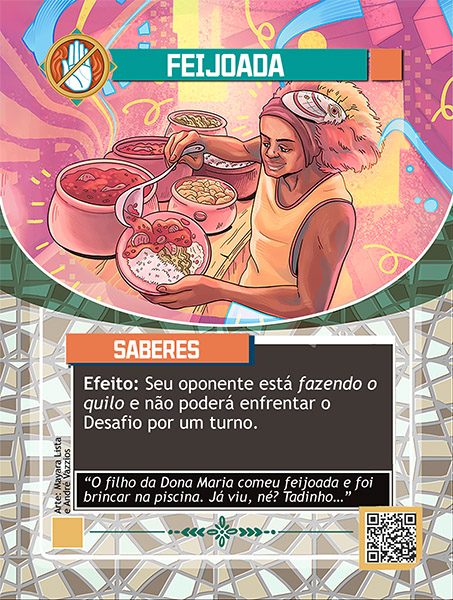
Download the high-resolution artwork

References
- BITELLI, Fábio Molinari; JUREMA, Maria Luíza Melquiades. Feijoada: origem e considerações acerca de um patrimônio cultural imaterial. Contextos da Alimentação: Revista de Comportamento, Cultura e Sociedade, São Paulo, v. 7, n. 1, p. 20–35, nov. 2019. (www3.sp.senac.br)
- CASCUDO, Luís da Câmara. História da Alimentação no Brasil. São Paulo: Global, 2023. (www.amazon.com.br)
- COZINHEIRO nacional, ou collecção das melhores receitas das cozinhas brasileira e européas. Rio de Janeiro; Paris: Livraria Garnier, [s.d.]. (biowit.files.wordpress.com)
- CUISINE BÉNINOISE ET D’AILLEURS. Féchouada // Feijoada. YouTube, 4 fev. 2021. Vídeo. (www.youtube.com)
- MACIEL, Maria Eunice. Uma cozinha à brasileira. Estudos Históricos, v. 1, n. 33, p. 25–39, 2004. (periodicos.fgv.br)
- QUERINO, Manuel. A arte culinária na Bahia. Salvador: Livraria Progresso Editora, 1957. (digital.bbm.usp.br)