
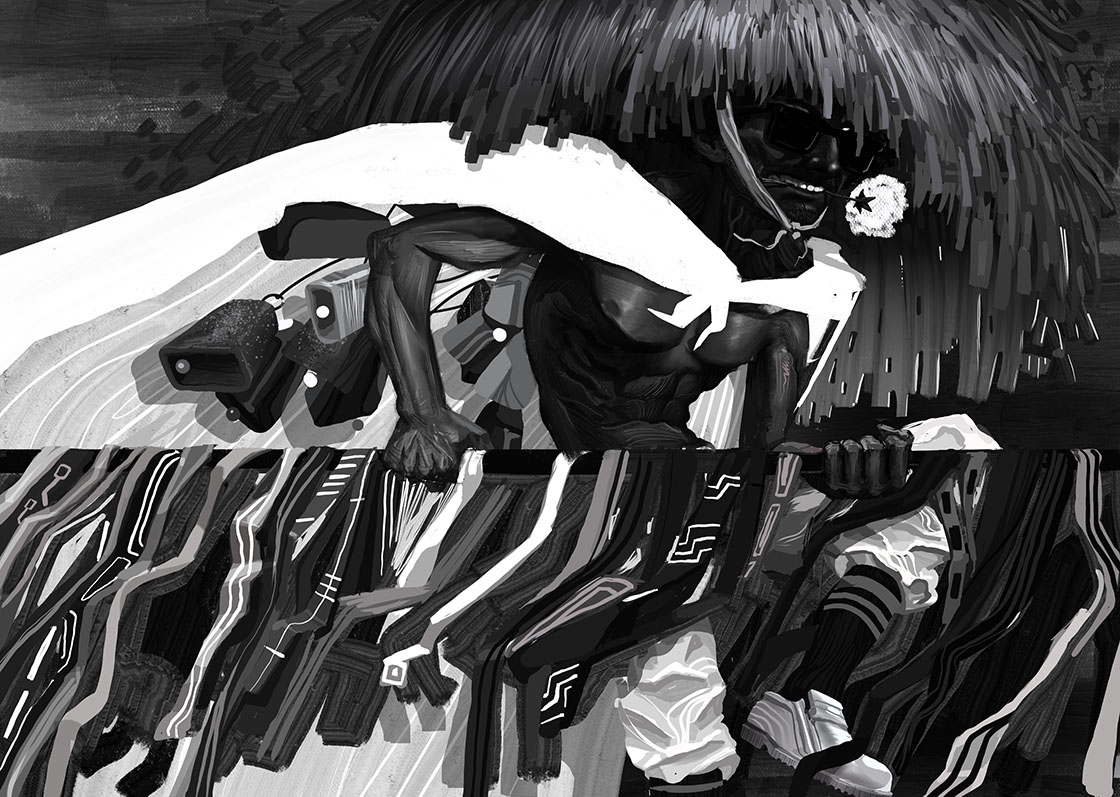
Illustration by João Queiroz
Caboclo de Lança
Folklore and history
There are two forms of maracatu: Maracatu Nação, also called baque virado, and Maracatu de Orquestra, or baque solto. The latter is better known as Maracatu Rural, distinguishing it from the Nação tradition of metropolitan Recife. Maracatu Nação is the older form, documented as early as the eighteenth century. People long described Nação as religious and Rural as more secular. The groups themselves tell a more varied story. In Nazaré da Mata, known as the Land of Maracatu, many groups give the calunga doll and its preparatory rituals as important a religious role as groups in the capital do. There are also Christianized maracatu groups that exclude Afro-Brazilian religious practices.
In Nazaré da Mata, home of Maracatu Rural, the Caboclo de Lança is the central figure. His bearing is martial, his image one of masculine strength. It takes real strength, too, to carry his heavy cloak in the heat.
The Caboclo de Lança embodies masculinity, the Dama do Paço femininity. In some groups both roles require ritual “purity”, including sexual abstinence and, for women, restrictions connected with menstruation. Performers who observe these practices say that neglecting them can leave a person unwell or in difficulty during Carnival. The body has to be prepared.
One of the traditions among the Caboclos de Lança is the use of azougue, a ritual drink described in different preparations. In Mestre Simões’s statement collected by Olímpio Bonald Neto, lemon, gunpowder, brandy and sweet olive oil appear, in a mixture taken in honor of Zé Pelintra. The name also designates mercury, a liquid metal at room temperature.
There is a gentler detail in the warrior’s costume: the lance bearer carries a flower in his mouth. The feminine is there in the masculine, tenderness alongside the brutality of war. Such pairings run through maracatu.
The lance, or guiada, is sacred. The caboclo makes it himself or receives it as a gift from a master. Others, particularly women, must not touch it, lest it lose its power.
The calunga, by contrast, passes from hand to hand before the procession sets off, until it reaches the dama do paço. Here again the masculine and feminine roles differ. Performers may also seek protection for themselves through calços, protective charms prepared alongside the procession.

References
- BRITO, Fabelly Marry Santos. “Maracatu não é par, é ímpar”: práticas culturais, representações e identidades no maracatu rural de Pernambuco (2000–2014). 2020. Dissertação (Mestrado em História) – Universidade Federal de Campina Grande, Campina Grande, 2020.
- INSTITUTO DO PATRIMÔNIO HISTÓRICO E ARTÍSTICO NACIONAL. Maracatu de baque solto: patrimônio cultural imaterial do Brasil: dossiê de candidatura. Recife: Iphan, 2013.
- INSTITUTO DO PATRIMÔNIO HISTÓRICO E ARTÍSTICO NACIONAL. Registro do Maracatu de Baque Solto como Patrimônio Cultural do Brasil. Bem Brasileiro. [s. d.]. Disponível em: https://bcr.iphan.gov.br/acoes-de-salvaguarda/registro-do-maracatu-de-baque-solto-como-patrimonio-cultural-do-brasil/. Acesso em: 10 nov. 2026.