
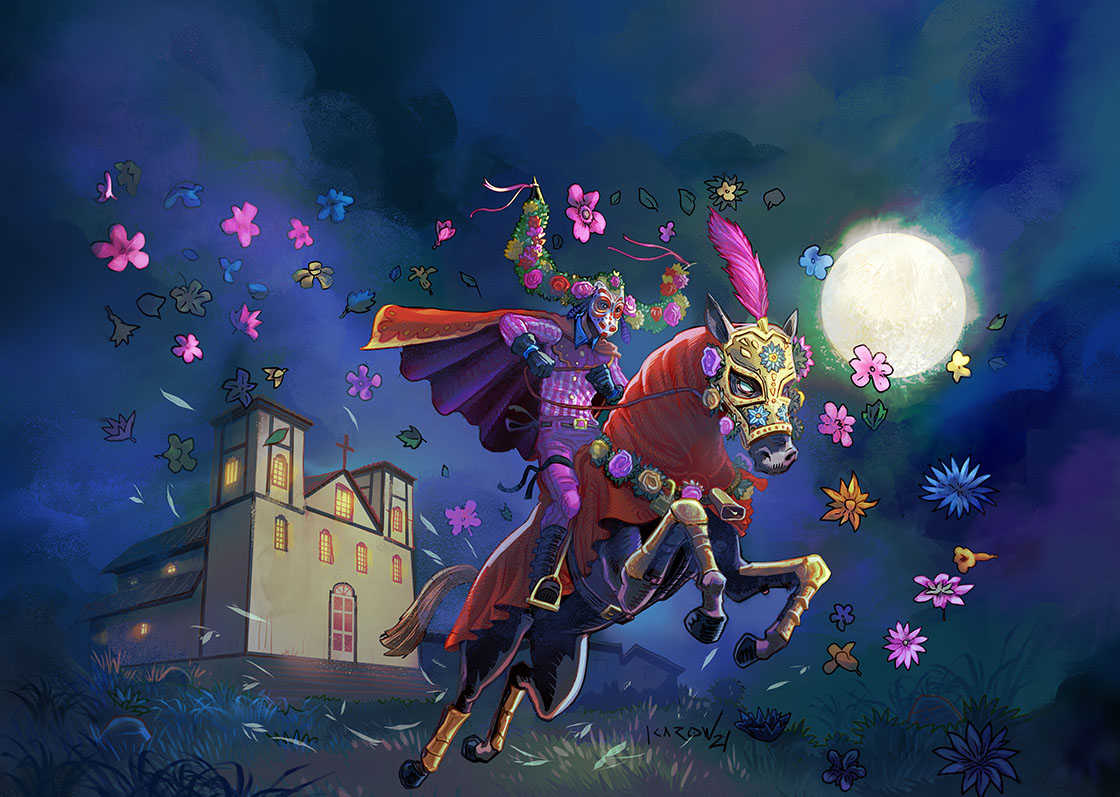
Illustration by Ikarow
Curucucu
Folklore and history
Curucucu is one of the names given to a masked performer typical of the cavalhadas in the city of Pirenópolis (GO), located about 130 km from the capital Goiânia. There are cavalhadas throughout the national territory, but the masked performers of this region are known for their extravagant antlers, always very decorated and colorful.
The cavalhadas and their characters
Cavalhadas are popular festivals in which the wars between Christians and Moors are reenacted. This is a very common element in our popular culture and has a direct Portuguese heritage. "Moor" comes from the Latin language and means "dark"; it was also the name generically given to the Islamic peoples who invaded the Iberian Peninsula in the 8th century and occupied territories of Portugal and Spain until the end of the Middle Ages, in the 15th century.
During the cavalhada, this war is reenacted through the confrontation between two armies, with literature as its main inspiration – especially an epic poem called "The Song of Roland". On the blue side are Charlemagne and the 12 peers of France, his elite guard known as the "paladins". On the red side are the Moors, often represented by a giant king known as Ferrabrás.
There are several ways to celebrate the cavalhadas throughout Brazil. In some places, the focus of the festival is on skill competitions – a legacy of medieval tournaments that served as entertainment for knights between wars. In this context, the highlight is the "ring toss," in which the knight must use a lance to collect rings attached to the field.
The festival in Pirenópolis
Another way to celebrate the festival is by focusing more on the theatricality of the competition, with the participants taking on the roles of characters. In Pirenópolis, there is a mix of theater and skill tests, with the two armies being formed by a king, an ambassador, and ten knights. Another peculiarity of Pirenópolis is the date: traditionally, the cavalcade takes place alongside the celebrations of the Feast of the Divine, on Pentecost Day.
There are three days of events in the city of Goiás, and, on each of them, the cavalcade advances in its plot and presentations. The plot begins with the discovery of a Moorish spy in Christian lands, represented by a jester wearing a jaguar mask who is killed by the enemy. Each army takes its place, representing its castle, and is visited by the opponent, who tries to convince them to change their religion. With the failure of the dialogues, the war begins.
The disputes continue throughout the second day, when the Christians surround the Moors, who are surrendered and converted to Christianity. On the third day, there is no more war, only fraternization and tests of skill.
The anonymity of the masked figures
During all these days of celebration, the Curucucus must remain anonymous. Not even members of their family should know who the masked figures are who appear between tests to provoke and entertain the audience between the skill tests. Their name is an onomatopoeia and comes from the shouts they make to cause a ruckus.

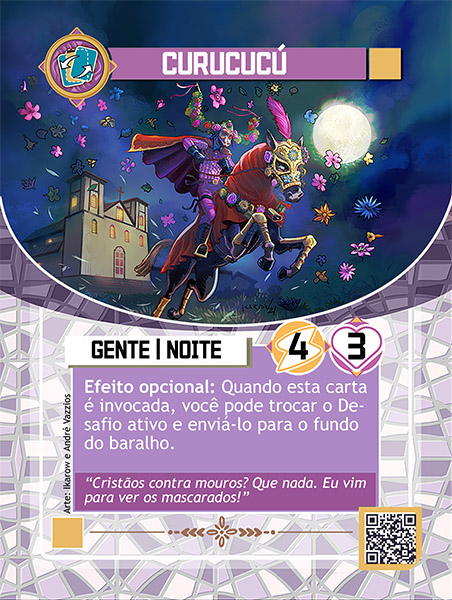
Curucucu
Strength: 4
Health: 3
Folk / Night
“Christians against Moors? Never mind them. I came to see the masked riders!”
Cavalhada · Swap
When you summon this card, you may swap the active Challenge. Put it on the bottom of the deck.
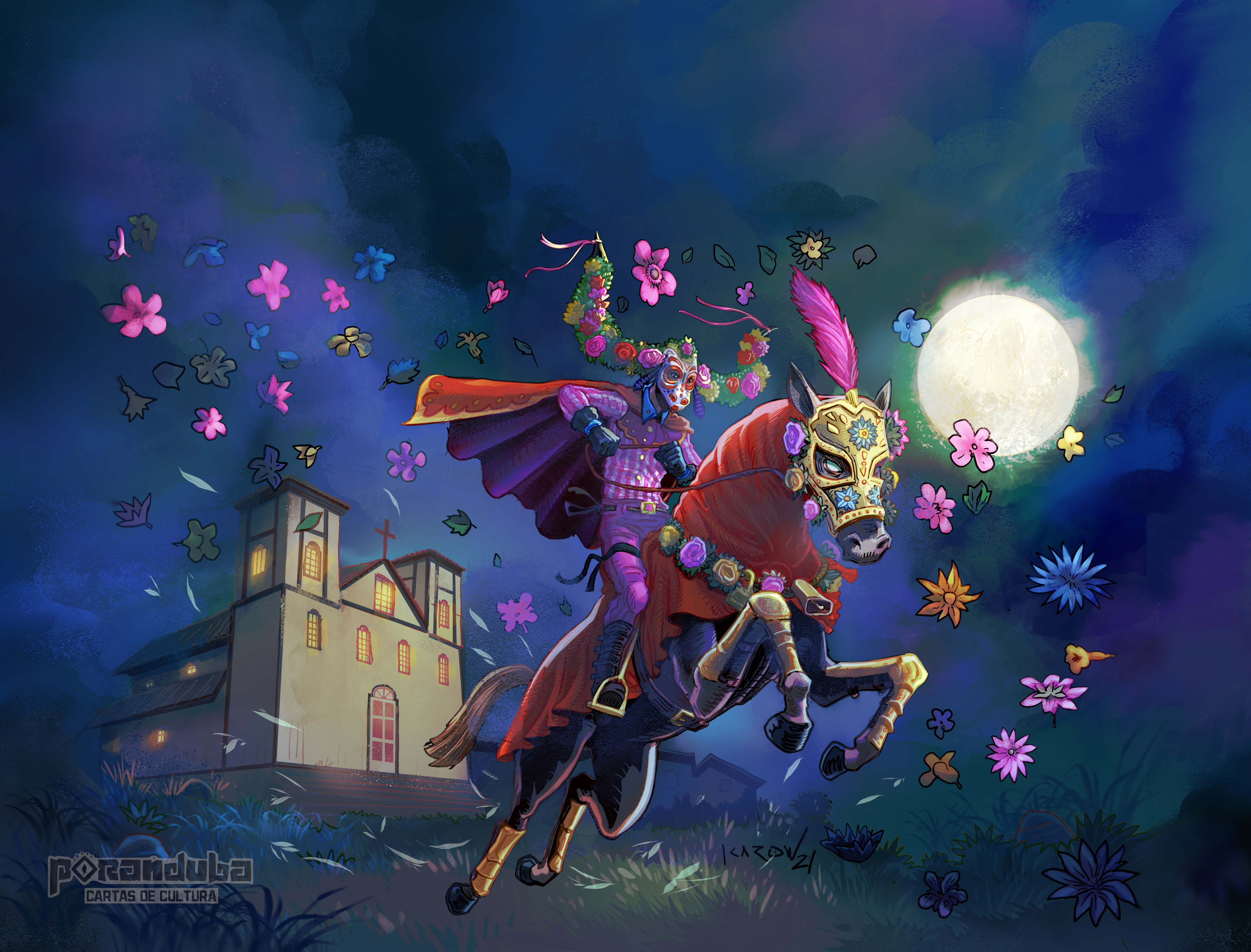
Download the high-resolution artwork
References
- BRANDÃO, Carlos Rodrigues. Cavalhadas de Pirenópolis: um estudo sobre representações de mouros e cristãos em Goiás. São Paulo: Oriente, 1974.
- GONZALEZ, Lélia. Festas populares no Brasil. Rio de Janeiro: Index, 1987.
- SPINELLI, Celine. Cavalhadas em Pirenópolis: tradições e sociabilidade no interior de Goiás. Religião e Sociedade, v. 30, n. 2, 2010. p. 59–72.