
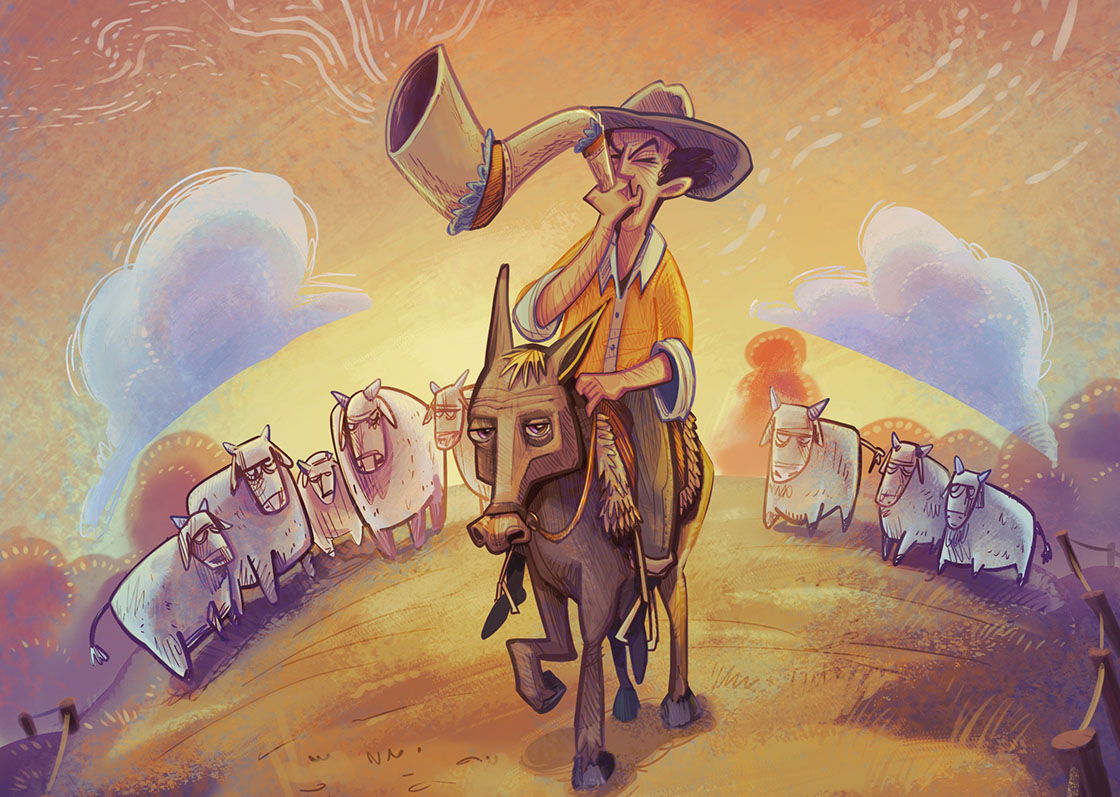
Illustration by Augusto Figgliagi
Cattle Drover
Folklore and history
The bonfire, the night Hammocks in the shed The cigarette, the fashion, The mate, the conversation The saga, the fate The “tale” and jaguar There's nothing more Oh cowboy… – Cowboy (1986), by Almir Sater and Renato Teixeira
The rhythm of the waters
As Augusto César Proença recalls, in the Pantanal, everything depends on the waters: “They are what condition the various types of work, lead man to have the need for changes in the great floods, modify the soils, force certain birds to migrate to other places on the planet, pushing the cattle up the mountain ranges, break the monotony of the plain, isolating many farms”.
What happens is that the Pantanal Complex is a Brazilian biome characterized by two distinct moments of landscape transformation. The “flood,” from December to March, and the “recession,” from April to June. During the first, the rivers overflow and flood up to two-thirds of the Pantanal plain. When the rains stop, the water begins to disperse slowly, returning to its original position.
The wild fauna and flora, which evolved prepared for this environment, have adaptations that allow their continuity. But what about the animals that were introduced there by humans?
Cattle were introduced to the Mato Grosso region starting in 1719, foreshadowing the region's agricultural vocation. According to estimates, there are currently 3.8 million head of cattle in the Pantanal region alone. For the proper management of these animals between the flood and ebb periods, many ranchers own two properties: one in the lowlands, where the pasture will be more lush due to the floods that nourish the land; another in the highlands, to protect the livestock when necessary.
Life on a cattle drive
To move animals from one property to another, or even to take them to be sold at auctions, it is common to use the work of cattle drives. When a cattle driver lives on the farm and works there, he is called a "campeiro" (cowboy). When he travels driving cattle, we have the so-called "boiadeiro" (cattle driver). And it is there, living on the dirt road, sleeping in the open air, accompanying the cattle, that they experience and tell stories of apparitions and hauntings; tales and anecdotes.
In a tale collected by Ricardo Pieretti Câmara (2007), Seu Marcondes recounts that his group got lost after having lunch near a pond. The group was following a known trail, but could not find the low-water point that served as a reference for the path. They stopped the pack animals and began to look for the passage. Two cowboys moved away, entering the woods next to a fence.
When the others recognized the path again, they called for their companions with shouts and horn blasts. It was late afternoon when the two heard the calls and returned, following the fence. One of them had considered tying up the donkey and continuing the search on foot. Recalling the episode, Seu Marcondes insisted on what seemed inexplicable to him: they knew that place, the resting place was nearby, and yet they had lost their way.
Knowledge and customs of the cowboys
The popular culture of the cowboy is also manifested in their crafts. Many are great artisans and masterfully use cowhide to make their reins, lassos, harnesses, and saddlebags. With sheep's wool, they make sheepskins to protect the saddles of their mounts – usually donkeys.
Another custom is the consumption of ground yerba mate. When drunk with cold water, it is called tereré. When consumed with hot water, infusing the herb, the drink is simply called "mate" (and not "chimarrão," as the gauchos do). The beverage is served in a guampa, a cow horn, and drunk with metal bombillas, which function like a straw with a filter or sieve at the end.
The lead rider and the berrante
A cattle drive takes a whole crew. One of the most important jobs, and one of the most dangerous, belongs to the ponteiro. This rider leads the herd and is the only one who carries a berrante, an instrument made from cattle horn. Its calls steer the herd and carry messages to the other drovers. If the herd stampedes, the lead rider is directly in its path.
A berrante player learns to shape high and low notes with the lips. Some calls are well established, each with a particular job.
The Departure Call or Dawn Call is used to remove the cattle from the corral or to wake the herd in the morning. The Road Call is used to revive the herd on the road. We also have the Lunch Call or Garlic Burning Call to signal the time to stop for a meal; the Alert or Rebate, to warn of any danger; and, of course, the Flourish. This one has no direct function, it is a free call, for fun.

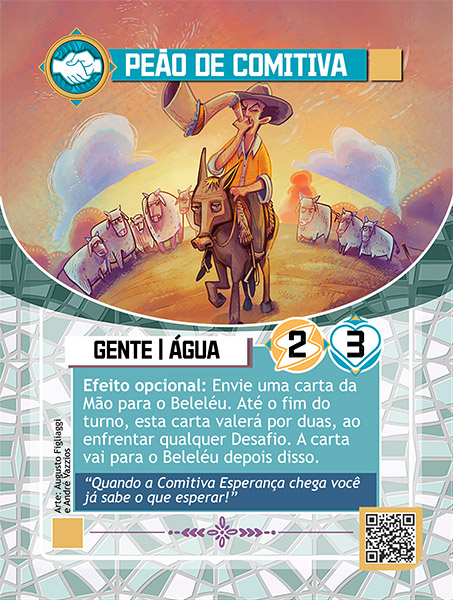
Cattle Drover
Strength: 2
Health: 3
Folk / Water
“When the Esperança cattle drive comes through, you know what to hope for!”
Cattle Horn Call · Partnership
Send a card from your hand to the Beleléu (your discard pile). Until the end of the turn, this card counts as two when facing any Challenge. Send it to the Beleléu afterward.
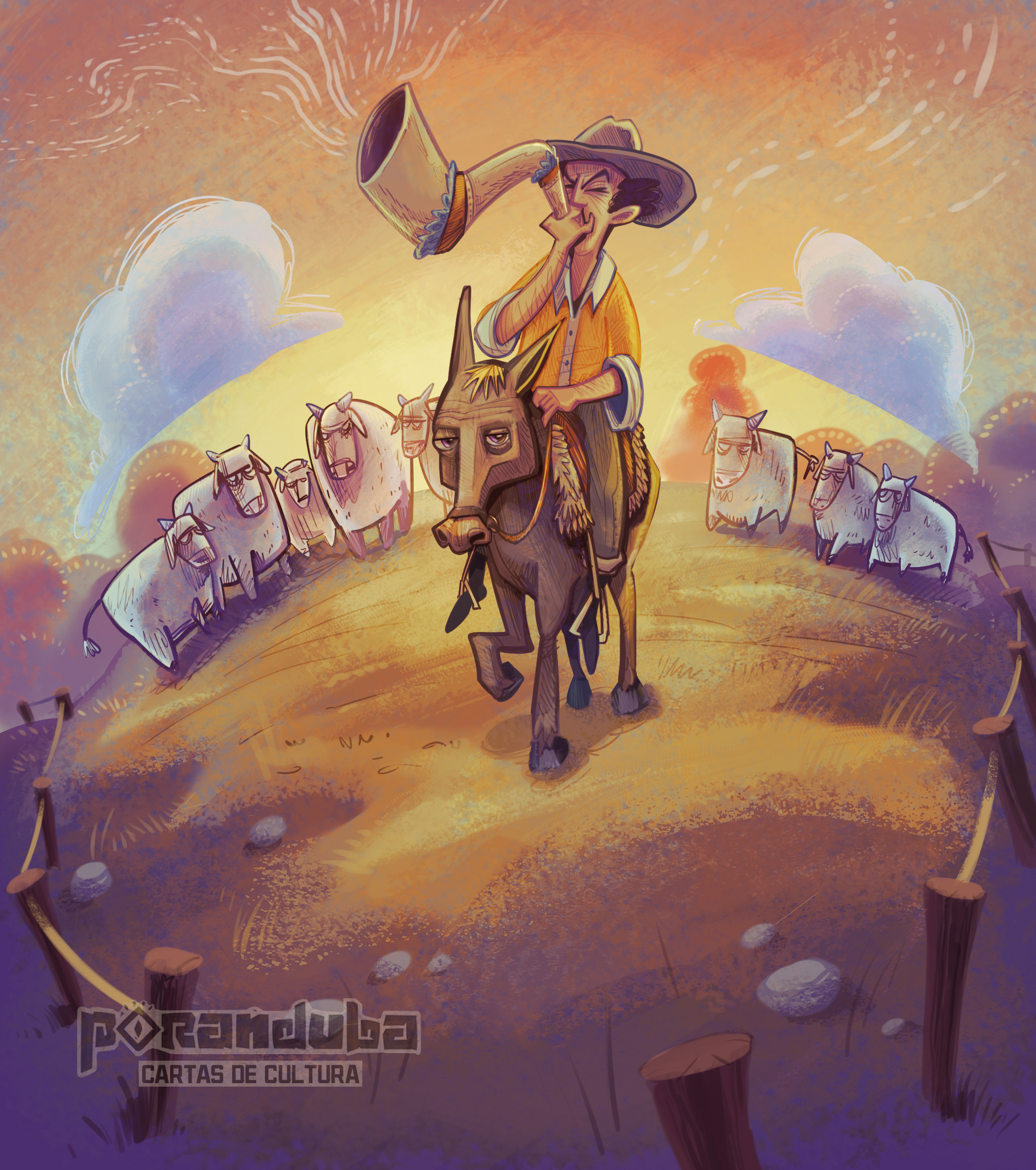
Download the high-resolution artwork
References
- CÂMARA, Ricardo Pieretti. Os causos: uma poética pantaneira. 2007. Tese (Doutorado em Humanidades) – Departamento de Humanidades, Faculdade de Filosofia e Letras, Universidade Autônoma de Barcelona, Barcelona, 2007.
- DUARTE, Alexsander Jorge. De sinal sonoro a marco sonoro: a recontextualização do berrante no Brasil e sua presença na música raiz do centro-sul brasileiro. Post-ip: Revista do Fórum Internacional de Estudos em Música e Dança, v. 2, n. 2, p. 9–20, 2013.
- LEITE, Maria Oliveira Ferreira. Comitiva de boiadeiros no Pantanal Sul-Mato-Grossense: modos de vida e leitura da paisagem. 2010. Dissertação (Mestrado em Ciência Ambiental) – Universidade de São Paulo, São Paulo, 2010.
- PROENÇA, Augusto. Pantanal: Gente, tradição e história. 3. ed. Campo Grande: UFMS, 1997.