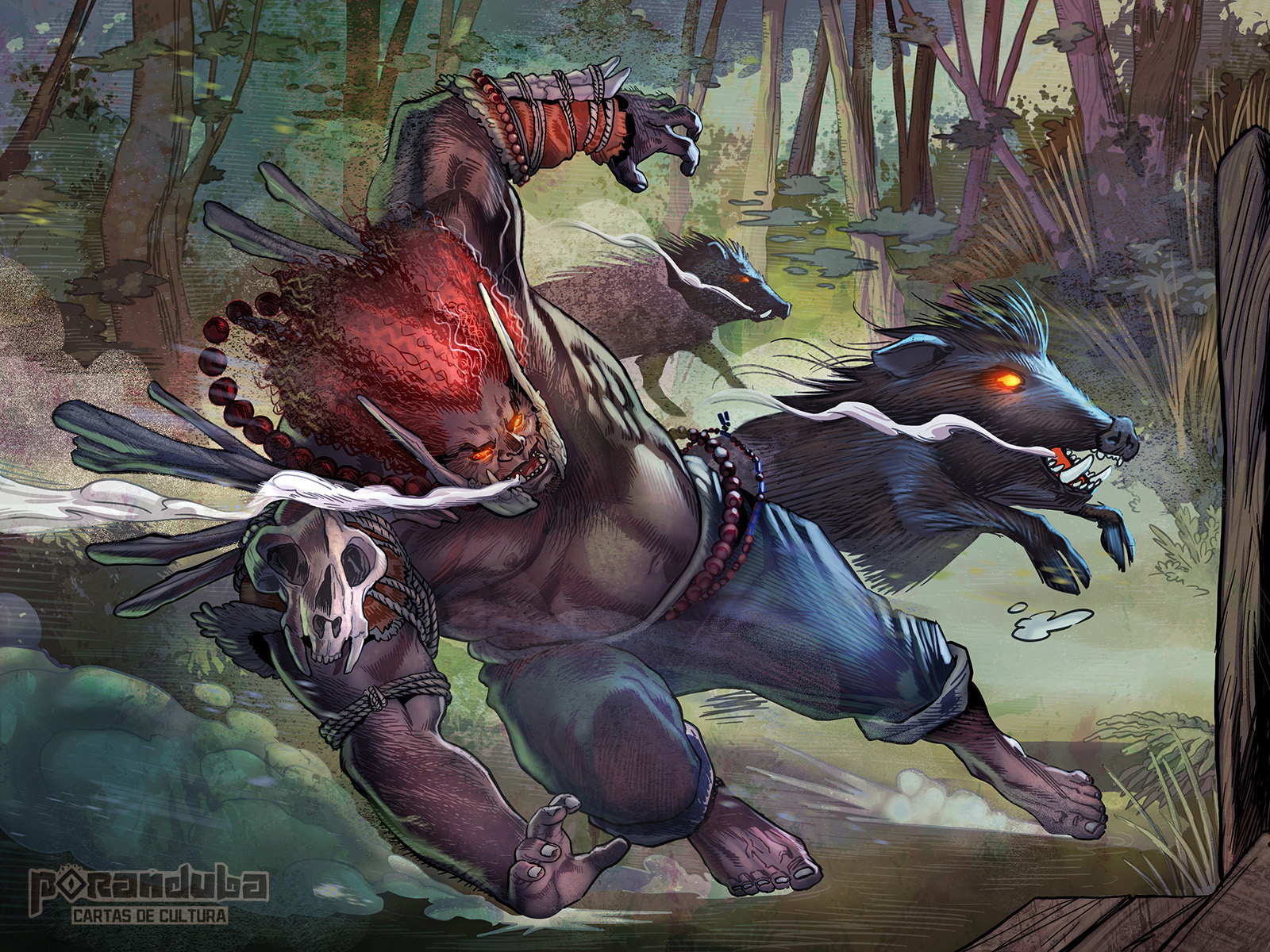
Its name comes from Tupi, "Caá-Porá," and means inhabitant of the woods. The apparition is one of those with the greatest number of variants: it can be small or giant, it can be male or female, it can be a combative warrior or a deceived Trickster.
Old names and records
Apparently, the name Caipora was a later derivation. Unlike the Curupira, already recorded in 1560, there was no mention of a Kaapora in the same period. However, we find reference to an entity called “Kaa-gerre” or Kaagerre, which the French missionary Jean de Léry describes as follows:
“These poor people, during their lives, are afflicted by this evil spirit, which they also call Kaegerre, and when they spoke to us, as I often witnessed, feeling tormented and suddenly crying out as if enraged, they said: ‘Ah! defend us from Anhanga, who beats us.’ And they said that they actually saw him, sometimes in the form of a quadruped, sometimes of a bird, sometimes of any other strange figure.”
In turn, the Franciscan André Thevet records: “They have as much need of fire as we do, both to cook their meat and to resist this spirit that besets them during the night and harms their business. Some call him Agnan and others call him Raa-Onan or Kaa-Gerre.”
We perceive, from the testimony, this mixture of the primordial caipora with the figure of Anhangá, and how both were reduced to "demon" by religious people. The name "Caipora" is still used today to indicate bad luck, a person who suffers from panema, a kind of "bad luck" that permeates those who are the target of punishment from the protectors of the forest.
Gonçalves Dias supposes that "Gerre" is a derivation of "guara", whose suffix will also indicate "inhabitant", "of the place". In the Tupi-Portuguese Vocabulary, by Lemos Barbosa, we find words like "momoyguara", which would mean "outsider/foreigner", which would prove the approximation between Inhabitant and Inhabitant of the Forest, the Caipora.
Caipora and the world of hunting
In Cornélio Pires' record, already with more caipira influence, it is a legitimate caboclo. A big, bushy-bodied, and hairy creature like an animal. "The caipora is crazy for tobacco, and if you know how to please him, you'll be a rascal during hunts; his favorite thing is to ride a wild boar, driving peccary and collared peccary sticks along the forest trails."
It is with this aspect that the apparition is best known today, as a protector of the woods alongside his pig. However, in regions where his Trickster side prevails, we find narratives that bring him very close to a Saci: he becomes playful, deceitful, assuming different forms to punish hunters – from a jaguar to a tree, or even a rain cloud.