
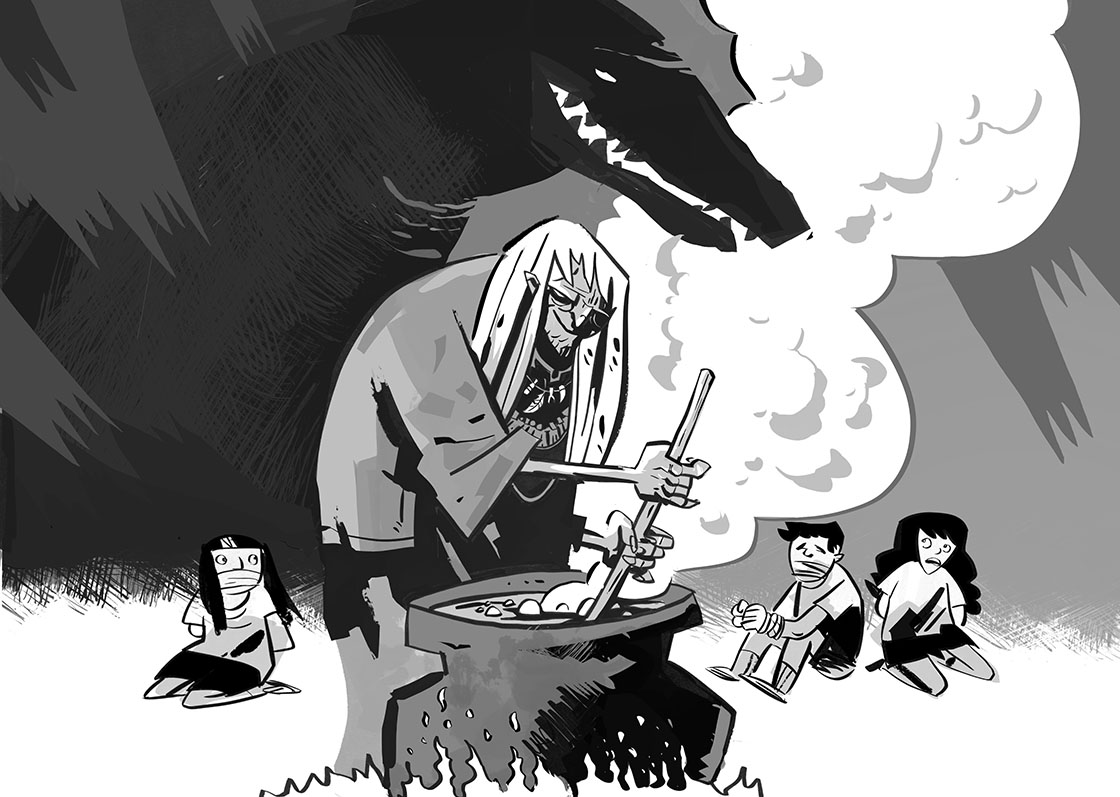
Illustration by Fred Rubim
Cuca
Folklore and history
Go to sleep, baby,
or Cuca will come for you.
Papa’s out in the fields,
Mama’s among the coffee trees.
– One of the versions of the Cuca song
But what does the Cuca look like? Those who only know the song can imagine whatever they want: the verses warn that it is coming, without saying what it is like. Câmara Cascudo says that, for many people, this threat was enough. Others knew how to describe her: a thin, hunchbacked old woman with white hair, lying in wait for the children who were making noise when they should have been sleeping.
And the alligator’s face? Look in O Saci, which Monteiro Lobato published in 1921 and rewrote over the years. Even Narizinho’s fate depends on which edition you open. In early editions Cuca swallows her; in later ones she turns the girl to stone. The witch’s own face changes too. In 1928 Pedrinho sees an old woman with bat’s ears and an alligator’s snout. Later Lobato gives her an alligator’s face and a hawk’s talons.
On the other side of the Atlantic there is also a reptile with a similar name. In Monção, in the north of Portugal, Saint George faces a dragon called Coca during the Corpus Christi festival. The similarity invites comparison with the witch of Lobato, although it is not known whether the writer was familiar with this party.
And where does the coconut come in? Look at the marks on its shell. Can you see a face? As early as the sixteenth century, Portuguese chronicler João de Barros wrote that his countrymen called the fruit coco because it reminded them of the bogey they used to frighten children. A head, a bogey, a reptile: all three images meet in Cuca.

References
- CASCUDO, Luís da Câmara. Geografia dos mitos brasileiros. 1. ed. digital. São Paulo: Global, 2012.
- CLARO, Majori Fonseca. Da isbá na floresta gélida à caverna tropical: aproximações entre as personagens Baba-Iagá e Cuca. 2012. Dissertação (Mestrado em Literatura e Crítica Literária) – Pontifícia Universidade Católica de São Paulo, São Paulo, 2012.
- LOBATO, Monteiro. O Saci. São Paulo: Monteiro Lobato e Cia., 1921.