
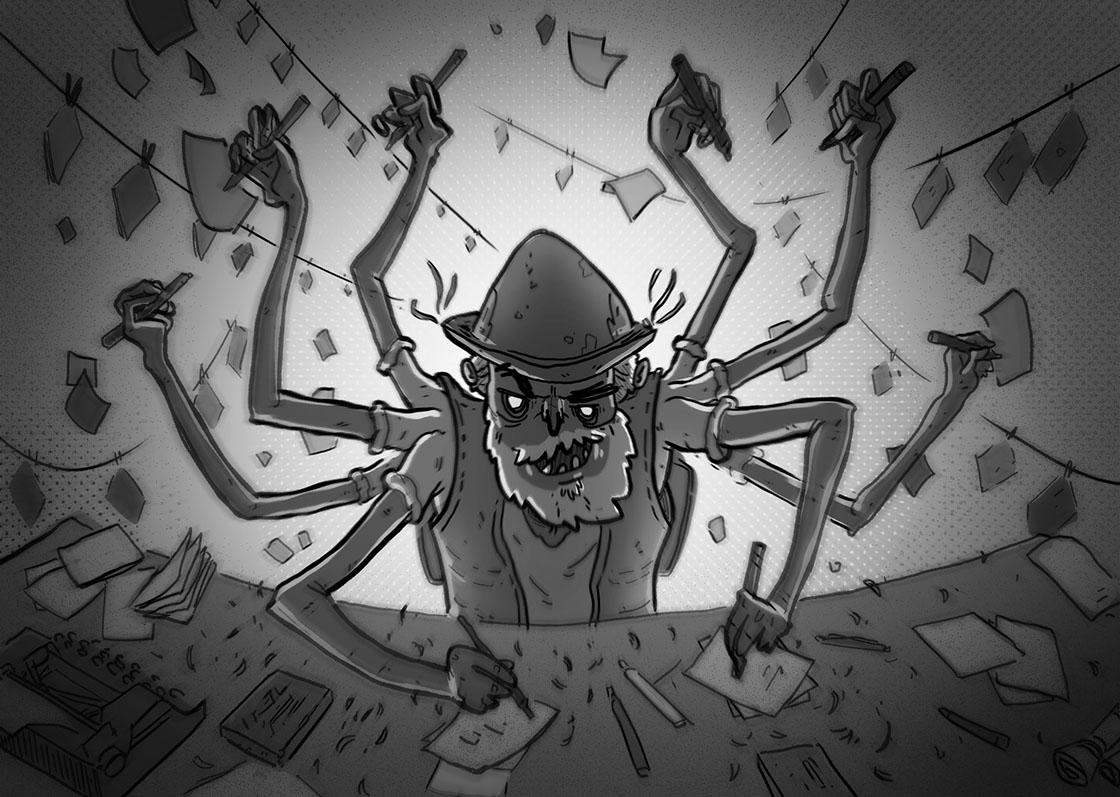
Illustration by Caique Pituba
Cordel Poet
Folklore and history
A cordel poet tells stories and comments on events in verse. In the Northeast, the poetry of songs also found its way onto the pages of printed leaflets, where, among many other stories, the adventures of chivalric romances began to circulate.
One way to illustrate the cover of a cordel booklet is with a woodcut. The Greek word xylon means “wood”. Printmakers carve blocks of cherry, cedrinho, peroba or cedar with gouges. They ink the raised areas and press the block against paper. The design appears in reverse.
Gilmar de Carvalho observes in Xilogravura: doze escritos na madeira that a black-and-white print has no shades of grey to soften the contrast. It heightens the drama of these almost baroque stories, where good and evil, right and wrong, confront one another.
One of the pioneers of publishing Cordel leaflets in Brazil was Leandro Gomes de Barros, from Paraíba. Among the stories he helped to popularize are the adventures of Juvenal dealing with a dragon and the battle of Oliveiros, one of Charlemagne’s paladins, against the giant Ferrabrás.
Cordel booklets carry news as well as stories. Gilmar de Carvalho links the spread of cordel in the Northeast to the arrival in inland towns of presses that big-city printers had replaced. For scholars of folkcommunication, cordel poets are popular journalists: they use the means at hand to tell their readers what is happening now.
Thus, we find stories that talk about notorious battles, man’s trip to the Moon, diseases and their treatments, political decisions and sporting victories. In Bahia, Cuíca de Santo Amaro (1907–1964) circulated the city’s denunciations and disputes in verse.
Cuíca also took commissions, sometimes telling readers outright that a piece had been paid for. If someone felt wronged by what he had printed, he offered a solution entirely in character: for ten thousand cruzeiros they could buy up the whole print run.
On the back of his booklets, Cuíca printed a preventive writ of habeas corpus, ready to show police officers who threatened to confiscate his work.

References
- CARVALHO, Francisco Gilmar Cavalcante de. Xilogravura: doze escritos na madeira. Fortaleza: Secretaria da Cultura do Estado do Ceará; Museu do Ceará, 2011. Disponível em: https://repositorio.ufc.br/handle/riufc/47498. Acesso em: 10 nov. 2026.
- CUÍCA de Santo Amaro. Direção: Joel de Almeida e Josias Pires. Salvador: DocDoma Filmes, 2012. 1 filme (75 min). Disponível em: https://docdomafilmes.wixsite.com/nossos-filmes. Acesso em: 10 nov. 2026.
- INSTITUTO DO PATRIMÔNIO HISTÓRICO E ARTÍSTICO NACIONAL. Dossiê descritivo da Literatura de Cordel. 2018. Disponível em: https://bcr.iphan.gov.br/wp-content/uploads/tainacan-items/65968/66741/Cordel_de_Dossie_Descritivo1_.pdf. Acesso em: 10 nov. 2026.