
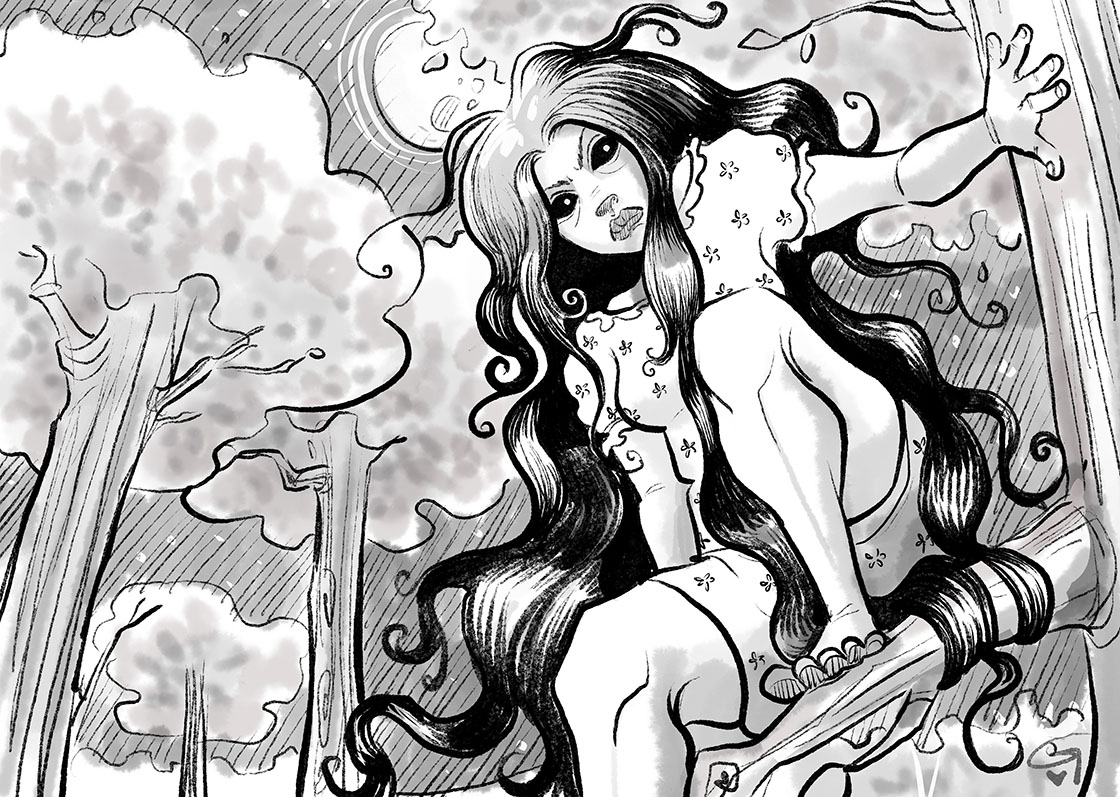
Illustration by Germana Viana
Comadre Fulozinha
Folklore and history
To hunt in her woods
you needed her leave,
or you would feel the lash.
That was Fulozinha’s way.
When the blows fell, stinging,
no one could see
where they were coming from.
– Comadre Fulozinha: The Romance of Serra das Flechas
Vanderley de Brito
Comadre Fulozinha, also known as Florzinha, guards the forests, especially in Brazil’s Northeast. Calling her comadre invokes the kinship between a child’s parent and godparent. It is a familiar way of addressing a feared apparition: treat her as family, and perhaps she will spare you.
How did she become the Comadre? One story tells of a cabocla girl just over ten who grew up in a violent home. After her mother died, her father, a heavy drinker, beat her until her back burned and abandoned her in the forest. There, all alone, she became an enchanted being.
And what does the apparition look like? The records are imprecise, but it is usually said that she maintains the appearance of a girl, walking around naked with long disheveled hair that burns like nettles (or even made of nettles). They are the ones that Fulozinha uses to whip the invaders, also leaving them burned with the slaps.
Speaking of hair, one of Comadre’s great features is tying knots in the horses’ manes and tails. Depending on the region of the country, the same behavior will be attributed to Witches or Sacis. And, like the latter, Comadre is also a notorious whistler.
According to the Dicionário do folclore brasileiro, she can take the form of an animal her own size, a young woman or even a boy. She beats dogs and chases runaway children. If she gives someone a present, it comes with one rule: the recipient must not share it with anyone else.
She is fond of treats with cachaça and hunks of tobacco. A hunter from Bonfim, in Salgadinho, Paraíba, told Ivo Fernandes de Sousa how he offered tobacco to Comadre. He would light a cigarette and take three puffs to one side, three to the other and three to the top. Then, with the ember facing inside his mouth, he blew three more times outwards. He left his cigarette on a stump and went hunting.
Another way to please her is with traditional wheat porridge, without salt or sugar. There are stories in which a woman, jealous that her partner always asked Fulozinha for help, put pepper in the apparition’s porridge. It was her undoing… Comadre also hates being called Caipora, and will harshly punish anyone who disrespects her.
Comadre Fulozinha also figures among the enchanted beings of Jurema Sagrada, an Afro-Indigenous religious tradition with deep roots in northern and northeastern Brazil. There she also answers to Maria. Compare that with Cascudo’s account, in which she dislikes Maria because it is a saint’s name. In one of her ritual songs, she gives this warning:
I am the flower of the forest; through the woods I walk alone!
You called me comadre, but I’m Maria Florzinha.
I am the flower of the forest. Why did you send for me?
You called me Caipora… Caipora you will be!
There’s a sting in that last line. Caipora is also a word for someone dogged by bad luck. Call her Caipora and you may become caipora yourself: a sufferer from what people call caiporismo.

References
- BRITO, Vanderley de. Comadre Florzinha: o romance da Serra das Flechas. Campina Grande: CampGraf, 2009.
- CASCUDO, Luís da Câmara. Dicionário do folclore brasileiro. 10. ed. Rio de Janeiro: Ediouro, [s. d.].
- SOUSA, Ivo Fernandes de. Comadre Florzinha: ritos e representações à entidade na cultura de Salgadinho-PB, 1980–1990. In: CONGRESSO INTERNACIONAL DE MEIO AMBIENTE E SOCIEDADE, 1.; CONGRESSO INTERNACIONAL DA DIVERSIDADE DO SEMIÁRIDO, 3., 2019. Anais […]. Campina Grande: Realize Editora, 2019. Disponível em: https://editorarealize.com.br/artigo/visualizar/63351. Acesso em: 10 nov. 2026.