
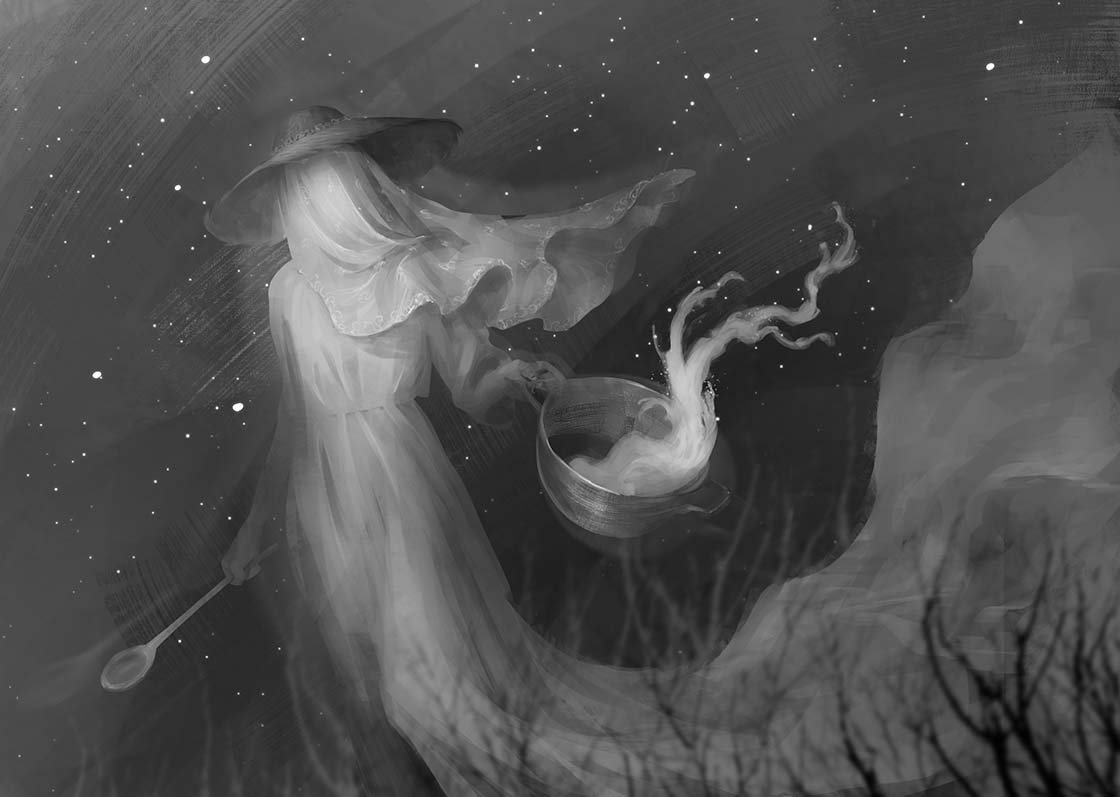
Illustration by Jânio Garcia
Careta do Mingau
Folklore and history
On the night of 1 July, women in Saubara, in Bahia’s Recôncavo region, take to the streets as Caretas do Mingau. Their celebration continues into 2 July, the anniversary of the day in 1823 when Portuguese troops were expelled from Bahia in the wars of independence.
The women reenact an episode remembered in Saubara. Portuguese naval forces were trying to put down the uprising, and the town was close to falling.
The men in the trenches were hungry and out of ammunition. To reach them, the women disguised themselves as restless souls. Screaming like creatures from another world, they carried weapons and great pots of porridge to their husbands. Here popular tradition became a means of resistance.
Many times, they even took weapons for themselves in order to defend the city. A fact recorded by Pierre Labatut himself, a French soldier who commanded Brazilian troops against the Portuguese.
Two centuries later, the city’s women relive the moment by dressing in long white cloths, straw hats and carrying large metal pans on their heads. There are no more weapons inside, just food. And three types of porridge are always served: corn, tapioca and carimã.
This memory also passes from mother to daughter. In an Iphan publication, Guiomar Freitas, who fishes for a living, recalls spotting her mother, Dona Antônia Barbosa de Freitas, among the figures in white and wondering, “Were they people, or were they souls?” Dona Antônia took part in the procession for more than thirty years. Guiomar followed her mother into it and passed her enthusiasm on to her daughters, Raiana and Taiane. New generations learn how the women of Saubara defended their town by taking part themselves.

References
- ARQUIVO NACIONAL. Apontamentos sobre a independência do Brasil na Bahia. [s. d.]. Disponível em: https://www.gov.br/arquivonacional/pt-br/sites_eventos/sites-tematicos-1/brasil-oitocentista/especial-bicentenario-da-independencia/apontamentos-sobre-a-independencia-do-brasil-na-bahia. Acesso em: 10 nov. 2026.
- BAHIA. Secretaria de Cultura. Caretas do Mingau de Subara reverencia o papel da mulher na Independência da Bahia. [s. d.]. Disponível em: https://www.ba.gov.br/cultura/noticia/2024-02/52640/caretas-do-mingau-de-subara-reverencia-o-papel-da-mulher-na-independencia-da. Acesso em: 10 nov. 2026.
- INSTITUTO DO PATRIMÔNIO HISTÓRICO E ARTÍSTICO NACIONAL. Prêmio Rodrigo Melo Franco de Andrade: 36ª edição: educação, democracia e igualdade racial: 20 anos da Lei nº 10.639/03. Brasília, DF: Iphan, [2024]. Disponível em: https://www.gov.br/iphan/pt-br/acesso-a-informacao/acoes-e-programas/premios/premio-rodrigo-melo-franco-de-andrade/edicao-2023/revista_prmfa_2023.pdf. Acesso em: 10 nov. 2026.
- SAUBARA. Dados municipais. [s. d.]. Disponível em: https://www.saubara.ba.gov.br/site/dadosmunicipais. Acesso em: 10 nov. 2026.