
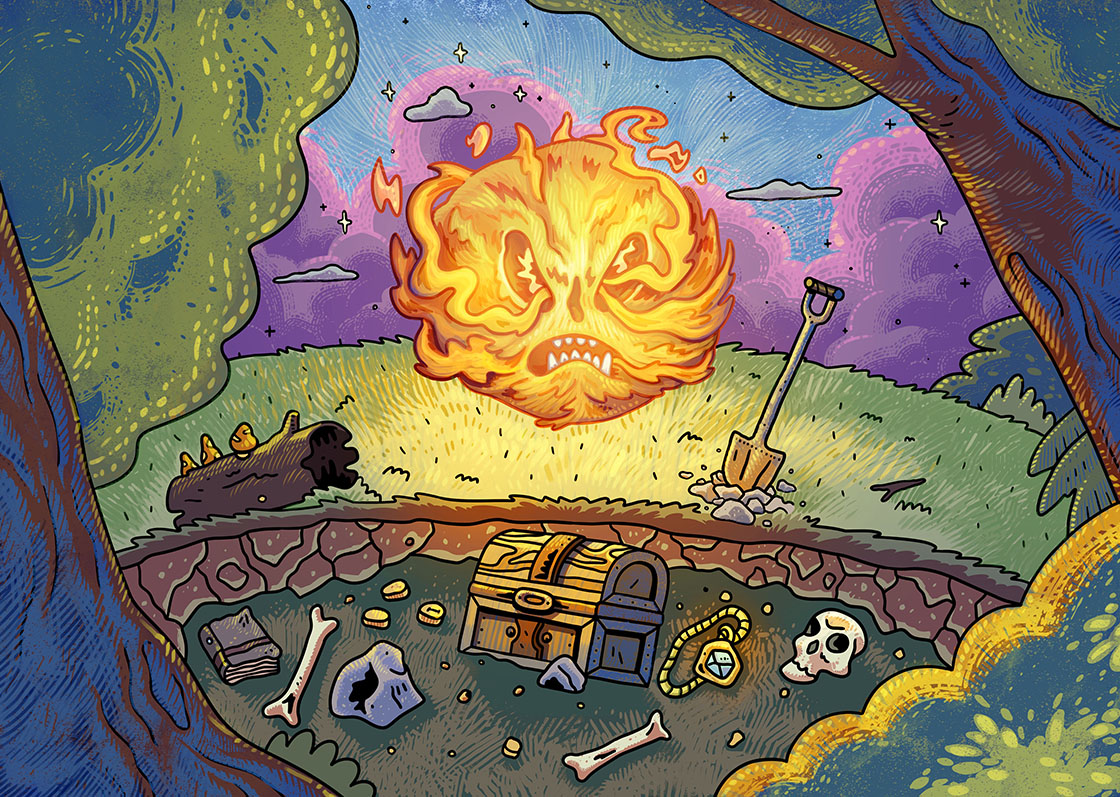
Illustration by Berjê
Buried Treasure Jars
Folklore and history
The phenomenon known as will-o'-the-wisp is certainly one of the most inspiring sources of myths and legends in Brazil and the world. The decomposition of organic matter accumulates gases in the soil which, when released, can cause phosphorescence and burn in the form of a brief, wandering fireball.
The Mother of Gold
This, of course, is the scientific explanation. In the imagination, several other ways of understanding what happened arise. Some will perceive a trail similar to a snake in the torch of fire, forming the well-known Boitatá. Others will see in the phantom flame the soul of a woman; the mother of gold, who protects the place of the buried treasure.
Some people will attribute an indigenous origin to this myth. This is because it is very common among the Tupi peoples to believe that all elements have a mother: the Mother of Fire, the Mother of Itching, the Mother of Water… Thus, it would make sense to think of a Mother of Gold. However, it is worth remembering that this valuation of gold is something that is not intrinsic to the original peoples.
Luís da Câmara Cascudo, in his Dictionary of Brazilian Folklore, collects different versions of the myth of the Mother of Gold. Within the flames, she may appear as a headless woman, as a serpent, a lizard, or even without a defined appearance. Her behavior is often described as that of a mermaid, capable of seducing men and causing them to get lost in the hills in search of the promised gold. Other versions say that she protects the location of the buried treasures, being at the same time responsible for indicating the promised location and also for preventing it from being stolen.
The names of the buried treasure
In addition to the Mother of Gold, narratives of spirits that protect buried treasures exist throughout the national territory. In the Northeast, these treasures are known as "Botijas," a word that means "earthenware vessel" and refers to the custom of hiding gold and precious stones in the ceramic before burying it. In the Midwest, in the Mato Grosso do Sul region, they are generically called "Enterros" – or "Plata Yvyguy" when one is closer to the border region with Paraguay. The term is Guarani, and it means, precisely, "buried treasure."
Riches and memories of injustice
Gilberto Freyre, in Casa-grande & senzala (2003, p. 40), describes how the manor houses also served to store riches. Money and jewels were hidden in the walls and under the floor. In the stories recorded by the author, the souls of the plantation owners appeared to relatives or strangers. They asked for prayers, lamented, and indicated the places where the buried treasures were.
This money did not always belong to the owners. Freyre mentions valuables that godparents, widows, and enslaved people had entrusted to them to keep safe. Some owners appropriated these riches. The passage adds another dimension to the stories of treasures: the hidden money could also carry the memory of an injustice.
In Mato Grosso do Sul, the connection is with the War against Paraguay (1864-1870). Normally, these are buried treasures from this era, whether the possessions of a family that died in the conflict, or the great National Treasure – which legends say was scattered by the Paraguayan president himself, Francisco Solano López, in caravans all along the border.
The conditions for finding the treasure
The souls bound to these treasures seek worthy people to claim them, appearing sometimes as balls of fire, sometimes in dreams for those of pure heart. However, one must be knowledgeable about the tradition to be able to claim one's share: one must go alone, resist the attack of all the animals and spirits, not have negative thoughts, not fart, and a series of other precautions. Those who are not worthy will find only coal instead of gold.
Another recommendation is to draw a cross with one's own blood on the treasure pot as soon as it is found. This is a way to prevent the spirits from moving the gold.

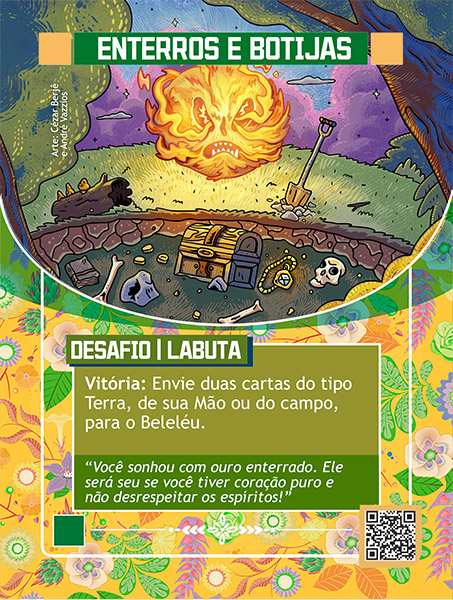
Buried Treasure Jars
Challenge / Toil
You dreamed of buried gold. It will be yours if your heart is pure and you show the spirits respect.
Win · Send two Earth cards from your hand or field to the Beleléu (your discard pile).
Download the high-resolution artwork

References
- CASCUDO, Luís da Câmara. Dicionário do Folclore Brasileiro. São Paulo: Global, 2012.
- COSTA, Andriolli de Brites da. O ouro dos espíritos: tradição e esperança no imaginário paraguaio. Revista GeoPantanal, Corumbá, v. 15, n. 28, p. 49–60, jan./jun. 2020. (periodicos.ufms.br)
- FERNANDES, Frederico Augusto Garcia. Entre histórias e tererés: o ouvir da literatura pantaneira. São Paulo: EdUNESP, 2002.
- FREYRE, Gilberto. Casa-grande & senzala: formação da família brasileira sob o regime da economia patriarcal. 48. ed. rev. São Paulo: Global, 2003.
- LEITE, Mário Cézar Silva. Águas encantadas de Chacororé: natureza, cultura, paisagens e mitos do Pantanal. Cuiabá: Catedral Unicen Publicações, 2003.
- PINHEIRO, Alexandra Santos. Em busca do nacional: lendas e causos do interior brasileiro. Ideação, v. 11, n. 1, 2009. (e-revista.unioeste.br)
- SALES, Thiago de Oliveira. Corpos fechados e tesouros enterrados: uma incursão ao mundo mítico do agreste pernambucano. 2011. Tese (Doutorado em Ciências Sociais) – Universidade Fernando Pessoa, Porto, 2011. p. 152. (bdigital.ufp.pt)