

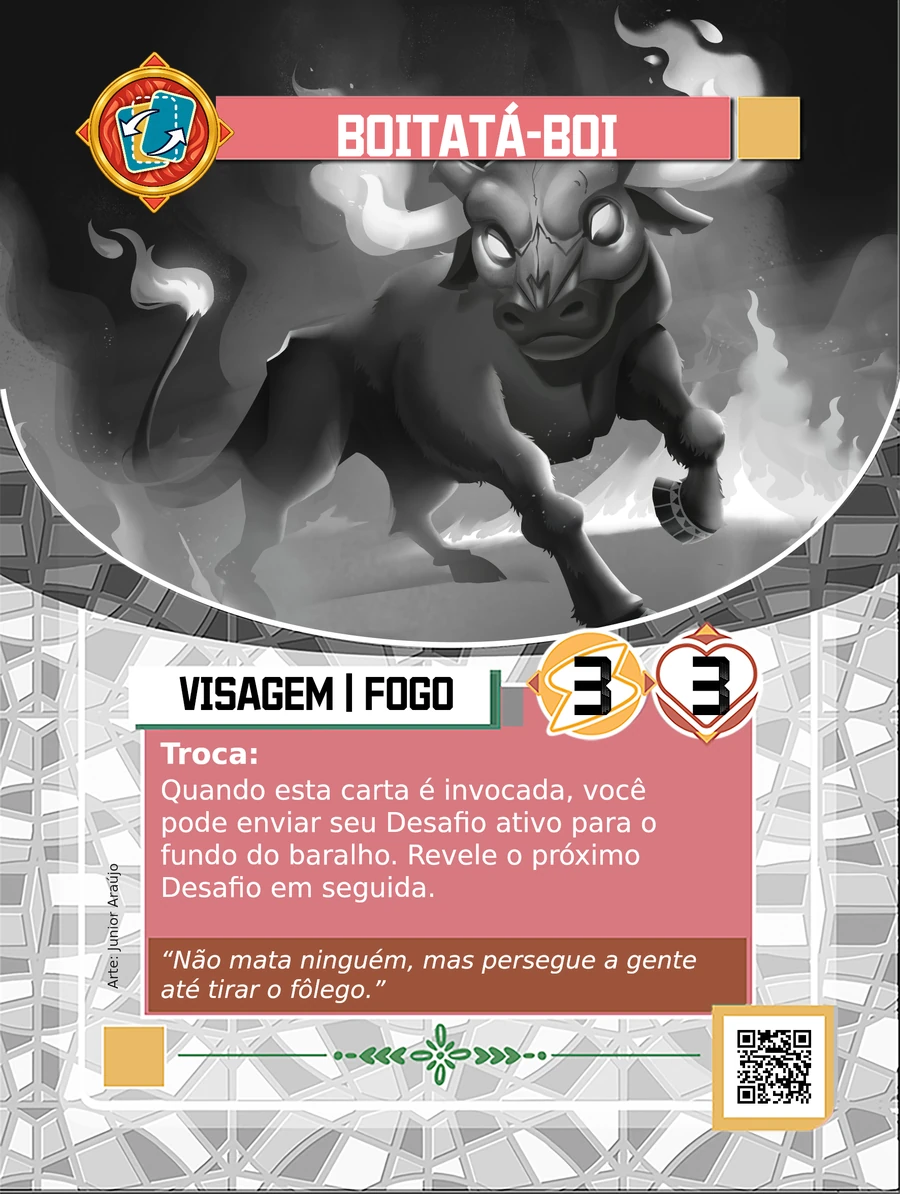
Illustration by Junior Araújo
Boitatá-Boi
Folklore and history
After all, is the Boitatá a snake or an ox? In the letter he wrote in São Vicente in 1560, Father José de Anchieta describes the baetatá as a beam of light that ran from one side to the other along the beaches and rivers. The name, the Jesuit translated, meant "thing of fire." And the snake? Câmara Cascudo draws attention to the similarity with another Tupi word, mboi, which means snake. Hence the reading of mboi-tatá as "fire snake."
But we are talking about orality. And whoever hears the word Boitatá may very well hear an ox inside. This was the explanation that Oswaldo Elias Xidieh proposed for a story he heard on the coast of São Paulo.
On Santa Catarina Island, Franklin Cascaes went further and gave the Boitatá a family. There came the Vaca-tatá, the Bezerro-tatá, the Touro-tatá… The artist himself, who had heard and drawn so many stories from the island, claimed to have invented this family.
And the ox of the caiçaras? Xidieh heard about it in the São Francisco neighborhood, also called the Convento neighborhood, in São Sebastião. On January 6, 1947, he was there for the São Benedito festival when he saw a family returning in a hurry, asking for lodging. What had made them return? Years of research sometimes fit into a good question, and Xidieh made sure to record the conversation. The report was published in O Estado de S. Paulo on December 17, 1948.
– "There is an ox that is not of the living kind; it is a ghost ox that on certain days of the week appears by the roadside to frighten and torment people who have passed by. It is large and dark and has a torch of fire on each horn which, sometimes, turns into a single, large flame. Its bellows are ugly and, when it runs, its hooves hit the ground as if they were made of iron. It usually hides near the cemetery and likes to appear on feast days, late at night, to haunt the latecomers returning to their homes."
On January 6, 1947, when we attended the São Benedito festival in that neighborhood, we had the opportunity to verify the horror that the apparition provokes among the caiçaras. As soon as the festival ended, the families returned to their ranches. Suddenly, in a stampede and shouting, one of them returned terrified, asking for shelter in the village. After they told her what had happened, she was given lodging: – "Right at the edge of the village, a little before the cemetery, the ox had appeared, snorting, digging the ground with its iron hooves and spewing tongues of fire from its horns… and they didn't dare continue."
To a question from us, they replied: – "It's certainly an ox, and a very large and dark one. It doesn't kill anyone, but it chases you until you're breathless."
– "But is it really an animal?" – We insisted.
– "Yes, it's an ox, that's why it's called the fire ox."

Boitatá-Boi
Wonders / Fire
“It never kills anybody, but it’ll chase you till you’re out of breath.”
Swap
When you summon this card, you may put your active Challenge on the bottom of its deck. Then reveal the next Challenge.
Download the high-resolution artwork

References
- CASCUDO, Luís da Câmara. Geografia dos mitos brasileiros. 1. ed. digital. São Paulo: Global, 2012.
- FLORES, Maria Bernardete Ramos. Franklin Joaquim Cascaes: do desejo de saber à representação do ser. Sæculum – Revista de História, João Pessoa, v. 26, n. 44, p. 10–29, 2021. DOI: https://doi.org/10.22478/ufpb.2317-6725.2021v26n44.55829.
- XIDIEH, Oswaldo Elias. Boitatá. O Estado de S. Paulo, São Paulo, 17 dez. 1948. Republicado por Andriolli Costa no Colecionador de Sacis, 2 dez. 2017. Disponível em: https://colecionadordesacis.com.br/2017/12/02/boitata-oswaldo-elias-xidieh-1948/. Acesso em: 12 nov. 2026.