

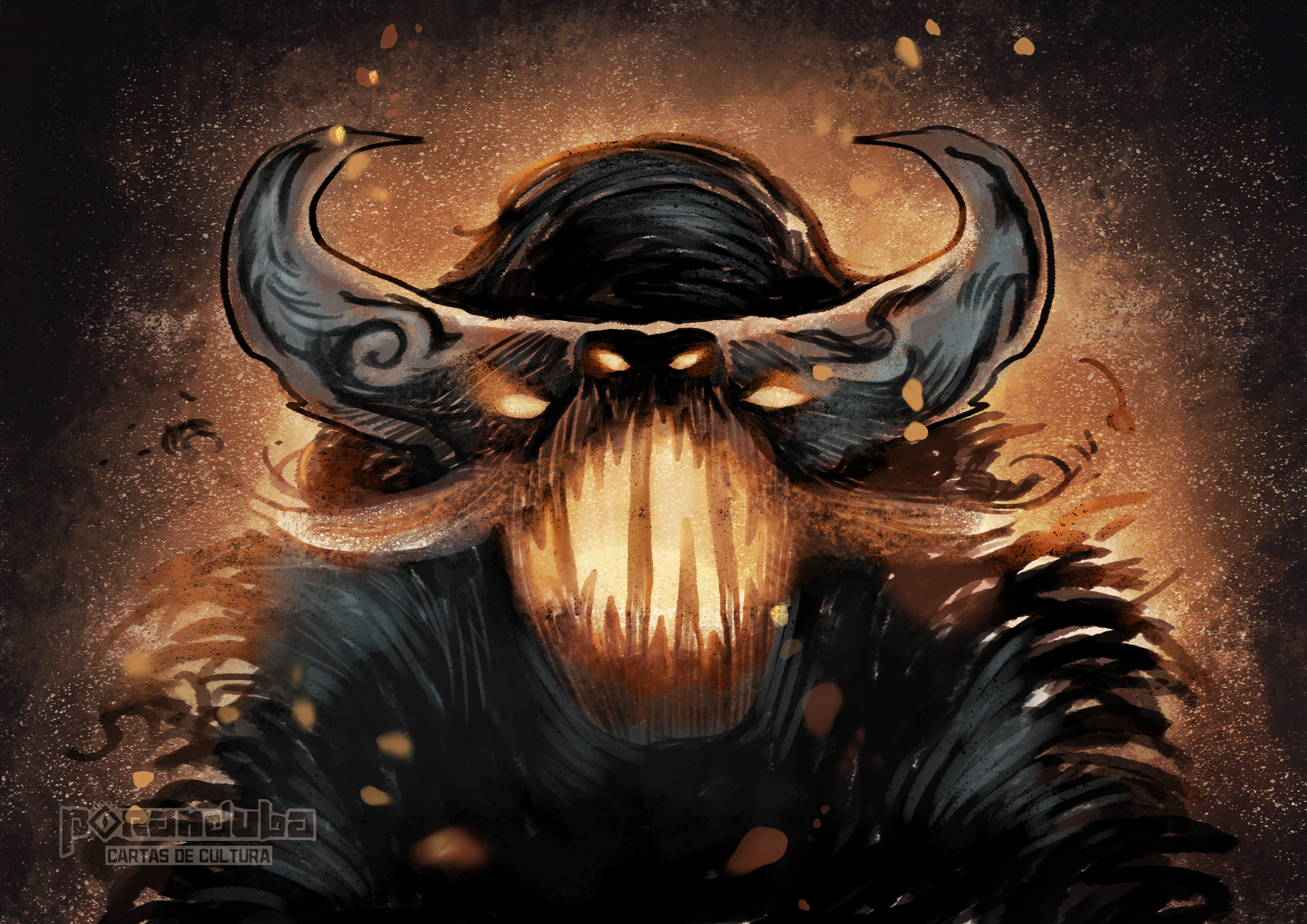
Illustration by Waldeir Brito and André Vazzios
Boi da Cara Preta
Folklore and history
The Black-Faced Ox is a character from folk songs that belongs to the cycle of childhood anguish. It has no defined form or guiding narrative. However, precisely because it is embedded in the oldest memories of so many Brazilians, its figure crystallizes in the imagination.
Everything that needs to be known about it is inscribed in its song: “Ox, ox, ox. Black-faced ox. Catch this boy who is afraid of making faces.” In some versions, the song has a continuation: “No, no, no. Not the poor thing. He is crying because he is very cute.”
Fear and comfort in the lullaby
The song is part of a branch of popular traditions known as “lullabies,” which are those used to lull children to sleep. This being the case, what would be the logic of singing something to scare children instead of calming them? Well, what will lull them to sleep is the rhythm of the voice, the movement of the arms and, of course, the presence and confidence of the figure responsible for putting the children to bed.
In addition, the fear symbolized is also a great opportunity for the child to experience, from an early age, the distinction between what is said and what is spoken. No parent truly wants to hand their child over to the Ox, however badly behaved and grimacing they may be, just as no one wants the Cuca to take away the one who doesn't go to bed early.
Oxen in Brazilian tradition
We can take some time now to think about how the ox is an almost omnipresent character in Brazilian popular culture. It is present in our festivities, in our visions, in our rhymes and in our folk tales. Names of oxen became famous through traditional narratives, to the point that they are still remembered today.
This is the case of Boi-Espácio – recorded in 1885 by Sílvio Romero – which was so large that its brains fed an entire city and there was still some left over for the dogs. Tales of oxen that are the most beloved by the boss and that are killed at the request of a beautiful woman give rise, in some places, to the plot of Bumba Meu Boi. In others, they will be told as the story of Boi Leição.
Disputes between a cowboy and an enchanted ox or bull are also very well known, showing the tenacity of man in the face of untamed nature. In Rio Grande do Sul, one of the best known is the story of the Boi das Aspas de Ouro – with "aspas" being one of the ways to refer to the animal's horns.
The ox in songs
We can also remember the oxen that were successful in Brazilian popular music. “Moda do Boi Amarelinho” was the first song that Inezita Barroso played on the viola, when she was only 10 years old. It begins like this: “I am that little ox / That was born in the month of May / Since I was born into the world / It was only to suffer work”. (www.youtube.com)
The relationship between humans and oxen in music is often one of closeness and recognition. As a metaphor for two workers who, after they are old, are no longer useful to the boss or family. Songs that always make the cowboy emotional are the classics “Couro de Boi”, by Palmeira and Teddy Vieira, and “Herói sem Medalha”, composed by Sulino. (www.youtube.com · www.youtube.com)
The ox is this representation of nature that, under human control, allows the plowing of the land, feeding and reproduction. Uncontrolled, this nature becomes the untamed ox, ready to chase the cowboy. Or, in our case, the phantom ox, which runs through our dreams to chase us.

Boi da Cara Preta
Strength: 3
Health: 3
Wonders / Earth
“No, no, no. Spare the little one! He’s only crying because he’s such a pretty one.”
Scared of a Scowl · Evil Eye
When you summon this card, choose a Folk card on the field and send it to the Beleléu (your discard pile).

Download the high-resolution artwork
References
- BARROSO, Inezita (intérprete). Moda do boi amarelinho. YouTube, 22 mar. 2022. Vídeo. (www.youtube.com)
- CASCUDO, Luís da Câmara. Literatura Oral no Brasil. São Paulo: Global, 2015.
- PALMEIRA & BIA (intérpretes). Couro de boi. YouTube, 12 fev. 2015. Vídeo. (www.youtube.com)
- ROMERO, Silvio. Contos Populares do Brasil. Lisboa: Nova Livraria Internacional, 1885.
- TIÃO CARREIRO & PARDINHO (intérpretes). Herói sem medalha. YouTube, 14 jan. 2017. Vídeo. (www.youtube.com)