
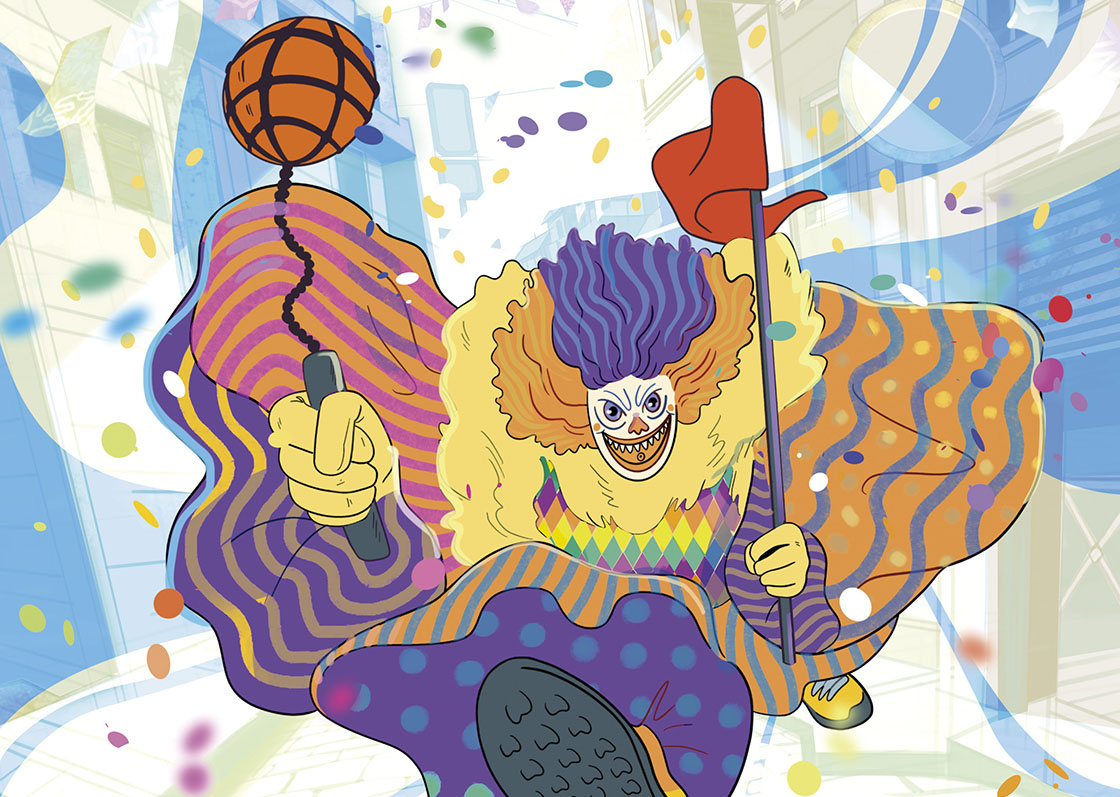
Illustration by Mayara Lista
Bate-Bola
Folklore and history
Bate-Bola is one of the most typical revelers of the carnival in the suburbs of Rio de Janeiro, in a nearly century-old tradition. Nowadays, there are several variations for their costume, but there is a traditional pattern: they are masked clowns who carry a stick with a ball attached to the end by a rope. With each step of the reveler, he bounces the sphere beside him. On group outings, when dozens of Bate-Bolas gather in celebration, the noise is more than impressive.
Another name by which this type of partygoer is still quite well known in Rio de Janeiro is “Clóvis”. The assumption is that this name came from a corruption of the word “Clown”, which means clown in English and, especially, in German. The Germanic language is important in this context, as it is directly linked to the emergence of the game. We will get to that soon.
From the Entrudo to the street carnival
To understand what the Bate-Bolas carnival means, it is interesting to understand the roots of the carnival festivities themselves. In Brazil, this tradition began in the 16th century, when the Portuguese brought the game known as “Entrudo”. Traditional to the Madeira and Azores Islands, it was celebrated in the days leading up to Lent – not by chance the name, which comes from “Introito”, the beginning.
It is curious to note that there were two types of carnival: the “familiar” one, which was a game of the aristocracy, celebrated in the homes of the masters, and the “popular” one, which took place in the street. In the familiar one, the hierarchy was maintained, so enslaved blacks could be hit with flour, water and scented lemons by the rich – but without ever retaliating. In the street, however, it was a time for revenge, and even chamber pots were thrown at the wealthy.
On more than one occasion, the popular carnival was criminalized, considered a barbaric and violent festival. This was the case, for example, in 1853. In an attempt to distance themselves from the customs of the people, the elite imported European masked balls – which ended up not catching on as much. However, the costume became part of the fun. Still in the second half of the 19th century, the first Carnival parades emerged, with cordões and blocos (groups of revelers). Later, this organization would give rise to the Samba Schools, which would take over the hegemonic space of the Rio de Janeiro carnival.
The suburban carnival, however, never ceased to exist – and even within the moment of rupture of the typical order of the time, it was never left unappealing by the elite and the press. And one of the great centers of the festival in the periphery of Rio de Janeiro has always been the Santa Cruz neighborhood, which had iconic masked groups.
Santa Cruz and the Masks
In 1930, in Santa Cruz, the Vargas government decided to build the Zeppelin Hangar in the region. A zeppelin is a type of German airship, over 200 meters long, and the hangar would serve as an airport for its landing. For a project of this size, many Germans ended up coming to live in the West Zone of Rio de Janeiro. And, here, they discovered our carnival.
It turns out that the Germans also have their own carnival, the “Fastnacht”, in which, in the guilds of fools, it is common to dress up as masked clowns, using as a “weapon” a mace made not of metal, but of pig bladder – as the court jesters did in the Middle Ages.
For 100 years, the economy of Santa Cruz revolved around the Public Slaughterhouse, installed in the neighborhood at the end of the 19th century. A byproduct of cattle slaughter, cow bladders served perfectly to make Brazilian versions of the Germanic game. Today, the balls are made of plastic, but for a long time, the dried bladder permeated the air of the revelers' houses.
The Germans also incorporated another important element: the mask made with a wire mesh. With it, it was possible to wear a mask without the need for holes for eyes or breathing.
Life in a Bate-Bola troupe
The game has transformed considerably over the years. Today, the closest thing to this retro version of the reveler is called "Lollipop Ball-Ball," with individual costumes that resemble a classic clown jumpsuit. But the most common thing nowadays is for the Ball-Balls to gather in groups, like an association.
Throughout the year, people pay a monthly fee to cover the cost of the party, costumes, and accessories, which are always themed and renewed year after year: cartoons, comic books, movies, historical events… anything can serve as inspiration.
Music is also part of the groups' identity. In research with groups from Rio de Janeiro, Aline Gualda Pereira and Luiz Felipe Ferreira (2009) recorded the creation of their own songs, called "anthems." The bases can be samba, rap, or funk. Produced in a studio or at home, the anthems accompany the costumed revelers' departure and the preparation meetings for Carnival.
The bond with the group is built throughout the year. Names, emblems, slogans, and t-shirts help members recognize each other as part of the same group. At fundraising parties, the large flags and anthems already announce the identity that the group will take to the streets.
For a long time, as happens with all cultural manifestations of the periphery, Bate-Bola was linked to violence. To try to disassociate themselves from this idea, some groups ended up giving up going out with the classic balloon and started using other accessories in their hands, such as stuffed animals or umbrellas. Even so, the tradition remains more and more alive.

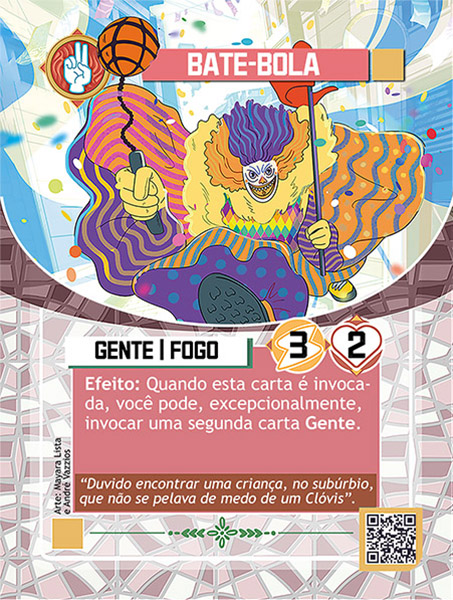
Bate-Bola
Strength: 3
Health: 2
Folk / Fire
“Find me a kid in the suburbs who wasn’t scared stiff of a Clóvis. I dare you.”
Here Comes the Troupe · Double Play
When you summon this card, you may summon a second Folk card.
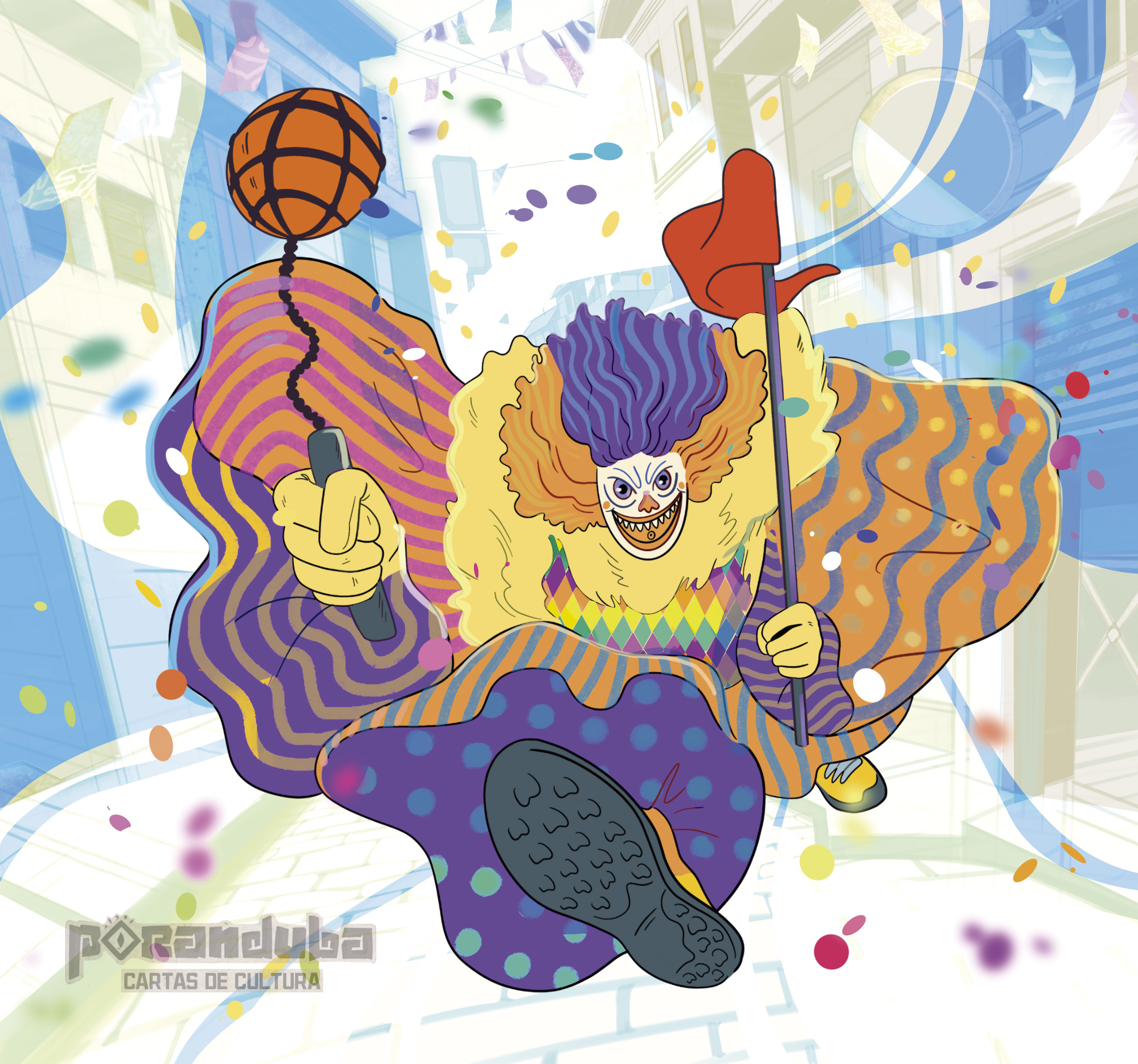
Download the high-resolution artwork
References
- GAMBA JUNIOR, Nilton; SILVA, Priscila Andrade. Bate-bolas: rastros materiais de rupturas históricas nas fantasias dos mascarados cariocas. Estudos em Design, v. 28, n. 1, p. 92–105, 2020.
- PEREIRA, Aline Gualda. Tramas simbólicas: a dinâmica das turmas de bate-bolas do Rio de Janeiro. 2008. Dissertação (Mestrado em Artes) – Universidade do Estado do Rio de Janeiro, Rio de Janeiro, 2008.
- PEREIRA, Aline V. V. Gualda; FERREIRA, Luiz Felipe. Turmas de bate-bolas do carnaval contemporâneo do Rio de Janeiro: diversidade e dinâmica. Visualidades, Goiânia, v. 7, n. 2, p. 45–67, 2009. DOI: 10.5216/vis.v7i2.18189. (doi.org)
- SANTOS, Luiz Gustavo de Lacerda. Entre memórias narradas e vividas: a cultura dos bate-bolas de Marechal Hermes. 2021. 237 f. Tese (Doutorado) – Faculdade de Comunicação Social, Universidade do Estado do Rio de Janeiro, Rio de Janeiro, 2021.
- SOIHET, Rachel. A subversão pelo riso: estudos sobre o carnaval carioca, da Belle Époque ao tempo de Vargas. Uberlândia: EDUFU, 2008.