
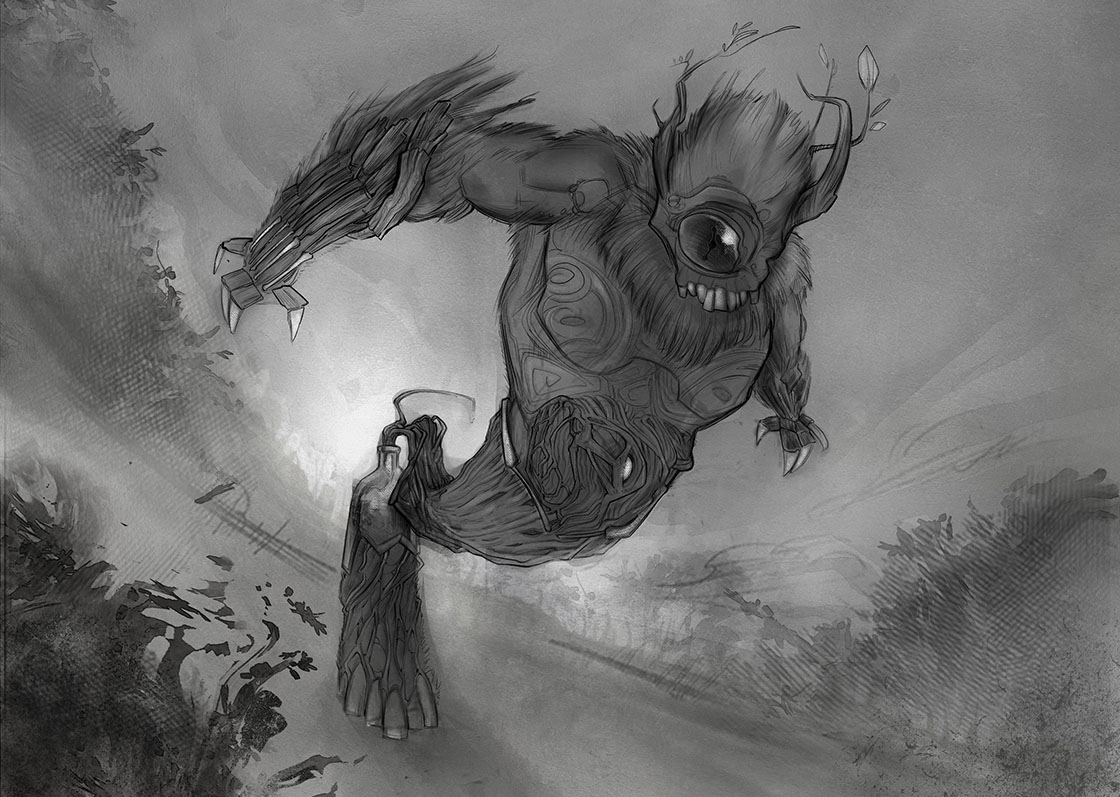
Illustration by Igum Djorge
Bottlefoot
Folklore and history
Anyone who finds Bottlefoot’s trail knows the apparition has been there. It’s difficult to say which way it went: the mark on the ground is round like the bottom of a bottle. And what figure leaves such a footprint? In Jacobina, in Mato Grosso, Sebastião Alves Correia described a man covered in hair, with only one leg, ending in a hoof. In Vão do Paraná, in Goiás, it was said that the animal had one horn, one eye and a single hand with claws.
The strength of these traces also appears in the Pantanal stories collected by Ricardo Pieretti Câmara. Seu Marcondes tells a story heard from a friend, in which a one-legged figure disappears in the woods and leaves characteristic marks. Seu Olimpião reports having found, with his boss, footprints attributed to the creature on the edge of a mountain range. In both cases, recognition of Bottlefoot involves the marks on the ground: even when the body escapes the eye, the trail feeds the narrative of its presence.
In some stories Bottlefoot calls out in a human voice, luring travellers closer. Anyone who encounters it becomes variado, bewildered: they lose their bearings and cannot find their way home.
Its whistle plays tricks on you too. According to Câmara Cascudo, when it sounds far off, the creature is already close. When it whistles right beside your ear, the danger is far away.
A well-known account of the monster was published in 1949 by Mato Grosso journalist Virgílio Correia Filho. He describes Bottlefoot as a major threat to poaieiros – the name given to collectors of poaia (Carapichea ipecacuanha) which, at the time, was widely collected for the production of medicines against whooping cough and amoebiasis. He writes:
“[…] a goblin capable of assailing the most fearless woodsmen. No one who sees it will return to his friends in his right mind. Yet they describe it as a one-legged monster of human appearance, leaving a print like the base of a bottle. It shows itself only to those destined for a tragic end. No one can look on its dreadful features and still find his way back to his familiar shelter. Even if the legendary enemy fails to clasp the poaieiro to its hairy chest, suck out his eyes and leave him stretched out as food for hungry scavengers, the man to whom it appears will never find his way home” (Correia Filho, 1949, p. 134).
In Poconé, in the Mato Grosso Pantanal, people say Bottlefoot holds sway over a tree called pau-de-perdiz (Simarouba versicolor). Touch the tree and you lose your bearings. Once lost in the forest, you are easy prey for the creature.
But Bottlefoot has a weak spot of its own. In the accounts Maria Cristina de Aguiar Campos gathered, the navel is the only part of its body the hair leaves bare. When threatened, the creature tosses its hair forward to cover its belly button.

References
- CÂMARA, Ricardo Pieretti. Os causos: uma poética pantaneira. 2007. Tese (Doutorado em Humanidades) – Faculdade de Filosofia e Letras, Universidade Autônoma de Barcelona, Barcelona, 2007.
- CAMPOS, Maria Cristina de Aguiar. A lenda do Pé de Garrafa. In: SIMPÓSIO NACIONAL DE HISTÓRIA, 23., 2005, Londrina. Anais […]. ANPUH, 2005. Disponível em: https://anpuh.org.br/uploads/anais-simposios/pdf/2019-01/1548206369_57396124ffe12384928bb89244ee7b68.pdf.
- CASCUDO, Luís da Câmara. Geografia dos mitos brasileiros. 1. ed. digital. São Paulo: Global, 2012.
- CORREIA FILHO, Virgílio. O poaieiro. Revista Brasileira de Geografia, Rio de Janeiro, v. 11, n. 1, p. 133–135, jan./mar. 1949. Disponível em: https://biblioteca.ibge.gov.br/visualizacao/periodicos/115/rbg_1949_v11_n1.pdf. Acesso em: 10 nov. 2026.
- SILVA, Mônica Martins da. A escrita do folclore em Goiás: uma história de intelectuais e instituições (1940–1980). 2008. Tese (Doutorado em História) – Universidade de Brasília, Brasília, 2008. Disponível em: https://repositorio.unb.br/handle/10482/7681.