
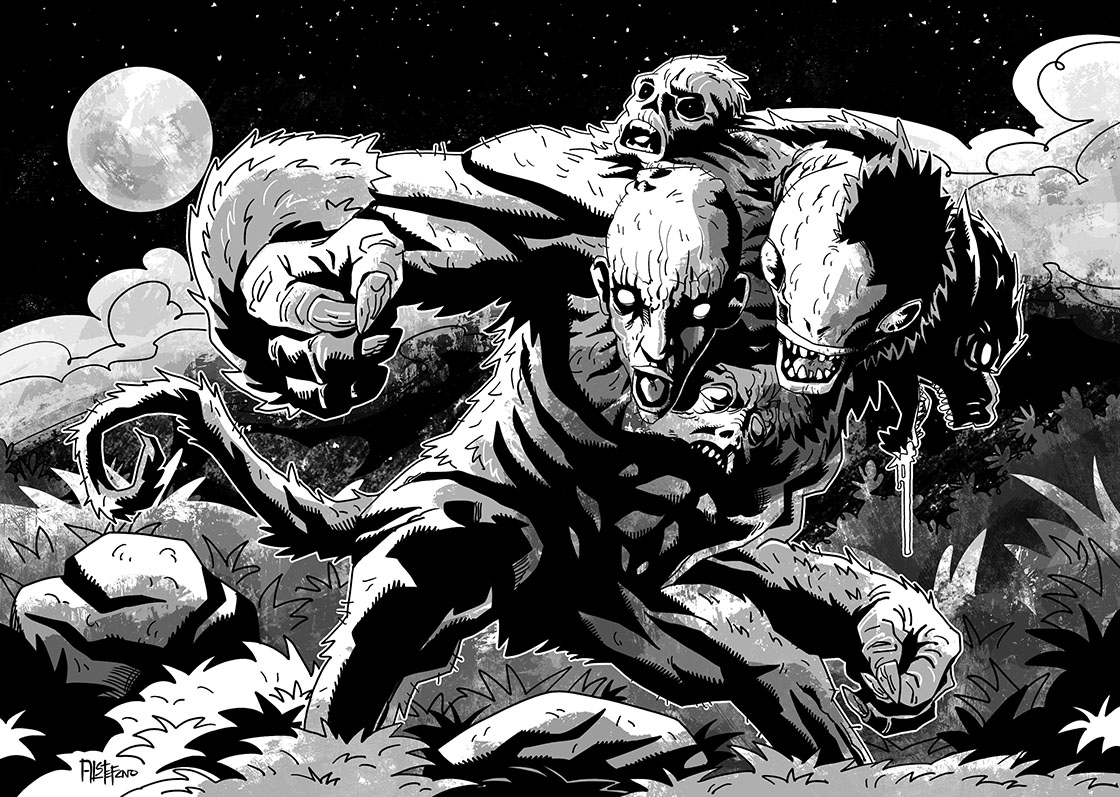
Illustration by Al Stefano
Bicho Tutu
Folklore and history
Tutu-Marambá, don’t come back here,
or the child’s mother will have you killed.
Tutu-Maramba, get down from the roof
Let my little son sleep peacefully
Jacaré-Tutu, Jacaré-Mandu,
Tutu go away, leave my love alone
Tutu-Marambá, get off the roof;
the child’s father is still awake.
Tutu-Marambá, away with you now,
the child’s mother watches over her baby.
— Popular song
Tutu, Bicho-Tutu and Tutu-Marambá are just some of the names and derivations of this Boogeyman linked to African tradition. Not by chance, Câmara Cascudo suggests that the etymology of its name would come, precisely, from Kimbundu. For him, Tutu would be a corruption of quitutu, with the meaning of “bogeyman” or “ogre”. Marcus Vinícius Medeiros Pereira, in turn, recovers the distinction made by Yeda Pessôa de Castro between bitutu, associated with the bogeyman, and kitutu, with food. The sound similarity, in this reading, does not mean that the monster has the same origin as the delicacy.
Belonging to the so-called “cycle of childhood anguish”, Tutu does not have a defined shape. It thus assumes the image of all possible fears for a child. It could be an old man, it could be a monster, it could even be a pig – confusing it with the animal called “caititu”, as Cascudo records in Bahia.
It is worth pointing out, however, that the monster’s connection with other figures also involves the sound of the names – as in Tutu, Caititu, the owl Murucututu (who thus assumes the role of bogeyman) and even Carrapatu. Gilberto Freyre recovers, in Casa-grande & senzala, an old song that scared little children: “Sleep, sleep, my little son, / There in the woods there is an animal / Called carrapatu”.
Was there really a Brazilian bogeyman called Carrapatu? The evidence goes beyond the rhyme. Veríssimo de Melo recalled the Carrapato as one of his greatest childhood fears. He pictured it as a giant turtle clinging to the rafters, ready to drop onto his hammock. In a 1949 recording reproduced in Silvia de Ambrosis Pinheiro Machado’s thesis, he sings a song he learned from his mother, Emília Melo, in Natal: Carrapato is told to get off the roof and let the boy sleep. For a child listening, the fear could take a very definite shape.
Brazilian bogeymen share songs as well as names. Variants of the same lullaby address the Bicho-Papão, the Cuca, the Portuguese Coca or one of the Tutus. In 1945 Aluísio Almeida recorded, among others, “Tutu Marambá / Don’t come back here / Or the boy’s father / Will have you thrashed.” Other verses ask Tutu to let the boy sleep, or say that his father is out in the fields and his mother among the coffee plants.
These songs also pass from orality to literature. Pedro Marques shows how Olegário Mariano incorporates a popular Tutu-Maramba quatrain into the poem of the same name. The researcher also brings the verses of “Xoxô, Papão”, by Mariano, closer to those that end “The world of the impossible boy”, by Jorge de Lima. The names and poems change, but the request to get off the roof and let the boy sleep remains recognizable.
The alligator’s verses also appear in other songs. In Our Toys, from 1909, Alexina de Magalhães Pinto records “Tu-tu-rú-tú-tú”, which ends with Jacaré-Tutu and Jacaré-Mandu, followed by a request for Tutu to leave and not take his little son. Machado recovers this record and also presents a version of “Murucututu” collected and harmonized by Aloysio de Alencar Pinto, with similar verses. It’s the same repertoire of names and requests crossing different ways of singing.
Peeking on top of the roof is a common practice for bogeymen, which is why many songs are sung to make them come down. When we have an apparition related to black imagery, however, it is very common for the myth itself to be racialized. That is, structural racism causes black people to be used as figures of fear. Almeida describes Tutu as “the old black corimba or coroca, who aged in the kitchen”. Cascudo recovers a song from Minas Gerais in which it was sung: “Look at the old black man / on top of the roof. / He’s saying, / he wants the boy roasted”. Skin color, in these records, becomes part of the threat.
Does the singer actually want the monster to come and take the child? Often the words tell it to go away. As Pereira observes, calling Tutu to scare a child is quite different from driving it away so the child can sleep. The same voice that conjures up the monster can send it packing.

References
- ALMEIDA, Aluísio de. A festa da Coca. Colecionador de Sacis, 15 dez. 2017. Disponível em: https://colecionadordesacis.com.br/2017/12/15/aluisio-almeida-cuca-tutu-maramba1945/. Acesso em: 11 nov. 2026.
- CASCUDO, Luís da Câmara. Dicionário do folclore brasileiro. 10. ed. Rio de Janeiro: Ediouro, [s. d.].
- CASCUDO, Luís da Câmara. Geografia dos mitos brasileiros. 1. ed. digital. São Paulo: Global, 2012.
- FREYRE, Gilberto. Casa-grande & senzala: formação da família brasileira sob o regime da economia patriarcal. 48. ed. rev. São Paulo: Global, 2003.
- MACHADO, Silvia de Ambrosis Pinheiro. Canção de ninar brasileira: aproximações. 2012. Tese (Doutorado em Teoria Literária e Literatura Comparada) – Faculdade de Filosofia, Letras e Ciências Humanas, Universidade de São Paulo, São Paulo, 2012.
- MARQUES, Pedro. Olegário, Jorge, Ascenso e a peleja nacionalista. Diadorim, Rio de Janeiro, v. 11, p. 69–85, jul. 2012. DOI: https://doi.org/10.35520/diadorim.2012.v11n0a3955.
- PEREIRA, Marcus Vinícius Medeiros. Acalantos do Folclore Brasileiro: terror, escravidão e (des)encontros culturais. Opus, v. 26, n. 2, p. 1–40, maio/ago. 2020. DOI: https://doi.org/10.20504/opus2020b2601.
- PINTO, Alexina de Magalhães. Os nossos brinquedos. Lisboa: A Editora, 1909.