
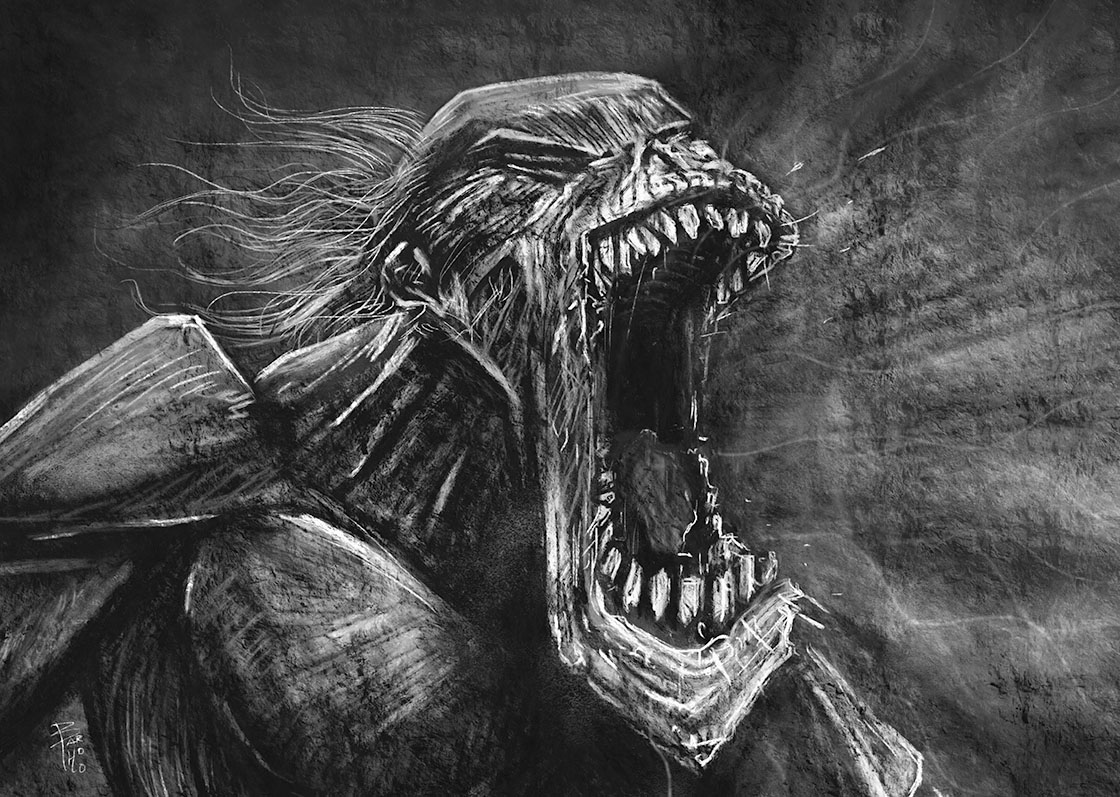
Illustration by Marcel Bartholo
Berrador
Folklore and history
The Bradador, also called the Berrador or Gritador, is an apparition whose cries echo through the night. No one is quite sure what it looks like. The same is true of many beings around the world known chiefly for their cries. After all, a voice need not have a visible shape.
Luís da Câmara Cascudo points to the Zorra Berradeira in Portuguese literature. Because of its name it is often described as a fox (zorro). In other versions it is the restless soul of someone who sinned greatly in life. Anyone who hears its cry at night and treats it with disrespect risks being pursued and severely punished.
Argentina has the Kaparillo, whose name comes from a Quichua word meaning “to scream”. Its shape is just as uncertain. Sometimes it is described as a ball of flesh that mimics human and animal cries, drawing close to its victims while the head of the household is away.
The name Berrador itself also appears in northeastern Argentina. In “Mitos guaraníes”, Miguel Raúl López Breard records two versions between Colonia Liebig and Garruchos, in which voices, screams and laments can be heard coming from deep in the forests. The researcher believes that the narrative arrived from Brazil, suggesting a circulation of these stories between both sides of the border.
There are several stories about Brazil’s Bradador. Some say he was a cattle herder cursed for going to work on Good Friday. Those cries you hear are his calls to an invisible herd.
Some records suggest that the Bradador is the spirit of a Corpo-Seco, that is, of a person who committed so many sins in life that his body was rejected by the earth. The idea of serving a sentence after death also appears in the Portuguese narrative.
One of the records gathered by Cascudo comes from Ribeirão das Onças, near Curitiba. According to folklorist Francisco Leite, Bradador crossed the fields on Fridays, after midnight. His voice was attributed to the spirit of a mummy unearthed from the Atuba cemetery and left next to an imbuia. The body rejected by the earth and the voice that roamed the open fields thus fulfilled parts of the same condemnation.
In Rio Grande do Norte, the Bicho Berrador also haunts the roads of Arez. In research carried out in 2004, André Valério Sales gathered testimonies from residents of Patané and surrounding areas. Rosalvo said that he was returning on a mule when a scream began to accompany him along the way: the sound stopped and started again further along, following his route. Other residents described a scream that they could not attribute to any known animal. The presence of the apparition was recognized by the sound, without it being necessary to see who was shouting.
How do the Corpo-Seco and the Bradador fit together? In Cascudo’s account, the spirit dwells in the corpse by day. At night it leaves the body and roams the countryside screaming. Cascudo hears little suggestion of repentance in those cries: to him they sound more like a protest against the punishment.

References
- CASCUDO, Luís da Câmara. Geografia dos mitos brasileiros. 1. ed. digital. São Paulo: Global, 2012.
- LÓPEZ BREARD, Miguel Raúl. Mitos guaraníes. 4. ed. Asunción: Intercontinental Editora, 2003.
- SALES, André Valério. Teoria folclórica de Câmara Cascudo: 10 outras lendas e mitos de Arez-RN, contos universais e locais (texto ampliado). [S. l.: s. n.], [s. d.]. Disponível em: https://mapacultural.natal.rn.gov.br/files/agent/2534/folk-verde-cap-5-ten-lendas.pdf. Acesso em: 10 nov. 2026.