
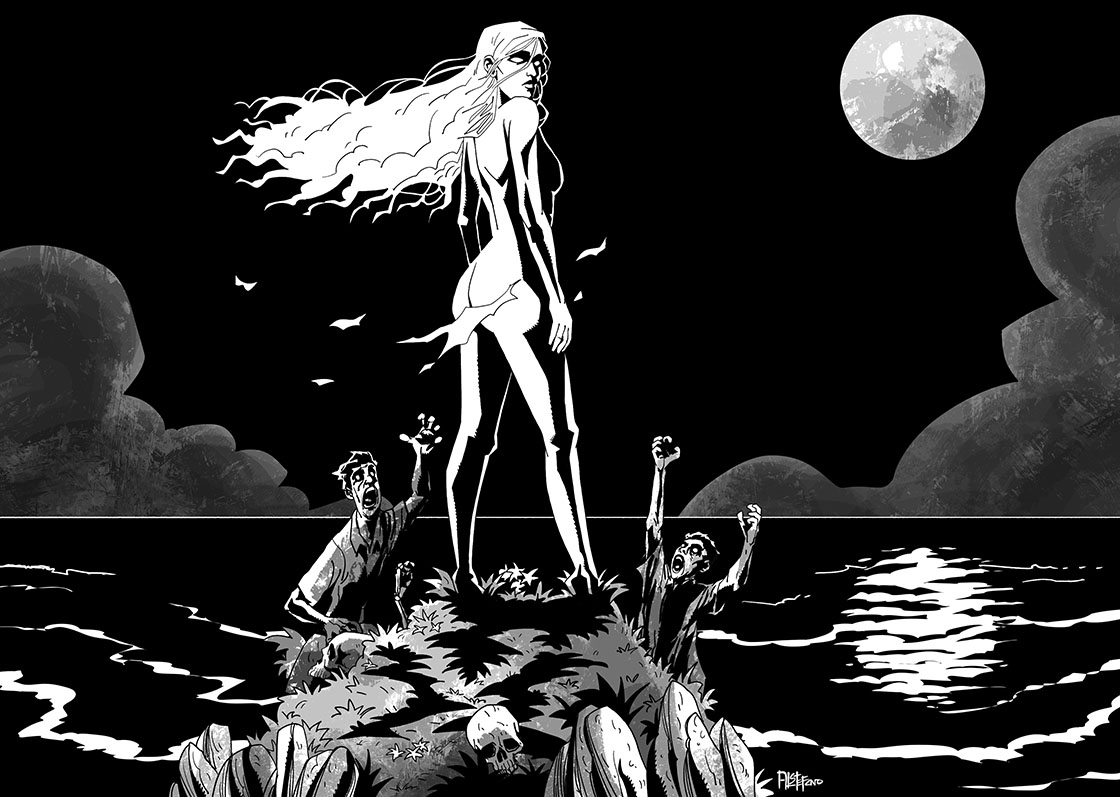
Illustration by Al Stefano
Alamoa
Folklore and history
A tawny maiden, the island’s fairy,
She puts on a smile and feigns kindness.
But do not be fooled by that show of goodness.
Do not go out, my love,
for that wandering figure
is an evil spirit: it is cruel Alamoa.
— “Alamoa”, from Risos e Lágrimas (1882)
Gustavo Adolfo Cardoso Pinto
Alamoa is a variant of Alemoa, the name of an apparition on Fernando de Noronha, particularly around Morro do Pico. People tell of a fair-haired woman dancing naked on a beach lit by flashes of lightning. Sometimes she appears as a ball of fire, a local form of the will-o’-the-wisp.
When Gustavo Adolfo Pinto put the islanders’ stories into verse in the nineteenth century, the wandering lights and the Alamoa were still distinct. One was a ghostly light, the other a mermaid or an alluring fairy. In time their stories merged.
Writing in 1904, in the same passage in which he mentions João Galafuz, Pereira da Costa describes the mysterious lights on the Pico in Fernando de Noronha. A light would appear and wander, dip and rise, then sweep out over the blue ocean, skimming the waves without going out.
In 1916, writing about the archipelago, Mário Melo described the wandering light as the restless soul of a “beautiful Frenchwoman”. She appeared to travellers, offering them a mysterious treasure. Only when someone claimed the gold would she be free: a familiar turn in stories of buried treasure.
From 1737 to 1938, Noronha served as an offshore penal colony. Little wonder that so many stories tell of prisoners seeing her. Stranded on the island, they would throw themselves into the sea to reach the phantom beauty, only to be devoured by sharks or swallowed by the waves.
In Olavo Dantas’s record, in 1938, we already find the name "Alamoa", with a peculiarity. When the seduced man gets too close, she takes on a cadaverous face – her true appearance, and the lover plummets to his death in the cracks of the night. More recent versions, told by tour guides, are more explicit. Alamoa would have sex with men until they died of exhaustion.
The apparition has inspired a number of artists. In a play by Altimar Pimentel, Alamoa haunts the widows of Noronha, who live in isolation on the island, mourning the husbands and sons she lured away. Verônica, wife of the last man left there, is persecuted because she resembles the apparition.

References
- CASCUDO, Luís da Câmara. Geografia dos mitos brasileiros. 1. ed. digital. São Paulo: Global, 2012.
- DANTAS, Olavo. Sob o céu dos trópicos. Rio de Janeiro: José Olympio, 1938.
- MELO, Mário. Arquipélago de Fernando de Noronha. Recife: [s. n.], 1916.
- PIMENTEL, Altimar de Alencar. A construção; A última lingada; Cemitério das juremas; Alamoa. Brasília: Thesaurus, 1992.
- PINTO, Gustavo Adolfo Cardoso. Alamoa. In: PINTO, Gustavo Adolfo Cardoso. Risos e lágrimas. Recife: [s. n.], 1882.