
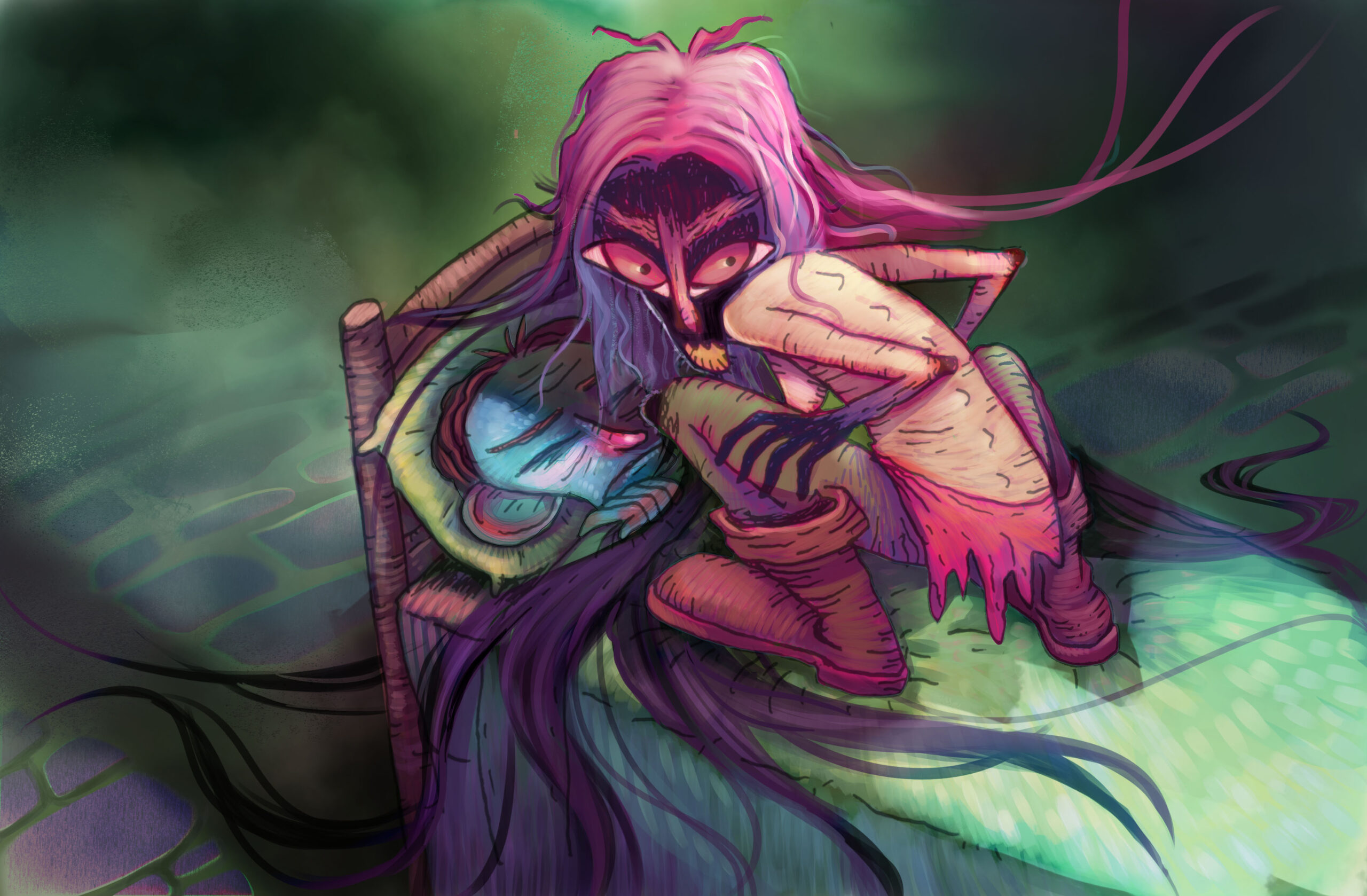
Illustration by Stuart Marcelo
Attack of the Pisadeira
Folklore and history
Do you see the Nightmare there?
Through the chimney flues
It descends stealthily upon the damp chest
Of the sleeping man who falls;
Silent, it crouches, it oppresses him
Like a tower and it bridles him
Of dreams that cause horror and pain.
– Miréio, by Frédéric Mistral (1859)
Did you go to sleep with a full stomach? And you even lay on your back? Well, it's people like that that the Pisadeira spies on from the roof. They say that the old woman with long nails waits for the house to quiet down, comes down and sits on the chest of the sleeping person. The person wants to scream, but the voice won't come out. They want to turn over, but their body won't obey. Anyone who has experienced sleep paralysis might recognize the sensation.
Other versions will speak of an old man, called only Nightmare. Narratives of Nightmare and Pisadeira are mixed, even generating variations of the same exorcism song: “Pisadeira, Pisadeira, with the pierced hand. Your outdated nails. If you want to come and haunt me, take three turns around the sea.” Usually it is the Nightmare, male, who has pierced hands – and, with them, suffocates the person in bed. She doesn't die, as she can still breathe through her pierced hands, but she has enormous difficulty breathing. Sending her to the sea, in turn, is a classic blessing ritual to get rid of everything bad in the purifying salt waters. Going around the entire sea three times is an impossible task, even for a spirit, which guarantees nighttime peace.
In Popular Traditions of Portugal, José Leite de Vasconcelos records Insonho as another name for the Nightmare. In Valongo, it is said that the Nightmare puts his hand on the chest of the sleeping person and prevents them from screaming. But woe betide him if the sleeper manages to grab his cap! The Nightmare flees to the roof and has to pay whatever they ask to get his cap back. It is reminiscent of what is said here about whoever manages to take the cap of a Saci.
In the middle São Francisco River region, Wilson Lins records the Pesadeira, with a red cap. He recounts that one night she sat on the stomach of a poor man. He slowly stretched out his arm until he reached the cap. As soon as he removed it, the sorceress became as light as a baby. She wanted the cap back. And what did he want? The next morning, the man's house was a palace, the cart had become a carriage, and he was dressed like a king.
As Câmara Cascudo points out, in various cultures the nightmare is personified with human forms. It is sometimes a giant, at other times a dwarf; a hideous man or woman; it may or may not have sexual behaviors (like an incubus or succubus). The relationship, in any case, is always linked to pressure. Nightmare in Portuguese, incidentally, is derived from the word "pesado" (heavy), that is, it refers to that feeling of weight on the chest that only a really good nightmare can cause.
In English, the word for nightmare is "nightmare," which also has an etymology that refers to the fantastic. "Night" means night; while "mare" comes from Old English, maere, a term used to identify evil female spirits that suffocated people during sleep. In Norwegian, in the Bokmål spelling, we have mareritt. In Danish, mareridt. Both words evoke the ride of the mare. In Icelandic, martröð, what is heard is the footsteps of this creature on the sleeper. Even in Iceland, believe it or not, the nightmare arrives by stepping.
Mahrs, Mares, or Marras; we find this name and its derivations in several European countries, always related to spirits that attack the dreams of humans. It is also said that they usually ride horses, causing them to wake up tired and sweaty. They are also known for tying knots in horses' manes and people's hair (Marelocks), something that in Brazil is a typical feat of the Saci, witches, or the Comadre Fulozinhas.

Attack of the Pisadeira
Challenge / Toil
“I told you not to go to bed on a full stomach…”
Send two Wind cards to the Beleléu (your discard pile).
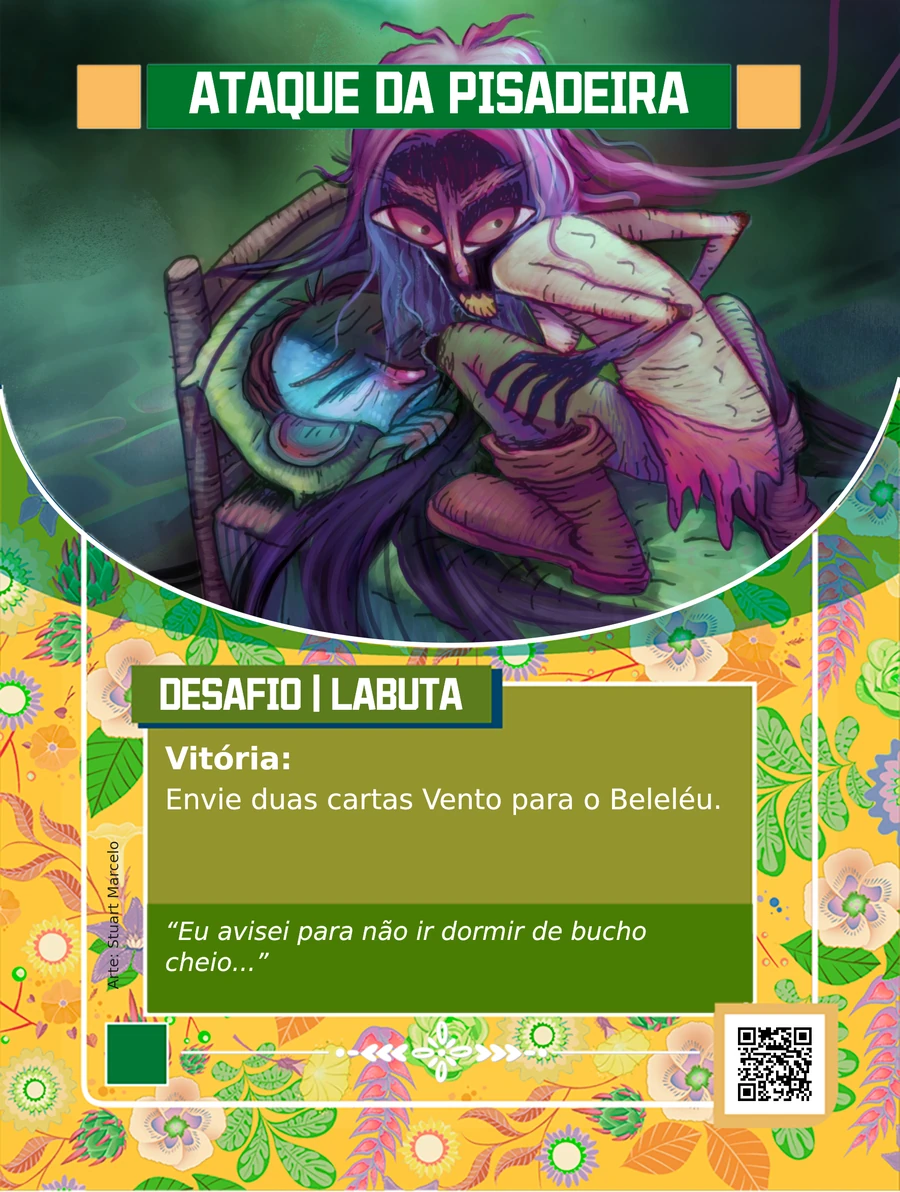
Download the high-resolution artwork

References
- BOKMÅLSORDBOKA. Mareritt. Ordbøkene. Disponível em: https://ordbokene.no/bm/37037. Acesso em: 12 nov. 2026.
- CASCUDO, Luís da Câmara. Dicionário do folclore brasileiro. 10. ed. Rio de Janeiro: Ediouro, [s. d.].
- CASCUDO, Luís da Câmara. Geografia dos mitos brasileiros. 1. ed. digital. São Paulo: Global, 2012.
- DEN DANSKE ORDBOG. Mareridt. Disponível em: https://ordnet.dk/ddo/ordbog/mareridt. Acesso em: 12 nov. 2026.
- KVARAN, Guðrún. Hvað er átt við með möru og tröð þegar menn fá martröð? Vísindavefurinn, 18 fev. 2008. Disponível em: https://www.visindavefur.is/svar.php?id=7072. Acesso em: 12 nov. 2026.
- LINS, Wilson. O médio São Francisco: uma sociedade de pastores e guerreiros. 3. ed. São Paulo: Editora Nacional; Brasília, DF: Instituto Nacional do Livro, Fundação Nacional Pró-Memória, 1983.
- MISTRAL, Frédéric. Mireio. Tradução de F. R. Gomes Junior. Rio de Janeiro: H. Garnier, 1910.
- NHS. Sleep paralysis. [s. d.]. Disponível em: www.nhs.uk. Acesso em: 10 nov. 2026.
- SÁ, José F. R. de; MOTA-ROLIM, Sérgio A. Sleep paralysis in Brazilian folklore and other cultures: a brief review. Frontiers in Psychology, v. 7, art. 1294, 2016. DOI: https://doi.org/10.3389/fpsyg.2016.01294.
- VASCONCELOS, José Leite de. Tradições populares de Portugal. Porto: Livraria Portuense de Clavel & C.ª, 1882.