RULES

Use your Poranduba deck to beat the Challenges. In the standard game, the first player to win three Challenges wins. Play solo, one against one, or in teams of two. Use separate decks or share a deck with your opponent.

Download the printed rulebook (Portuguese PDF).

RULEBOOK (VERSION 2.0)

1. Components

The printed game has two decks. The 40-card Poranduba deck contains Folk (performers, artisans and masters), Wonders (figures from myths and legends) and Lore (knowledge, customs and beliefs). The 14-card Challenge deck contains four kinds of Challenges: Trickery, Toil, Endurance and Combat.

2. Building a deck

Use exactly 40 Poranduba cards, with up to three copies of any card. Include at least five Normal cards and at most five cards bearing any one effect icon. Include at most one Master for each element: Water, Earth, Fire, Wind and Night.

Use exactly 14 Challenge cards, including at least three of each kind. Use the final two slots for Challenges of your choice.

3. Setting up

Separate and shuffle the two decks. Challenge cards have yellow backs and a floral print on the front. Place your Poranduba deck on your right and your Challenge deck in front of you. Leave space beside the Poranduba deck for the Beleléu (your discard pile). Discarded or defeated cards go there face up. Place completed Challenges face up across from it.

Draw seven Poranduba cards for your starting hand. Flip a coin or play odds and evens to decide who starts.

4. Your turn

Draw. Draw one Poranduba card. If there is no active Challenge, reveal the top Challenge card. A Swap effect can replace a difficult Challenge.

Action. Play up to one Folk or Wonder card and one Lore card. Cards brought into play by effects do not count toward this limit unless the card says otherwise.

Challenge. You may attempt the active Challenge once per turn.

Result. If you win, set the Challenge aside and reveal the next one on your next turn. If you fail, you may try again next turn.

Wrap-up. If you played no cards during the Action step, you may play them now. Discard down to seven cards and announce the end of your turn.

5. A full field

Up to five Folk and Wonder cards can occupy your field. Lore goes to the Beleléu after use. Five Wonders on your field force your opponent to discard a card from their hand before summoning a Folk card. With five Folk on your field, your opponent must send a card from their field to the Beleléu before playing Lore. Summoning your fifth Master immediately wins the active Challenge.

6. Strength and health

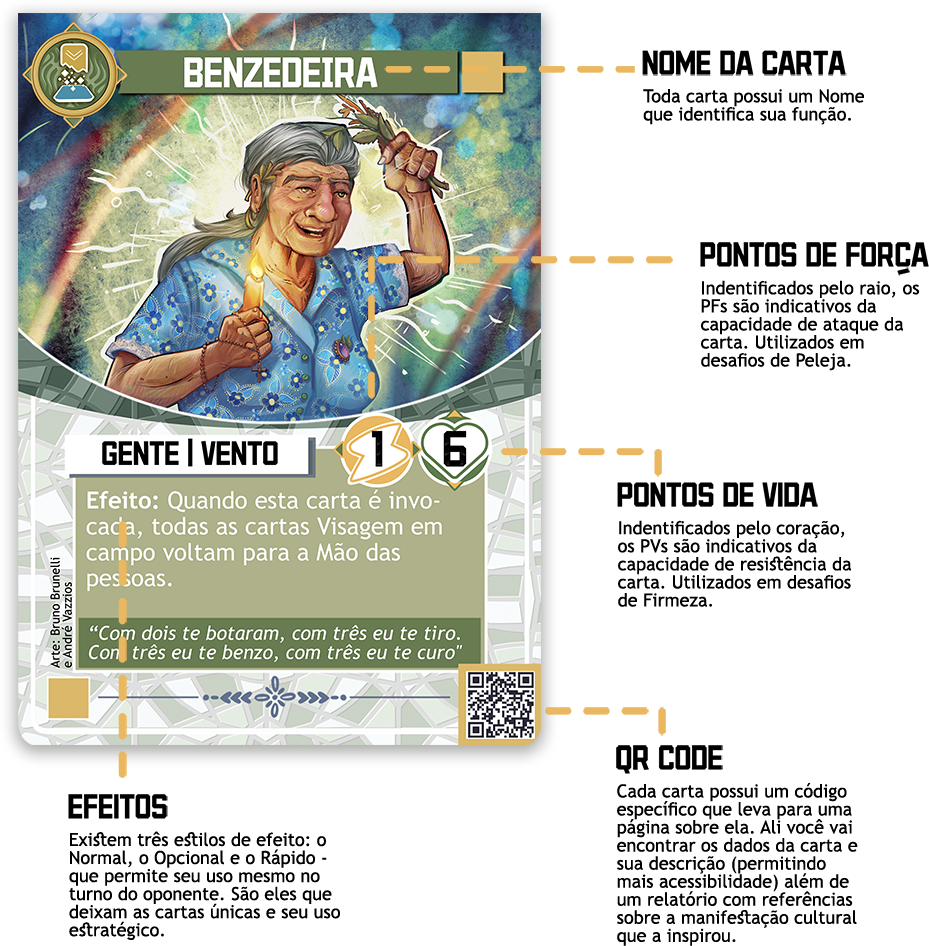
The lightning bolt shows Strength (STR), used in Combat. The heart shows Health (HP), used in Endurance.

7. Resolving Challenges

Challenge How to resolve it
Trickery Perform the task on the card, such as rhyming, saying a tongue twister or flipping a coin.
Toil Send cards of the specified elements to the Beleléu.
Endurance Reach the HP target with cards on your field. After winning, send all those cards to the Beleléu.
Combat At full strength, reach the STR target and flip a coin. If you lose, send the participating card with the lowest STR to the Beleléu. For an All-or-Nothing attack at half the target, losing the flip sends all cards on your field to the Beleléu.

8. Advanced rules and effects

Quick response. You can play a card marked for quick response from your hand even on an opponent’s turn. It does not count toward your two-card limit.

Mandatory and optional effects. Unless marked optional, an effect must resolve when the card enters play, even if it affects your own cards.

Original hand. A card returned to its original hand goes back to its owner. Discards remain face up in the Beleléu.

Strategy tip
If your field is full, Evil Eye or Return can free space by targeting one of your own cards. A card cannot target itself with its own entry effect.

9. Card effects

Pause. Prevents one or more players from facing a Challenge or playing cards for a turn.

Search. Find a card in your deck and bring it to your hand or field.

Double Play. Play two cards instead of one.

Enchantment. Take control of an opposing card.

Fated Burden. To summon this card, first send a Folk card to the Beleléu.

Persistence. The card stays on the field the first time a Challenge would send it to the Beleléu.

Partnership. The card counts more than once toward a Challenge’s requirement.

Protection. Send a card to the Beleléu to protect another.

Evil Eye. Send a card to the Beleléu.

Rescue. Retrieve a card from the Beleléu.

Return. Move one or more cards from the field back to their owners’ hands.

Swap. Put the current Challenge on the bottom of its deck and reveal the next one.

Normal. A card with no special effect contributes its attributes to your field.

10. Game modes and victory conditions

Standard (one against one). The first player to beat three Challenges wins. A game takes about 15–18 minutes and uses one or two decks. If both Poranduba decks run out, the game ends and the player who has beaten more Challenges wins. On Android you face a computer opponent.

Solo. Beat three Challenges by the end of turn seven. When Wrap-up ends, start the next turn. Adapt interactive tasks, such as riddles or rhyming, for one player. Score three points for finishing by turn three, two on turn four or five, and one on turn six or seven.

Teams (two against two). The first team to beat five Challenges wins. Allow 25–30 minutes and use two to four decks. Players alternate between teams. Partners may share information about their hands and discuss strategy. Each player has a separate field with a five-card limit. Partners share a Beleléu. Only cards on the field of the player attempting a Challenge count toward its requirements.

At the start of your turn, you may skip your draw and instead pass your partner one of your cards, from hand to hand or field to field. An effect targeting an opponent affects one player of the opposing team. An effect targeting everyone affects all four players.

11. The golden rule

Make the game your own. Use the cards to write stories, tell fortunes, play a memory game or invent a new way to play while exploring Brazilian folk culture.

Download the Poranduba rulebook in Portuguese as a PDF or EPUB.

PDF
Epub

Watch the video tutorial in Portuguese to see how the game is played.

Reading a Poranduba card

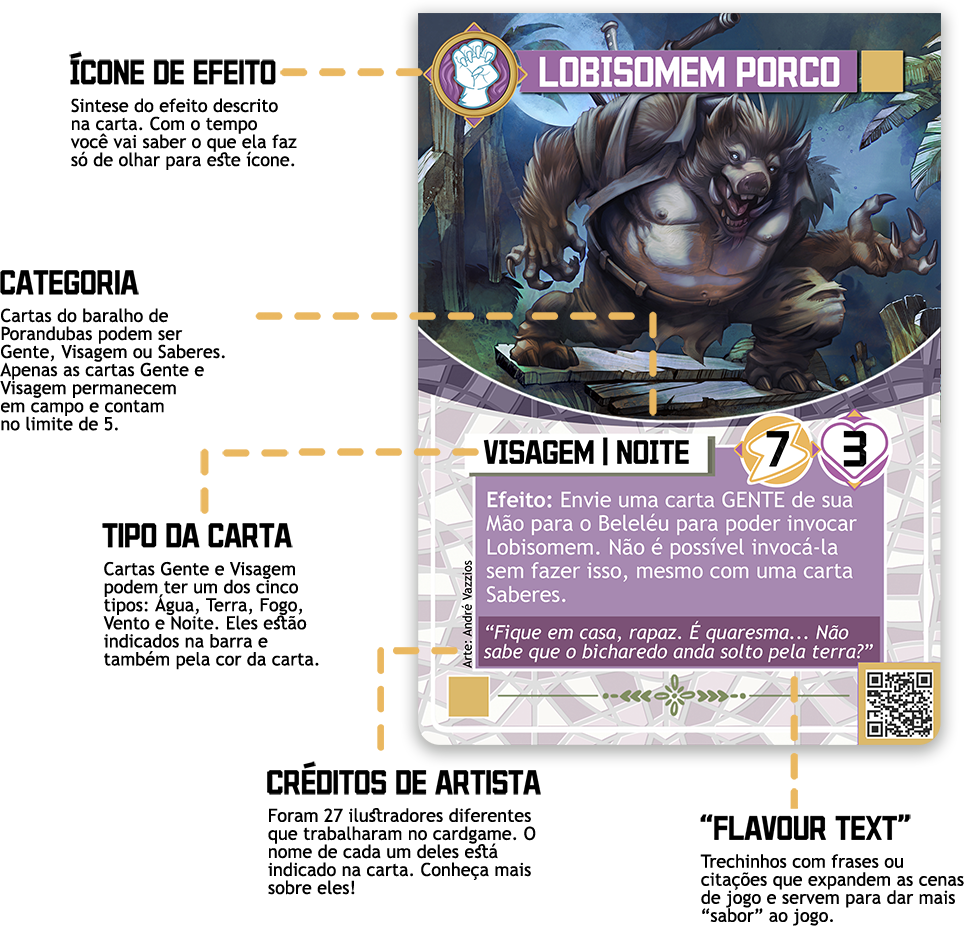
Each card shows its name, illustration and artist’s credit. The lightning bolt marks Strength and the heart marks Health. The effect icon and text explain what the card does, whether its effect is optional and when you can use it.

Folk and Wonder cards stay on the field. Their element is shown by both the label and the color: Water, Earth, Fire, Wind or Night. Lore cards are used for their effects.

The flavour text gives a glimpse of the story. Scan the QR code to find the illustrated entry, card details and bibliography. The printed edition features work by 27 illustrators.

Imagem mostrando a carta do Lobisomem Porco e da carta Benzedeira, como exemplo para mostrar os detalhes como: Ícone de efeito, Categoria, Tipo de carta, créditos de artista e "Flavour text", efeitos, nome da carta, pontos de força, pontos de vida, QR Code
Imagem mostrando a carta do Lobisomem Porco, como exemplo para mostrar os detalhes como: Ícone de efeito, Categoria, Tipo de carta, créditos de artista e "Flavour text"
Imagem mostrando a carta da Benzedeira, como exemplo para mostrar os detalhes como: nome da carta, pontos de força, pontos de vida, QR code, e efeitos

Reading a Challenge card

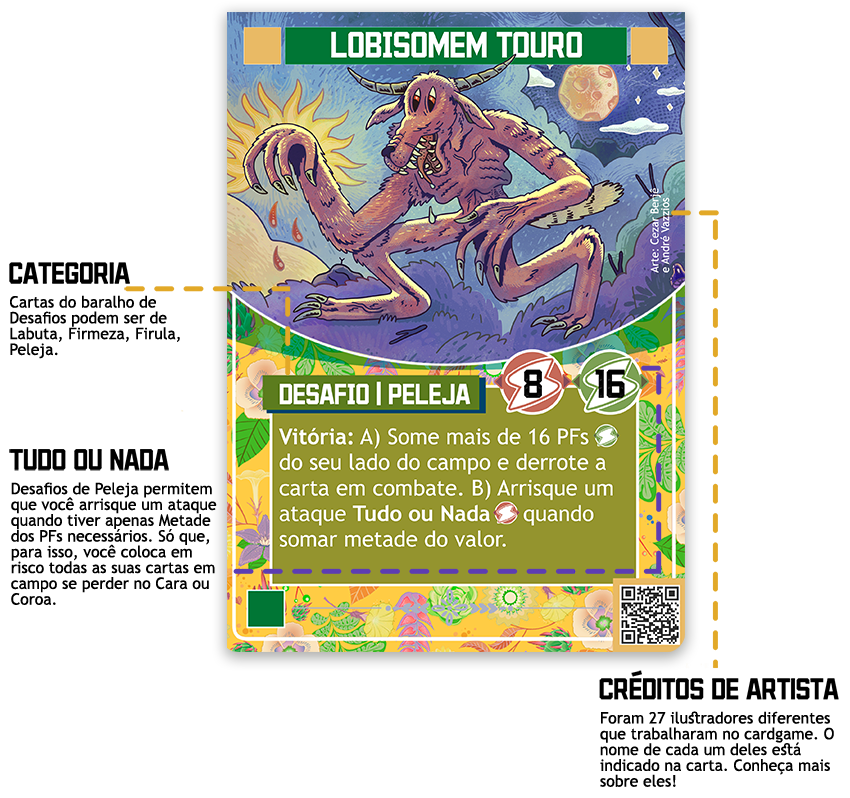
Each Challenge names its kind and tells you what to do to win. Check the lightning bolt for STR and the heart for HP. Some Challenges have additional effects or special conditions.

Combat Challenges let you risk an All-or-Nothing attack at half the required STR. If you lose the coin flip, send all your cards on the field to the Beleléu. Scan the QR code to read about the tradition that inspired the card and find its sources.

Imagem mostrando três cartas de exemplos, para apresentar as caracteristicas gerais, como: Nome, Pontos de força e de vida, categoria, efeitos, descrição, créditos, condição de vitória, especial, e QR code
Imagem da carta Lobisomem Touro, usada como exemplo para mostrar os detalhes gerais de cada carta. a Categoria, o tipo de desafio, os créditos do artista
Imagem da carta Ninho de Mafagafos, usada como exemplo para mostrar os detalhes gerais de cada carta.
Imagem da carta Promessa da Iara, usada como exemplo para mostrar os detalhes gerais de cada carta. O nome, os pontos de força e de vida, a descrição, efeitos adicionais, e QR code

Card effect icons

Ícone de bloqueio. Um circulo dourado de proibido preenchido de azul, com uma palma de mão levantada.

Pause
Prevents one or more players from facing a Challenge or playing cards for a turn.

Ícone de busca. Um circulo dourado preenchido de azul, com uma lupa no centro.

Search
Find a card in your deck and bring it to your hand or field.

Ícone de dobradinha. Um circulo dourado preenchido de azul, com uma mão fazendo "V" de vitória.

Double Play
Play two cards instead of one.

Ícone de encanto. Um circulo dourado preenchido de azul, com duas mãos em sentidos opostos e palmas uma para outra, entre elas um coração.

Enchantment
Take control of an opposing card.

Ícone de fadário. Um circulo dourado preenchido de azul, com uma garra de uma fera peluda.

Fated Burden
To summon this card, first send a Folk card to the Beleléu.

Ícone de isistência. Um circulo dourado preenchido de azul, com uma mão fazendo "joinha".

Persistence
The card stays on the field the first time a Challenge would send it to the Beleléu.

Ícone de parceria. Um circulo dourado preenchido de azul, com duas mãos se cumprimentando.

Partnership
The card counts more than once toward a Challenge’s requirement.

Ícone de proteção. Um circulo dourado preenchido de azul, com uma mão fazendo figa.

Protection
Send a card to the Beleléu to protect another.

Ícone de quebranto. Um circulo dourado preenchido de azul, com três cartas azuis, e um olho na do meio.

Evil Eye
Send a card to the Beleléu.

Ícone de resgate. Um circulo dourado preenchido de azul, com uma cruz no meio.

Rescue
Retrieve a card from the Beleléu.

Ícone de retorno. Um circulo dourado preenchido de azul, com uma carta azul abaixada e metade de outra carta dourada de pé.

Return
Move one or more cards from the field back to their owners’ hands.

Ícone de troca de desafio. Um circulo dourado preenchido de azul, com três cartas, e duas setas circulares sobre elas.

Swap
Put the current Challenge on the bottom of its deck and reveal the next one.

Inside the deck

Pôster mostrando o nome das cartas separadas em três colunas, duas mostram as cartas Poranduba, separadas pelos tipos: Água, Fogo, Saberes, Terra, Noite e Vento. E uma terceira coluna mostra o nome das cartas de Desafio, separadas em Firula, Labuta, Firmeza e Peleza.
Imagem mostrando os tipos de cartas separadas por elementos em uma coluna. Em Água estão: Boto Cor de Rosa, Boto Tucuxi, Caboclo D'água, Parteira, Peão de Comitiva, e Mestra Inezita. Em Fogo estão: Bate-Bola, Mestre Carneiro, Palhaço de Folia, Boitatá, Mula sem Cabeça, Romãozinho. Em Saberes estão: Canto do Galo, Carranca, Ch´pa de Jasmim, Espada de São Jorge, Feijoada, Mamulengo, Oferta de Fumo, Santo de Ponta CAbeça, Simpatia da Vassoura, e Tacacá.
Imagem mostrando os tipos de cartas separadas por elementos em uma coluna. Em Terra estão: La Ursa, Mestre Cascudo, Miolo de Boi, Boi da Cara Preta, Caipora e Negrinho do Pasteiro. Em Noite estão Curucucú, Gaiteira, Parafuso, Lobisomem Porco, Saci Urbano, Matinta Pereira. Em Vento estão Bazendeira, Capoeirista, Rendeira, Rasga Mortalha, Saci Pererê, Uirapuru.
Imagem mostrando os tipos de cartas de desafio em uma culona, nas de Firula estão: Disputa de Bafo, Duelo de Repente, Ninho de Mafagafos, e Purrinha. Nas de Labuta estão Águas de Itororó, Enterros e Botijas, e Perna pra que te quero. Nas de Firmeza estão o Chamado Misterioso, Despertar de João, Promessa de Iara, Serpente Adormecida. Nas de Peleja estão o Arranca-Língua, A Sétima Maria, Lobisomem Touro, e Mestra do Jogo da Espada.